

Way back in 2012, finance professors had already published 316 different “factors”, which are basically simple rules like “buy cheap stocks” or “buy last year’s winners” that supposedly beat the market.
In industry, quants call that list the factor zoo, and a handful of them are probably familiar to you (momentum, size, value, low volatility, carry).
Now, as we covered in A Quant’s Guide to “I Heard a Pod Blew Up”, the main value-add of these factors is for multi-strategy funds who use them to try muting as much risk as possible.
For instance, if you wanted to run a high-Sharpe strategy, you’d need to make sure that your strategy isn’t just exposed to the volatility of, say, the momentum factor, so you’d try to strip out that exposure by shorting other stocks in that bucket to ensure your exposure is solely tied to the alpha you’re trying to capture.
9 times out of 10, this works out well and is how you see profitable desks with 2+ Sharpe ratios for years on end.
However, you don’t really see much of this in crypto.
A big part of that is tied to the fact that most crypto assets don’t really have anything intrinsic you can build a factor off of (e.g., what’s the price-to-book ratio of Ethereum?), so there isn’t anywhere near as much factor adoption in the space.
Still though, I was a bit curious to see if there could be.
We’ve dabbled more than a bit in multi-strategy crypto operations, so I figured that in the best case, we’ll pick up something that could potentially boost our Sharpe ratio and allow us to scale up harder, and in the worst case, at least we’ll learn something.
So, to figure this out, we rebuilt the entire equity factor zoo and pointed it at the entire crypto universe to see how much edge we’d been sleeping on, if any.
Factors? In Crypto?
At root, a factor is essentially just a ranking, where you sort every coin on one number, buy the top of the list, short the bottom, and wait a week. If the top beats the bottom on average over a few years, you’ve got yourself a factor.
A bit crude, but that’s the mental model we’ll use for building this out.
So, with that in mind, here’s how we’ll set up the experiment:
Every Sunday, take the 100 most-traded perps on Binance (point-in-time universe including delisted), ranked by each coin’s typical daily volume over the past month.
A coin needs at least 60 days of trading history to make the list
Sort those 100 on the factor’s criteria.
Criteria like: last month’s return, realized volatility, funding rate, and so on.
Buy the top 20% (about 20 coins) and short the bottom 20%, with $1 on each side split equally across the coins.
Hold for one week, then re-rank and rebalance.
Every trade costs ~0.10% per side, which is roughly a taker fee plus a bit of slippage. The book also pays or collects funding, which is essentially the payment that flows between longs and shorts to keep a perp’s price near spot (longs pay it when it’s positive, shorts pay it when it’s negative).
I wanted to also point out how important it is to use a point-in-time universe, as if you’re using a universe of only coins that exist right now, any long-only strategy will look better than it is, since you’re only including those that performed well enough to stay listed.
We use the free Binance Vision dataset for this, which comes with the full futures and spot data for every asset ever listed (if you’re in the US, you should use a VPN from Canada or a crypto-friendly country to successfully pull the data).
So, now that we have the methodology and the data, we can start looking into whether these factors actually make money or not.
Do They Actually Make Money?
In the chart below, we plotted every factor we built and simulated the performance of each with the long/short strategy described above:
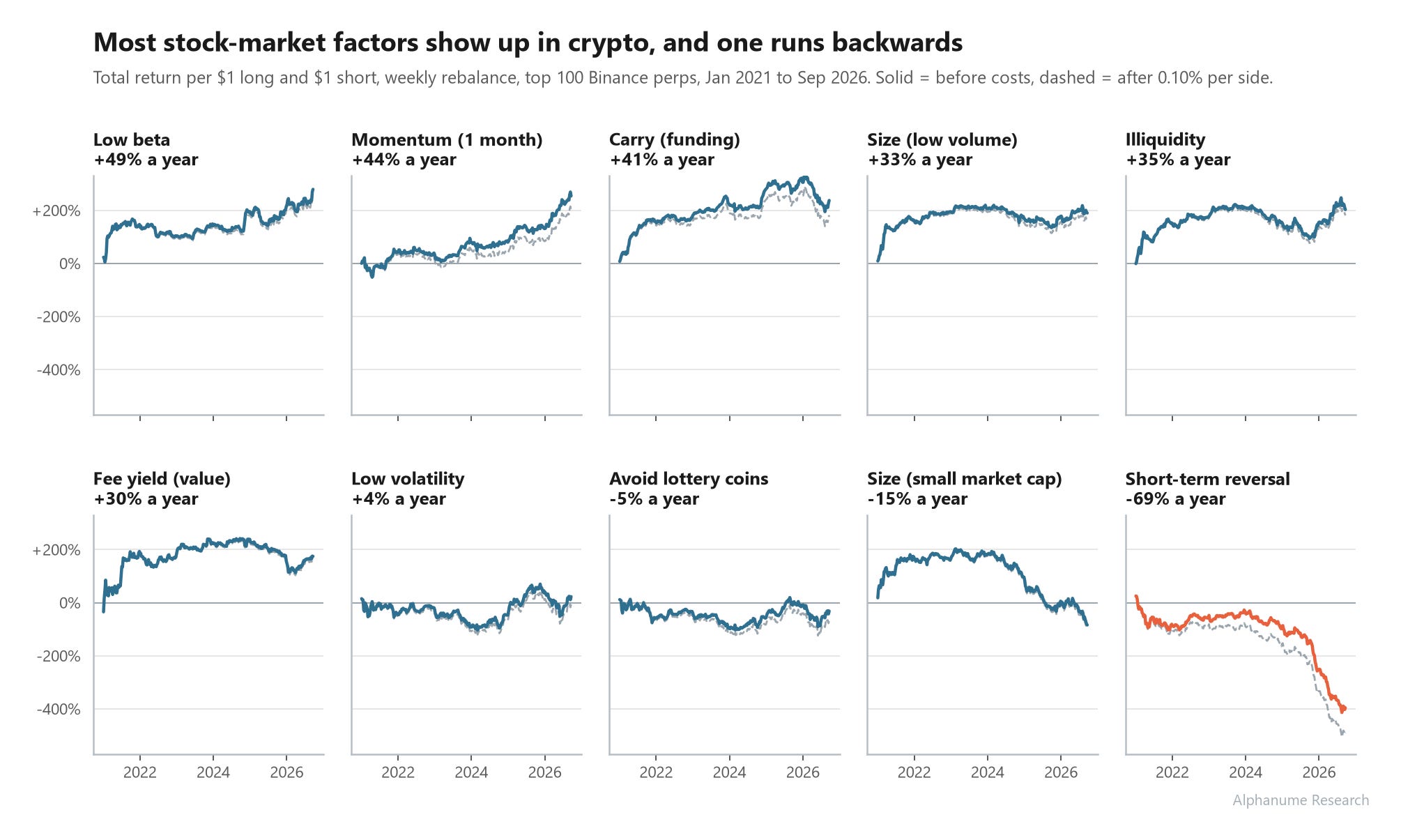
To break the numbers down a bit: