

It might be grandiose to say, but in equities, making money is pretty “easy”.
There are well-established paths that are pretty linear:
Momentum
Isolate a liquid universe that demonstrates strong investor appetite (e.g., weekly optionable, high average notional volume)
Create a metric for describing each stock’s returns
Combining the Sharpe ratio and beta over a lookback can be used to create a rank-able momentum score, of sorts.
Long the n highest scores, short the n lowest.
Relative Value
Long high-quality assets
Large market cap, healthy balance sheet, strong free cash flow
Short poor quality assets
Tiny market cap, debt-laden balance sheet, declining/negative free cash flow
Hedge out the vol
A beta hedge is typically used due to higher volatility in smaller cap names, so you may often end up shorting $2 of the low-quality assets for every $1 of high-quality you long.
And the list can go on, and on, and on.
The combined result is a return profile so stable you can build an entire business on it: lever it, sell it to allocators, pay bonuses off it.
So, there was one question we kept coming back to:
Why isn’t anyone running this playbook in crypto?
The asset class is volatile, the average participant is expressing a hunch, and the perp market lets you short basically anything with a ticker. If there were ever a venue where the multi-strategy model should print, it’s this one.
So today, we’re going to walk through exactly how we built ours: the sleeves, the combination machinery, and live execution across roughly 150 tokens at a time.
These Aren’t Stocks, Kid
When we first started exploring trading crypto systematically, we did what everyone does: long/short momentum.
The universe was liquid USDT-perps with at least $1M in daily volume and a 30-day realized vol of 30% or higher, rebalanced weekly with a one-week hold. Sensible, boring, the same recipe that’s worked in every asset class for decades.
And it worked here too, technically. Long momentum (28-day, risk-adjusted) came in at a weekly Sharpe of 0.71. Short momentum did better, at 1.20.
Net profitable, sure, but nothing you’d want to stake an operation on: a sub-1 Sharpe in an asset class this wild means long stretches underwater waiting for the math to catch up.
The traditional move at this point is to grind. Tweak the lookback, add filters, keep optimizing until the backtest is beautiful and the live results are anything else.
We went the other direction. Instead of perfecting one strategy, we started collecting them.
First came shorts on tokens with increases in circulating supply (unlocks, emissions), the same dilution logic we run in equities: someone is about to sell, so get in front of it.
Now, in crypto, it’s insanely difficult to ascribe explanations to returns as there aren’t any earnings reports or fundamental comparables, and the idiosyncratic context lives on X threads you’d never follow.
So, in order to expand our catalog of possible strategies, we did something we’d never do in equities: pure math.
To keep things at a high level, this mostly looked like:
Probability based: Under a basic assumption that daily return direction should be about 50/50 up or down, then in theory, if an asset has gone up n times in a row, it is probabilistically unlikely to have that same direction in the next sample.
Of course, the issue with this is that it ignores things like autocorrelation, volatility clustering and so on, but remember, the goal was just to expand our catalog of uncorrelated strategies.
The downward version of this (if sessions_up > n, short) had a weekly Sharpe of 0.35, while the upward version (if sessions_down > n, buy) had a weekly Sharpe of 1.20.
Implied Information: If a token has a +/- n standard deviation move, just follow the direction.
For instance, if asset A has an annual vol of 30% and it suddenly goes up 30% in a single session, just long it, and vice versa.
This produced a weekly Sharpe of 0.96.
Every one of these was generally net profitable, even after fees. And every one of them had a Sharpe we’d never build a business around: the best single sleeve topped out around 1.24.
Alone, none of them justified the infrastructure.
So, we tested running them all at once.
Silo, Silo, Silo.
The first thing worth checking before combining anything is whether the sleeves are actually different bets, or just the same bet five times over.
If every sleeve is secretly long crypto beta, stacking them accomplishes nothing.
So, we ran the correlation matrix on weekly sleeve returns, and the numbers were genuinely better than we expected (chart below):
Long momentum vs. short momentum: -0.34
Down-streak buy vs. short momentum: -0.62
Long momentum vs. up-streak fade: -0.48
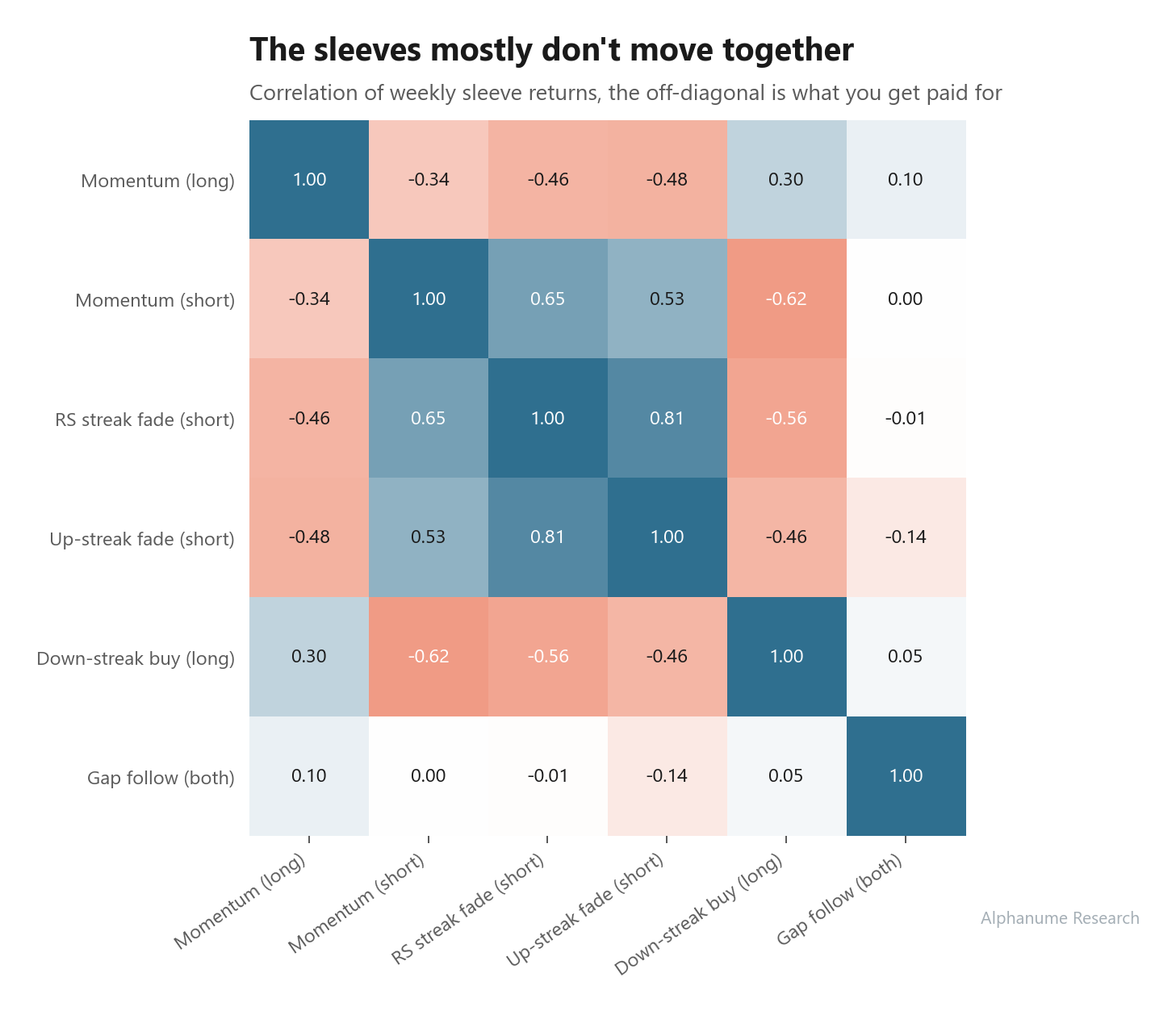
Negative numbers are the good stuff. When the momentum shorts are bleeding in a squeeze, the down-streak buys tend to be getting paid, and vice versa. One sleeve’s bad week is routinely another sleeve’s good one.
The quiet star was gap follow (implied information): roughly zero correlation against everything else (-0.14 to +0.10 across the board). It has no opinion on what the rest of the book is doing, which makes it the cleanest diversifier in the stack.
Now, you can’t just run five strategies side by side and call it a portfolio. Two problems show up immediately.
The first is overlap.
At the weekly rebalance, two sleeves will regularly want the same token, sometimes in opposite directions.
A token that’s down 3 days straight is a buy for the streak sleeve and, often enough, a short for the momentum sleeve.
Paying fees to be simultaneously long and short the same token in two different sleeves is a great way to donate to the exchange. So, we wrote a hard rule:
Each sleeve builds its basket independently at the rebalance.
If two sleeves claim the same ticker, the sleeve with the historically higher Sharpe trades it.
The ticker is dropped from the losing sleeve’s basket entirely. The book never holds the same token long in one sleeve and short in another.
The second problem is weighting. Crude equal weighting across components sounds fair until one wild name with triple-digit vol is suddenly steering the whole operation.
So components are weighted by inverse volatility, computed walk-forward on trailing history only (no lookahead), with equal weights early on until a name has enough history to earn a real estimate. The sleepy names get size, the wild ones get trimmed.
With the collision logic and the weighting in place, we ran the combined book across all 61 weekly rebalances (chart below):
Gross Sharpe: 2.68
Net, at 30bps per side: 1.97
Net, at a punitive 50bps per side: 1.50
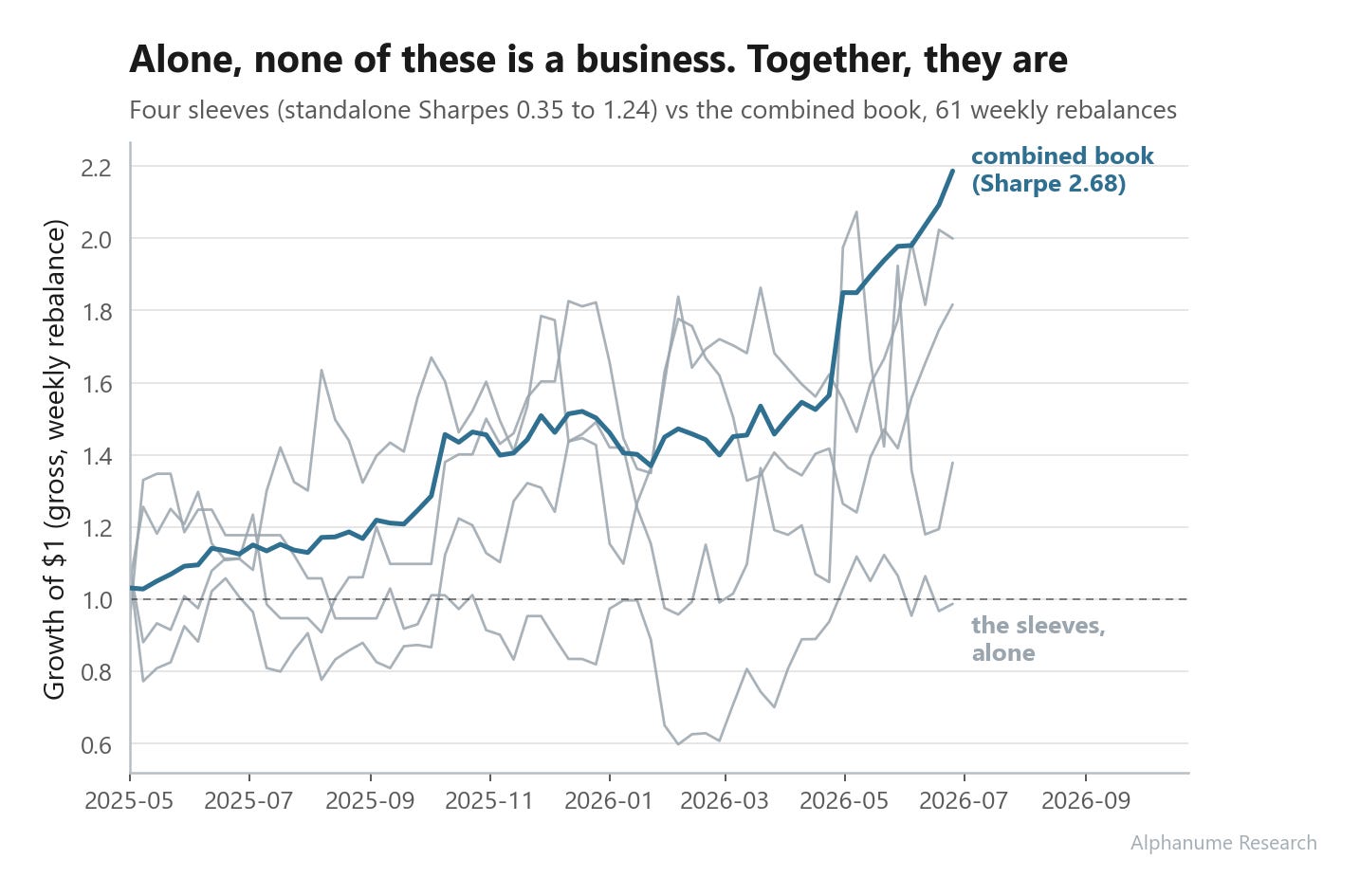
That comes out to an annualized +70.5% on 26.1% vol, with a max drawdown of -9.9% and a realized beta to BTC of -0.05. Roughly double the best single sleeve, on a book that genuinely does not care which way crypto goes.
To be fair: 61 weeks was a thin sample and the cost model is a flat 30/50bps per side with no funding drag on the shorts.
Can We Actually Trade This?
When we’re running a research experiment, it’s never for a “hmm, that’s interesting”. We do this entirely to actually realize profits, so after quadruple-checking our calcs, we began setting up a live, production version.
As we’ve mentioned before, accessing crypto perps as a U.S. citizen can be a nightmare, but eventually, we set up an account at Bitunix (no affiliation) and integrated their API.
The book holds 150+ individual tokens long and short at any given time, which puts manual execution completely out of reach; nobody is clicking through 150 order tickets every week without eventually fat-fingering a short.
Now, the infrastructure is not sophisticated, and we mean that sincerely:
At each weekly rebalance we loop through the valid ticker set, take each name’s weight, and submit a limit order for it.
That’s it.
Some of those orders rest unfilled for a few minutes, but since we’re not moving at a huge clip, this has worked fine so far. In general, the fills have landed close enough to the marks that we haven’t felt the need to build anything more clever.
A few notes from official launch:
Inverse-vol weighting shrinks outliers so that no single blowup hurts you, but also means you don’t get the full kick of just equal-weighting.
The book is often net short by 30% of notional, despite being “market-neutral”.
For instance, if gross risk is $100,000, the net short of the full portfolio is often ~-$30,000.
Despite being net short, the uncorrelated and dispersed nature of the components results in an average beta of -0.05.
Realized transaction costs have been 2-5bps; the exchange charges 0.02% for resting limit orders and 0.05% for taker orders.
Although we only send limit orders, when the bid/ask moves in the second before execution (orders sent via REST API), it ends up taking liquidity and auto-filling, resulting in the higher fee.
Over the first 4 rebalancing periods, the net unlevered return has been ~6.4% across the entire book.
Final Thoughts
We’ll keep monitoring this over the coming months; hopefully by then, the real question will become scalability:
How much capital can these perp books absorb before our lazy resting limit orders stop getting filled at prices we like?
After all, we’re not using any leverage at all, but for each liquid token in our book, we can push things all the way to 20x on a cross-margin basis. At that point, we’d have to get actually serious about proper execution, but the upside is enticing.
While this was a great next step in a new-to-us asset class, the bigger lesson was a shift in orientation.
For years we were ultra-focused on making single strategies the absolute best they could possibly be: more models, better features, another round of tuning to squeeze a 1.1 Sharpe toward 1.4.
When switching to a portfolio management view instead, we start asking what a strategy does to everything around it. A 0.35 Sharpe streak fade looks like a waste of a slot until you notice its -0.62 correlation to the short book, at which point it becomes one of the most valuable things on the desk.
Historically, we would’ve just tossed strategies like that in the recycle bin.
Without getting too ahead of ourselves, it makes us wonder what would happen if we looped back through everything we’ve ever run/tested and just put it all together?
For instance, in 0-DTE index options, what if we overlaid the short volatility strategy with an intraday momentum sleeve, then possibly another long volatility leg? What if we added in 3 more purely quantitative techniques and merged those in too?
Again, each leg might not have the 2+ Sharpe we need to feel safe, but if they’re legitimately uncorrelated to each other, what if combining them together actually does?
If we can have a multi-strategy desk in every asset class, running all the time, each balancing the other out… well, you can pretty much see the picture yourself.
As always, thank you for reading, and we hope to see you in the next one.