

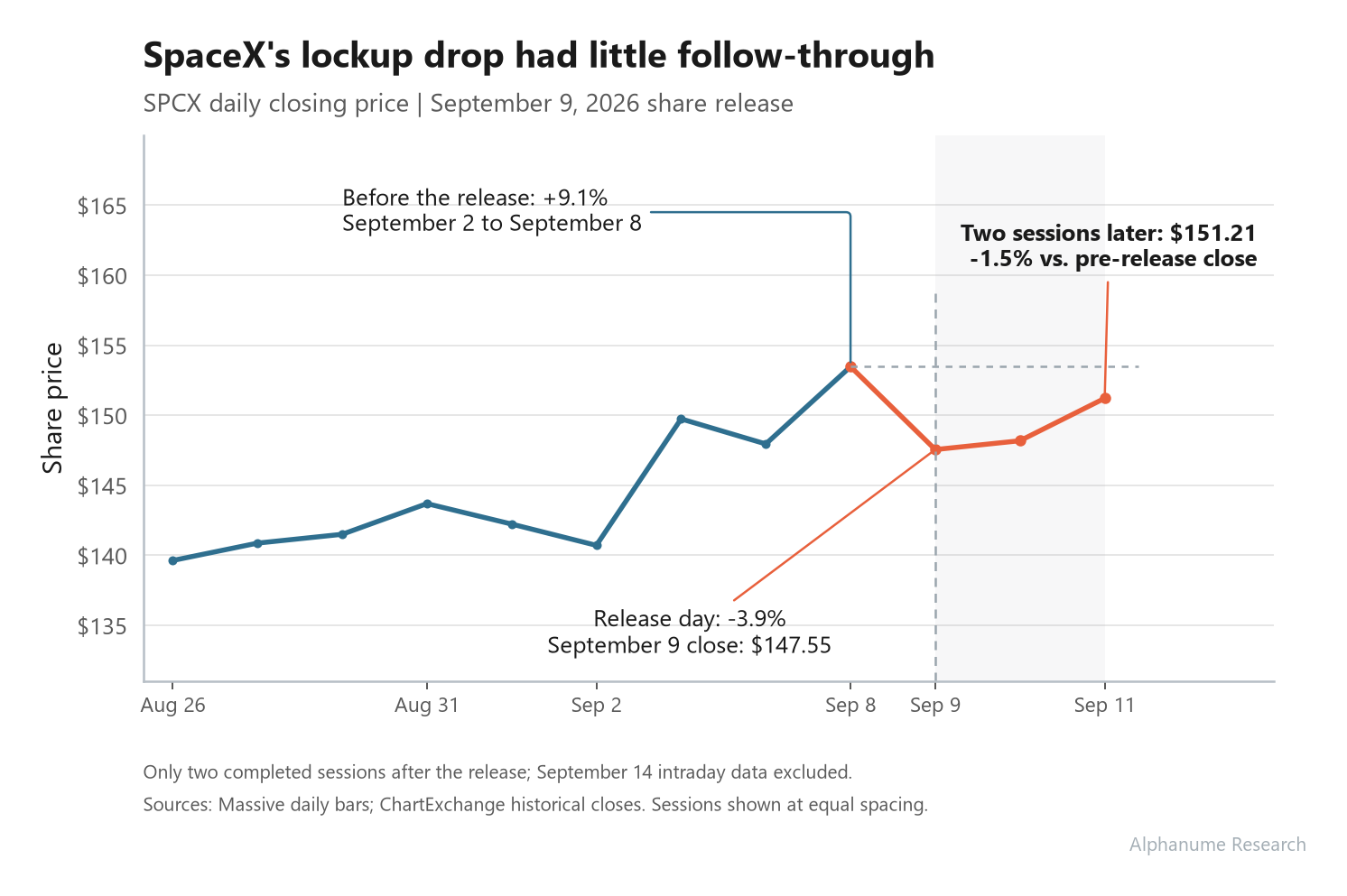
A few weeks back, everyone and their third-degree relative was talking about the SpaceX IPO and the coming disaster for the soon-to-be share unlock.
For quick context, about 319 million shares were scheduled to be approved for trading, so people worried that those holders would start unloading their positions to realize liquidity and thus severely bring down the stock price.
In reality though, virtually nothing happened:
Nevertheless, the whole ordeal was pretty interesting to me.
After all, event-driven trades are our bread and butter, and this one seems to have an extremely clear rationale of why it would work:
Employees, early investors, etc., go through the joys of an IPO
They’re told that in 6 months, they can finally trade their shares
Once approved, they sell and turn their shares into cash
Aggressive selling activity lowers the trading price
The SpaceX event was just 1 instance, but surely, over many of these events:
“shouldn’t one be able to generate a profit by just selling short in advance?”
If so, we could potentially turn a benign, routine event into a lucrative systematic strategy.
So, to test this out, we pulled the data for every share lockup expiration over the last few years to see what the data would say.
As you’ll see shortly, this was one of the easiest edges we’ve ever found.
This full dataset, along with 25 others, is now available over at Alphanume.
The no-brainer trade
As always, before getting into the trade, it’s important to go over some requisite knowledge on this stuff.
Although we started with IPO lockups, they’re essentially second-fiddle to the most predictable type of lockup:
Struggling companies often take on toxic financing agreements (PIPEs) where for a private capital injection, they sell shares to a private party, usually at a discount (e.g., 15% below current daily VWAP)
These shares come with their own lockup periods, usually between 6 and 12 months from the signing of the deal
PIPE agreements are the most interesting here since the incentive for selling is stronger than with a regular IPO lockup. These deals usually make money from the profit of selling the discounted shares the second they’re allowed to. Since these are so clearly linear, we made sure to add them to our universe.
So, again, it all goes back to the core rationale behind the trade:
motivated-to-sell shareholders are bound by lockup periods → lockup period ends → shareholders finally sell.
Now that you have pretty much all of the context you need, we can finally get into actually trading this.
To start, let’s run the simplest version: