As I write this, the Nasdaq-100 is about 19% below its October 6 high, just shy of officially being in a bear market.
You likely already know what’s happening; AI capex fears, inflation, the carry trade unwind, and so on. But if you’re running market-neutral systematic strats, this ruckus simply does not matter.
A grandiose statement, sure, but these times are inevitable which is exactly why I’ve spent months pounding the table on how these strategies work, why they make money, and I’ve even given you the code and data to run them yourselves.
Fortunately, despite the mayhem evident on every social feed and media channel, this has actually been the best month for our strategies yet.
I’m not here to gloat, but I think there’s no better time to showcase exactly what we’ve been talking about these past few months and show you the actual proof and mechanics of what’s actually making money today.
So with that said, let’s get into it.
You Were Told
Back in August, we wrote Monetizing The Golden Age of Short Selling, where I made the case that there’s never been a better time to short broken microcaps.
The basic idea was that a handful of corporate events predictably come right before a stock goes down, and we put all of those in a dataset anyone can access, including:
Reverse splits, where a sub-$1 company games its way back above the Nasdaq minimum
Dilutive S-1s, where a company that badly needs cash registers new shares
The daily pre-market drop risk list, where the day’s over-bid microcaps tend to give it all back and more by the close
That post ran on a few years of history, in a market that practically only went up, so now that the market is actually down, it begs the simple question of:
If you’d actually run those shorts this month, how would you be doing?
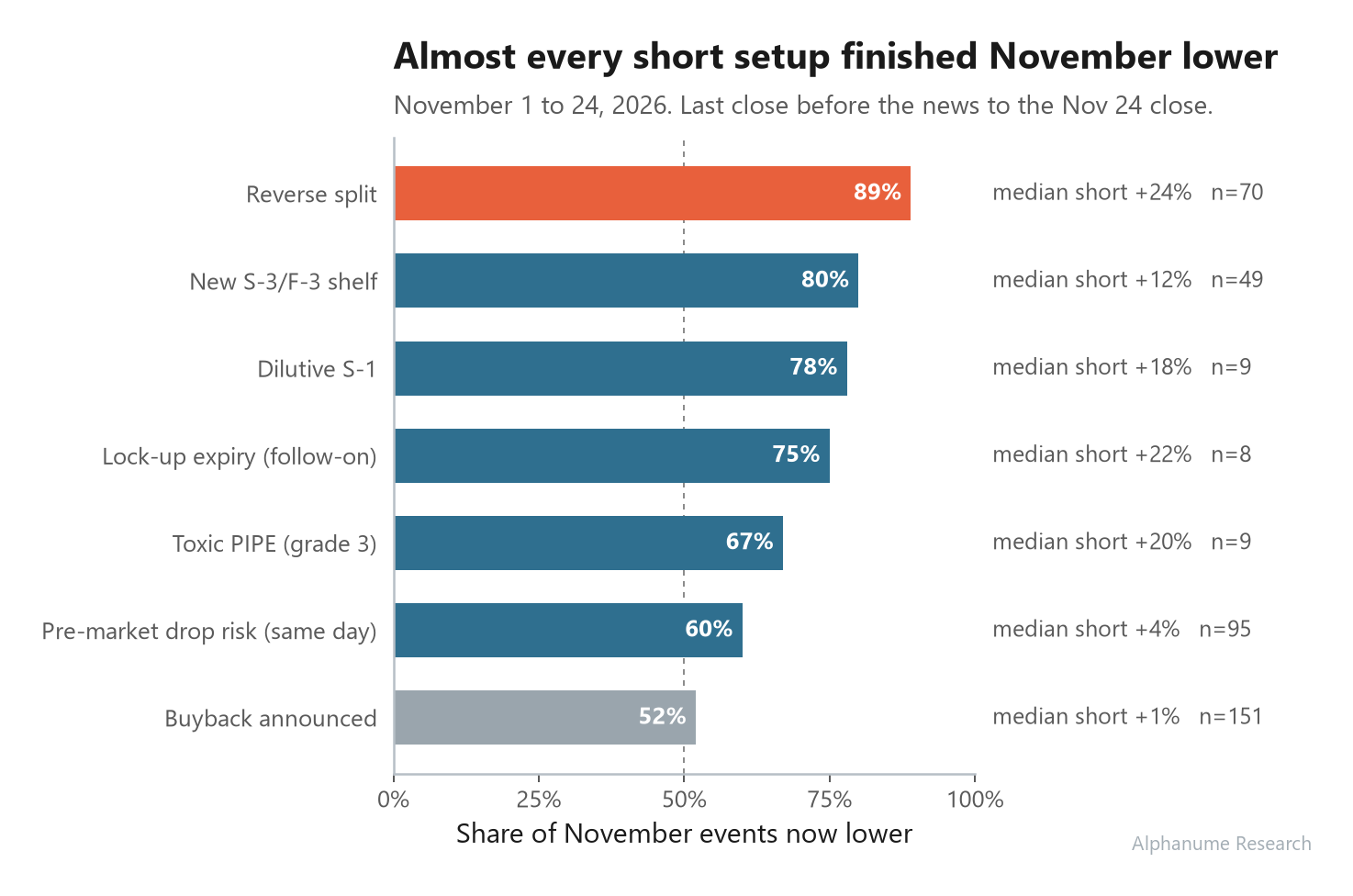
To show you, I pulled every short-biased event our datasets logged from November 1 through November 24, and measured each one from the last close before the news to Tuesday’s close (the pre-market shorts are the exception as those get opened and closed on the same day).
In sum, the stocks flagged as having a negative catalyst went down a lot harder than the market did: