

Back in the dot-com bubble, a lot of strange things were happening.
Historically, if you wanted to trade a stock, you’d need to work with a brick-and-mortar broker, have them log it on paper, then wait a week for a confirmation. When you wanted to get an update on the price, you’d either have to make a call or wait for the next day’s newspaper.
But in the ‘90s, the internet made it way easier to trade, so naturally, that’s exactly what people did. A lot.
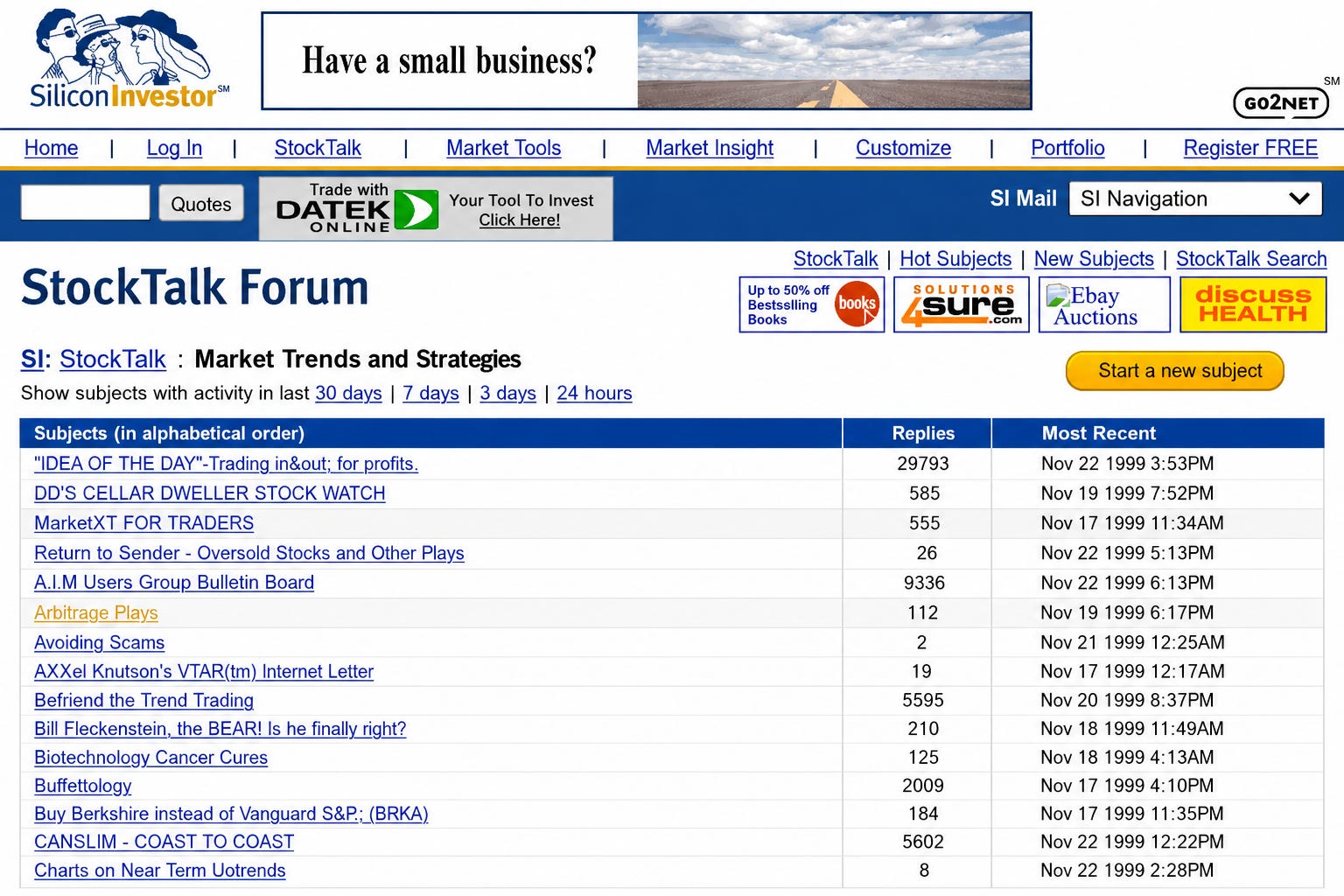
As more individuals started trading, interesting places like SiliconInvestor and Yahoo Finance message boards became the predecessors to what we know r/wallstreetbets to be today:
However, there was a pretty big problem.
Even on strictly online platforms like E-Trade, the commissions were north of $20 per trade. This meant that for someone placing 30 trades a day, they’d need to make over $150,000 per year just to break-even.
Naturally, tons of people lost their shirts.
This was clearly unacceptable for maintaining faith in U.S. markets, so in response, the regulatory bodies enacted the Pattern Day Trader rule (PDT), to restrict accounts with less than $25,000 from placing more than 3 back-and-forth trades in one day.
This slowed the bleed and things went on as normal. As commissions lowered to even $0 on many platforms, people continued to day trade, often using cash accounts to avoid the limitation.
However, in just one month from now, that limitation is going away. Individuals who were locked out of short selling and levered active trades are now going to get full access at the new minimum of $2,000.
Now, we're not interested in debating whether or not the rule should've gone away, but we are interested in how this might be a genuinely tradeable event.
If we know that after a certain date, thousands of new participants will be allowed to make certain kinds of trades, then surely, there must be a way to take advantage of this, right?
That was the core research question we set out to answer, and what we found was actually pretty interesting.
So, today, we’ll be cracking our research process open to figure out how to turn this rather minor rule change into an industrialized operation.
With that being said, let’s get right into it.
Who’ll Be Trading What
Okay, so we know that there will be thousands of new people entering the market. What we need to figure out is what they’ll be trading and how.
To figure that out, we have to look at what existing day traders are already doing.
Most day traders generally trade based on signals generated by their visual interpretation of a stock’s chart. We’re not going to argue the merits or demerits of this approach, we just need to have an awareness of it.
Now, we want to at least have some baseline proof that this sort of activity is market-moving as it is now. If there isn’t any meaningful impact from this type of trading now, then we can’t assume that there will be later.
So, we have to first answer the question of:
“When day traders receive a signal, does their combined activity meaningfully show up?”
We set out to find out what the most popular strategies among this segment were, and we found the most common one to be what’s dubbed an “opening range breakout”.
In sum, if the price of a stock is greater than the maximum observed price during the first n-minutes of trading, it represents a buying signal.
With that defined, we expect that once such an event happens, we’d see either a rise in volume, price, or both.
Here’s what we found:
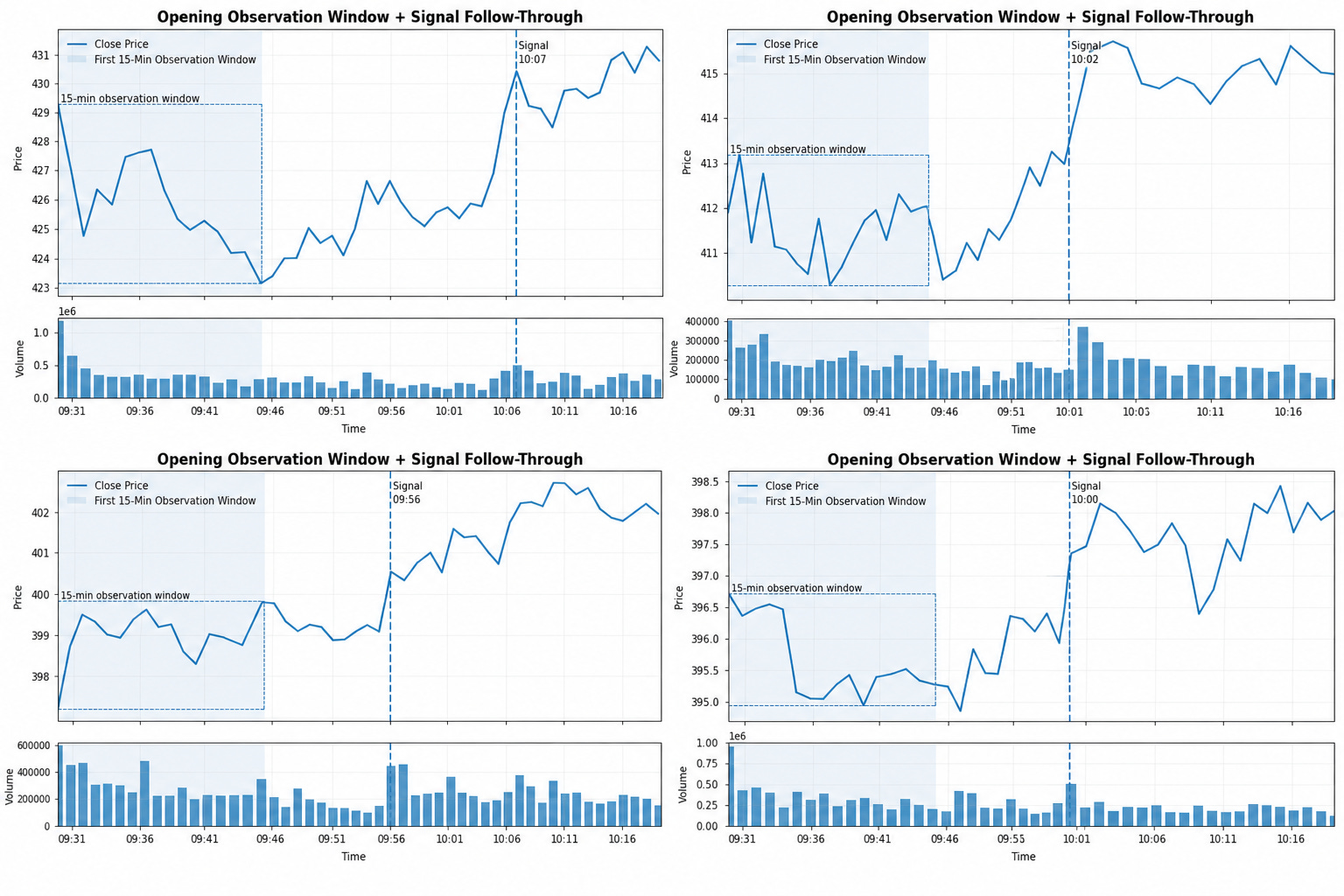
A quick look at a retail favorite like TSLA confirms the basic premise: when the signal fired, there tended to be a noticeable increase in relative volume.
Whether the signal itself ultimately “worked” wasn’t really the important part, but rather that the trigger appeared to consistently coordinate behavior.
Okay, so if we know that at some timestamp t, there will be a substantial increase in buying volume based on signal x, there’s a pretty simple path to monetization:
Front-running the trigger itself.
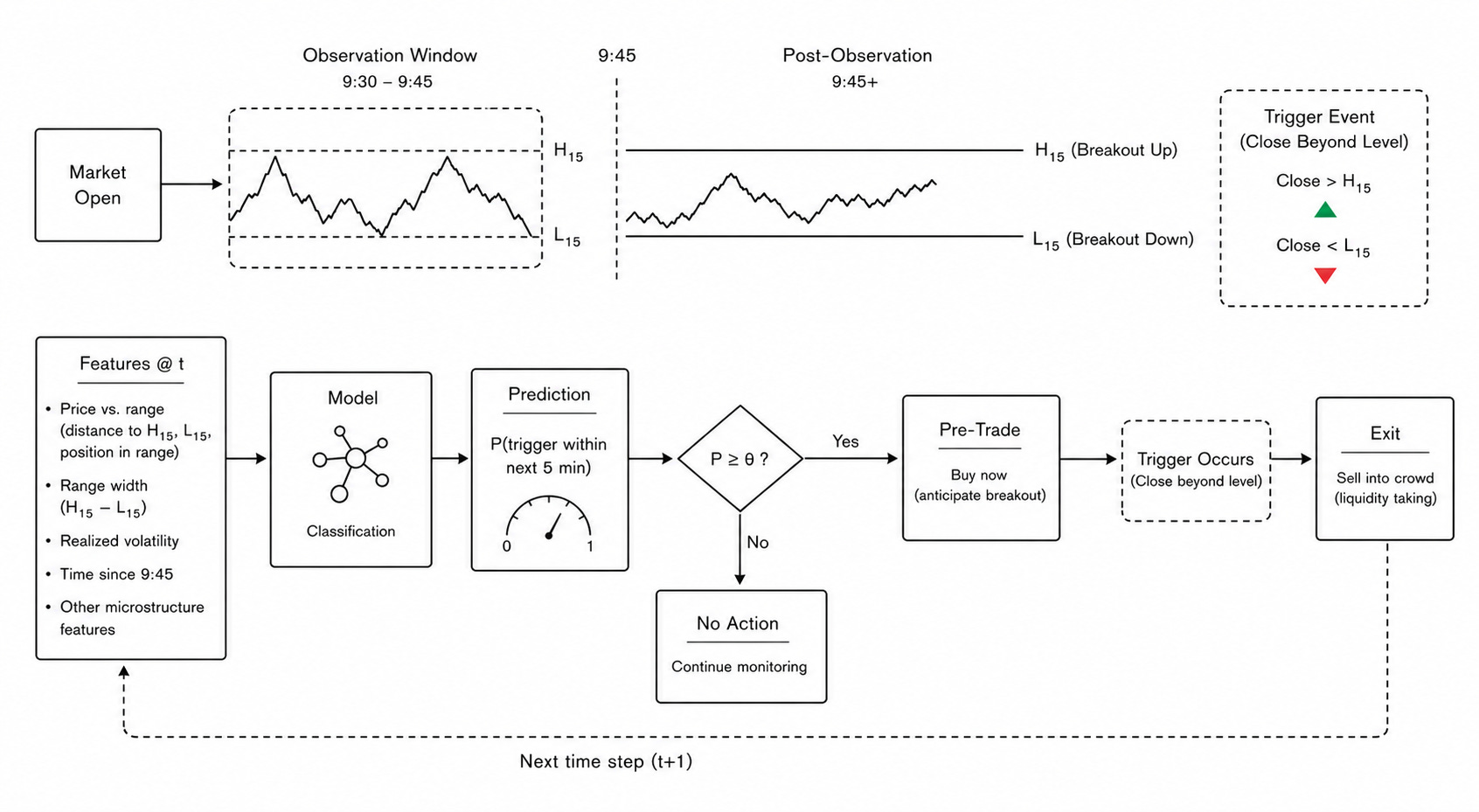
The signal that kickstarts this is mechanical and thus able to be systematized. After the 15-minute observation window closes at 9:45, we know that the cohort is staring at one of two horizontal lines, waiting for a close above or below.
From here, we can isolate the probability of the signal firing in the next 1–2 minutes as our prediction problem.
To do this, we can build a simple classification model where the features might be: where current price is relative to the ranges, how wide the observation range was, and realized vol of the underlying. The prediction target may be whether or not the trigger ended up happening sometime within the next 5 minutes.
When that probability crosses some threshold, the model can fire buy orders instantly, anticipating that the mechanical crowd will soon be reacting to the perceived buy signal.
Once the trigger actually happens, you just sell your pre-bought shares into that crowd of buyers.
Of course, these strategies are not tied to any core economic rationale, so you’ll still be exposed to market beta and the idiosyncratic risk of the underlying company, but it’s a starting framework on thinking about how to be positioned when you’re expecting certain actors to make certain behaviors at defined times.
But naturally, not everyone entering the market will gravitate toward momentum breakouts and chart patterns. Some will eventually drift toward strategies that actually do have structural economic rationale underneath them, and that’s where things really start to pick up.
A Great (or Terrible) Year for Short Selling
Everyone is familiar with the core actors in the S&P 500 and other major indices, but there are thousands of other tickers that don’t get mentioned and often just continuously underperform until the eventual delisting and/or bankruptcy.
Short selling requires a margin account as you’re borrowing shares, so if traders will now only need $2,000 to participate actively, this is likeliest the next arena to see a boost in flows.
To see what we’re getting at, let’s take a look at one of the most profitable short selling edges that still works today: