

At this point in the 21st century, you likely know what prediction markets are.
And likely, you group it into one of two buckets:
A venue for insider trading on niche events like Oscar winners or elections.
A -EV gambling den where most users donate to sophisticated players.
Whichever bucket you identify it with, the one thing you don’t see it as, is a place for building a scalable, systematic business with a high ceiling for profit.
We didn’t either. Not until we took a look at the leaderboard:
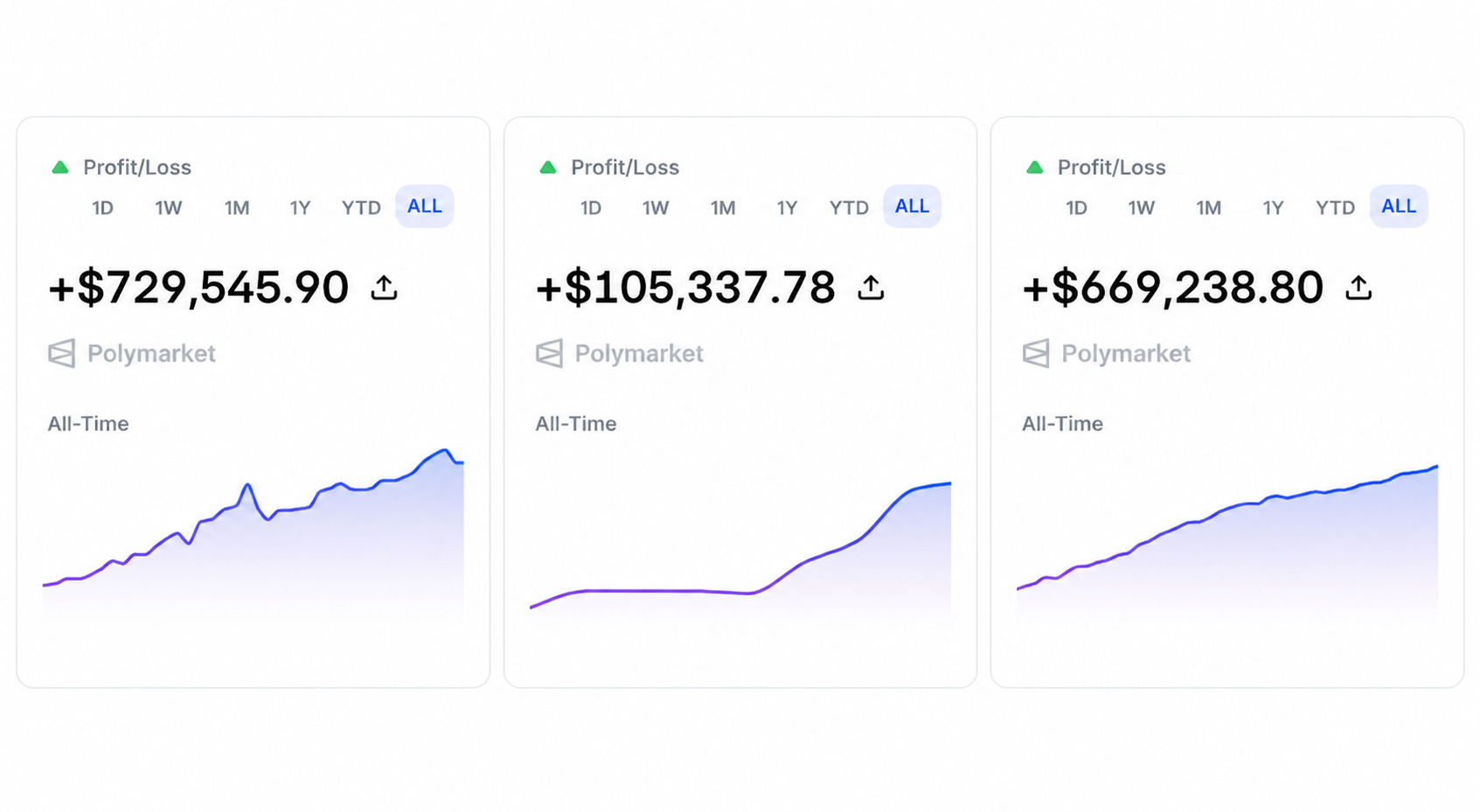
The dollar figures here are not the focus, what’s more interesting is the shape of the returns.
Even if you’re a good predictor who’s profitable, your best-case equity curve will look like the NASDAQ 100; good periods, large bad periods, but overall okay.
In order to have a virtually straight line up and high sharpe ratio, like those pictured above, you have to be doing something a little different.
We wanted to figure out exactly what these sophisticated players were doing and how such performance could be possible. By the end, we were actually pretty impressed at just how complex some of these operations are.
So, today, we’ll be showing you the exact mechanics, in detail, of what one of these profitable prediction market operations look like.
Without further ado, let’s get right into it.
Where The Sharpe Actually Comes From
Naturally, our starting point was to see what kinds of markets some of these accounts had in common.
Were they just consistently nailing the price range of oil? The weather in Miami? Whether or not there’d be a fed rate cut?
Turns out, it’s a little bit more strange:
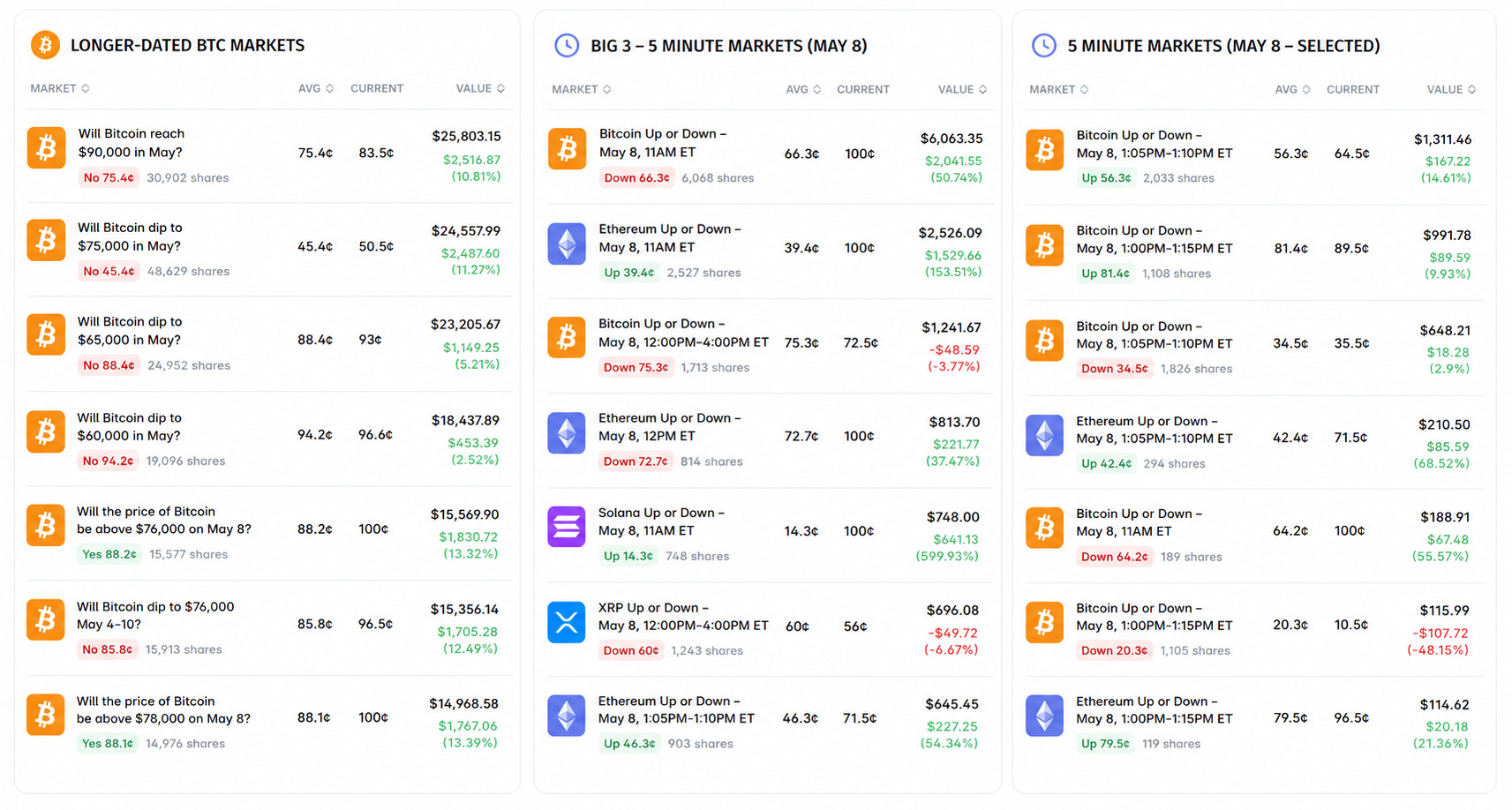
In almost all of the highest performing accounts, they were exclusively trading the up/down 5-minute market in cryptocurrencies.
Before going further, let’s see how that market works:
Every 5 minutes, the exchange opens a new binary contract asking whether BTC will be higher or lower at the end of the window.
For Kalshi, the reference price is the CF Benchmarks BTC-USD Real-Time Index, which is computed from a basket of major spot exchanges (Coinbase, Kraken, Bitstamp, etc.).
The contract opens at the start of the 5-minute window and closes at the end of it (e.g., 8:00-8:05). The starting price is locked in at open, the ending price is locked in at close.
YES pays $1 if the close is above the open, NO pays $1 if it isn’t. Contracts trade in cents between 1 and 99, where the price is the implied probability of that outcome.
Throughout the 5-minute window, traders can buy and sell YES/NO at whatever the current order book reflects.
At settlement, the winning side is paid out in full and the losing side goes to zero.
The way you profit is straightforward: buy contracts for less than their true probability of paying out, or sell them for more.
Pretty simple.
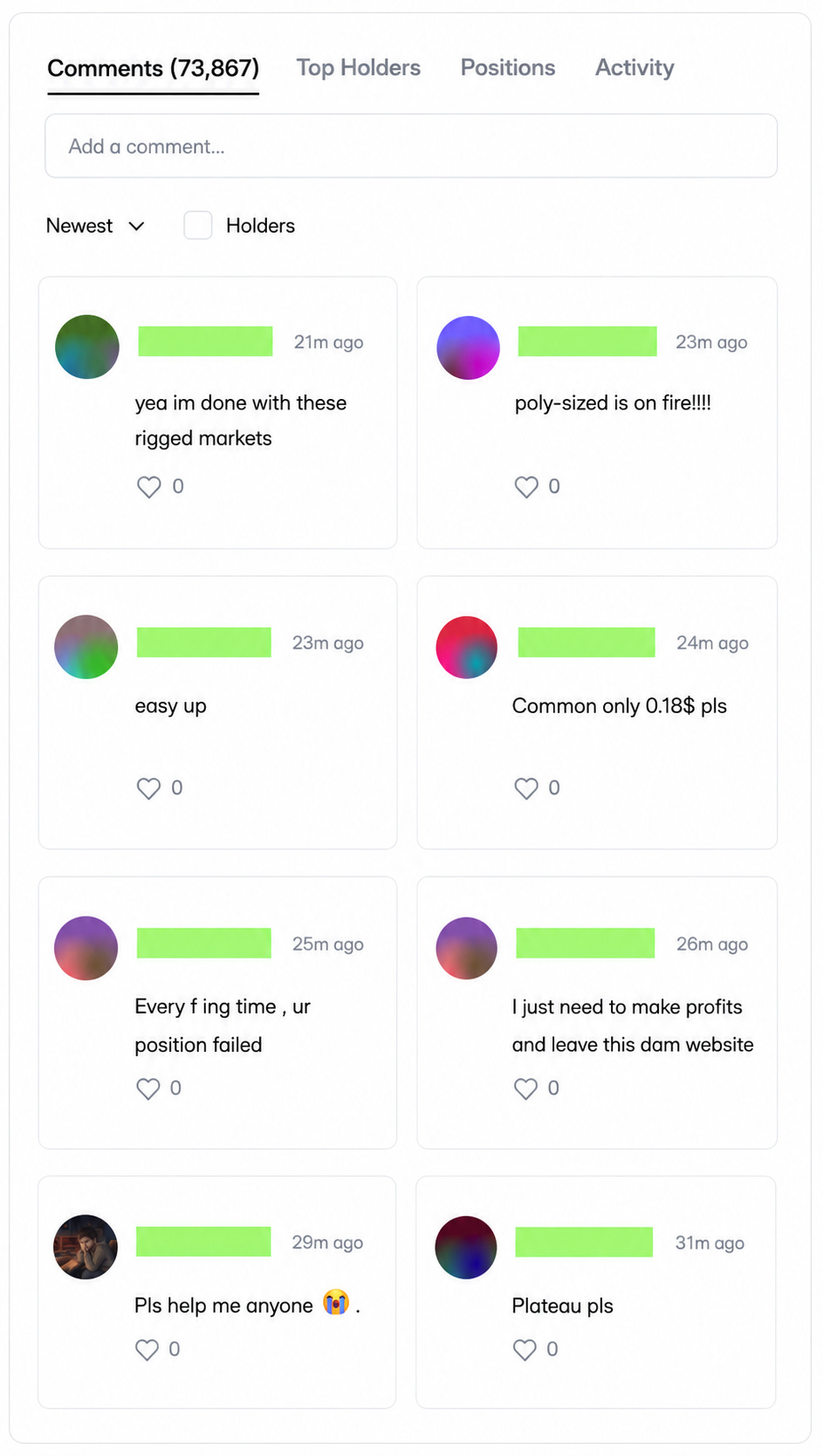
Now, in this particular market, the average counterparty tends to be a bit… underdeveloped.
Making it a target-rich environment for pros:
So, now that you have a grasp on how it works, we can look at how these operations are industrialized.
It’s Not Predicting At All, Really
Before we get into the trade itself, we have to look at where the price data is even coming from.
For Polymarket, it resolves based on a Chainlink Data Streams price report at a specific timestamp right at the close of the window.
The settlement price is not really “the price of Bitcoin”, but rather a specific report from a specific oracle network at a specific timestamp.
So now you have two parallel things happening:
The actual underlying BTC market, ticking in real-time across spot exchanges.
The Polymarket order book, which is a bunch of people trying to price a binary contract that will eventually settle against the oracle’s print.
In theory, both should be tightly coupled, but they often aren’t.
By the last 60 to 90 seconds of the window, the underlying BTC move is mostly determined. If BTC is up 0.4% with 90 seconds left, YES is going to settle in the money with very high probability.
But remember, these aren’t super liquid and the counterparty isn’t always operating on that same framework:
There are stale orders sitting on the book from people who placed them thirty seconds ago.
There are retail traders pricing the contract based on what they think will happen in the remaining 90 seconds.
There is still a wide bid-ask spread.
So, it’s simple: if fair value is .88 (88% chance it closes higher than open), and the current bid-ask spread is .83-.86, you buy up all of the asks below .88.
Now, “fair value” here is a bit vague. How do you really know the true probability of what Bitcoin is going to do in the next 90 seconds?
Well, generally like this:
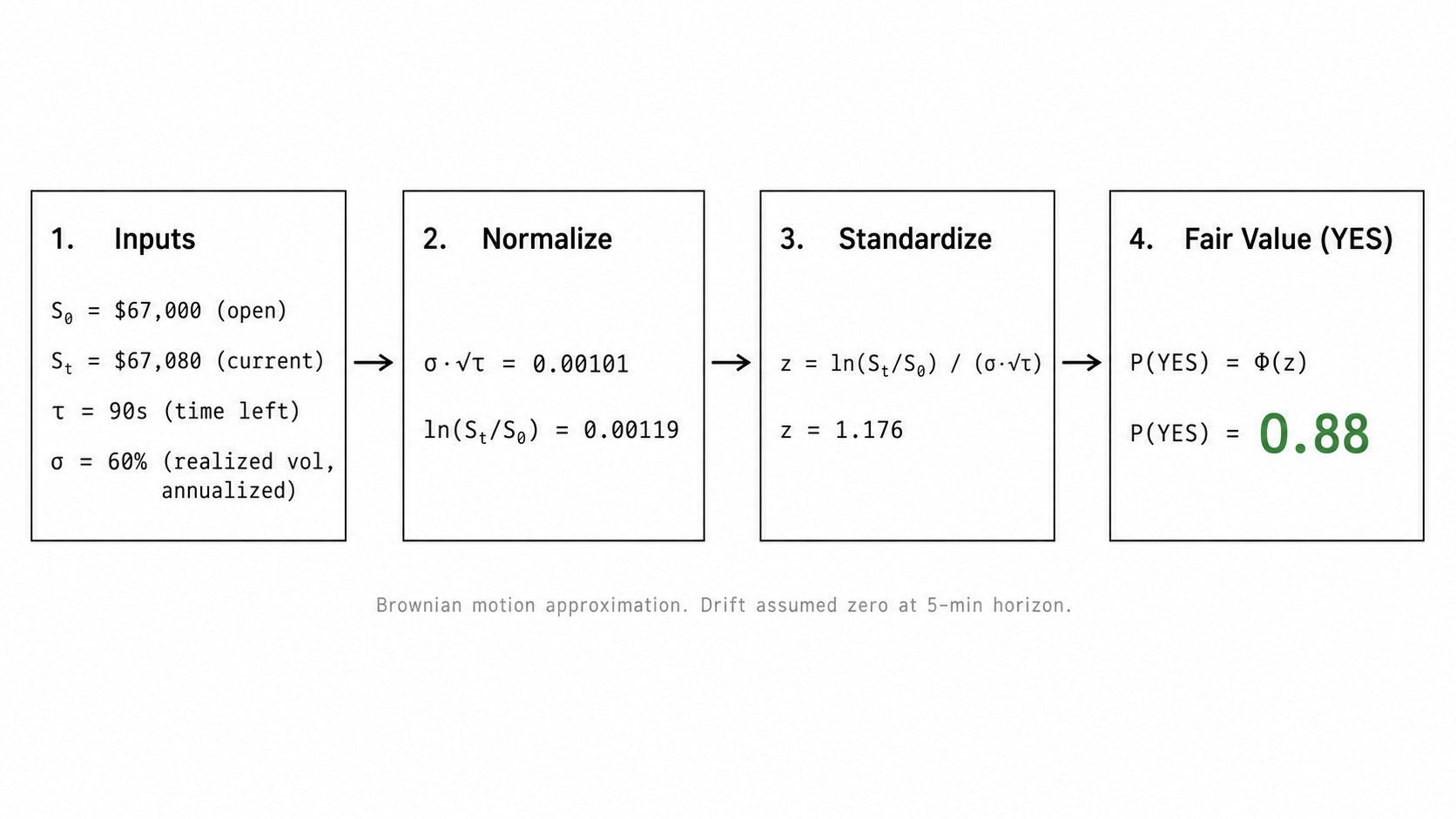
A bit of an oversimplification for time, but there are indeed standardizable ways of computing what the fair value of the contract might be at any given time.
However, anyone with a laptop can run that calculation. What actually creates the edge is everything else around it:
Latency
This is where the picture gets ugly for retail.