

There’s a version of 0-DTE trading that looks like this: it’s 3:45 PM, SPX is down 30 points, someone on Reddit buys 50 contracts of a put expiring in 15 minutes, and either makes $40,000 or loses everything. Screenshot gets posted either way. Comments say “this is the way.”


This is not a strategy. This is a coin flip with leverage.
And it’s a shame, because the same instrument, SPX options expiring today, is one of the most structurally profitable trades available to retail and semi-institutional traders. The edge just isn’t where most people think it is.
It’s not on the buy side. It’s on the sell side. And it’s not at 3:45 PM. It’s at 10:30 AM.
The Structural Edge in 0-DTE
Here’s what most 0-DTE buyers don’t understand: theta decay on a same-day option is not linear. It accelerates violently as expiration approaches. An option with 6 hours of life left loses value at a completely different rate than one with 45 minutes left.
This means sellers of 0-DTE options are collecting premium that decays in their favor every minute. The buyer needs a large, directional move in a short window. The seller just needs the index to not do something extreme. Over a large enough sample, “nothing extreme happens” is the base case most days.
This isn’t a secret. Market makers and prop desks have been running this trade for years. The question isn’t whether selling 0-DTE premium works; it’s whether you can do it well. And “well” comes down to one thing: where you set your strikes.
The Strike Selection Problem
Sell too tight and you’ll get clipped by normal intraday noise. Sell too wide and the premium just isn’t worth the risk.
Most traders solve this with rules of thumb. “I sell the 10-delta put.” “I go 50 points out of the money.” “I use the expected move from the options chain.”
These approaches aren’t terrible, but they all share the same flaw: they’re static. They don’t adapt to what the market is actually pricing today.
A 10-delta strike on a quiet Tuesday in August is a completely different risk than a 10-delta strike on FOMC day. The number looks the same. The risk profile is unrecognizable. Delta assumes log-normal returns, but intraday SPX movement is shaped by gamma exposure, order flow concentration, and event risk that the options market itself prices through skew and term structure.
The market knows things that delta doesn’t capture. The question is whether you’re listening.
A Better Way to Set Strikes
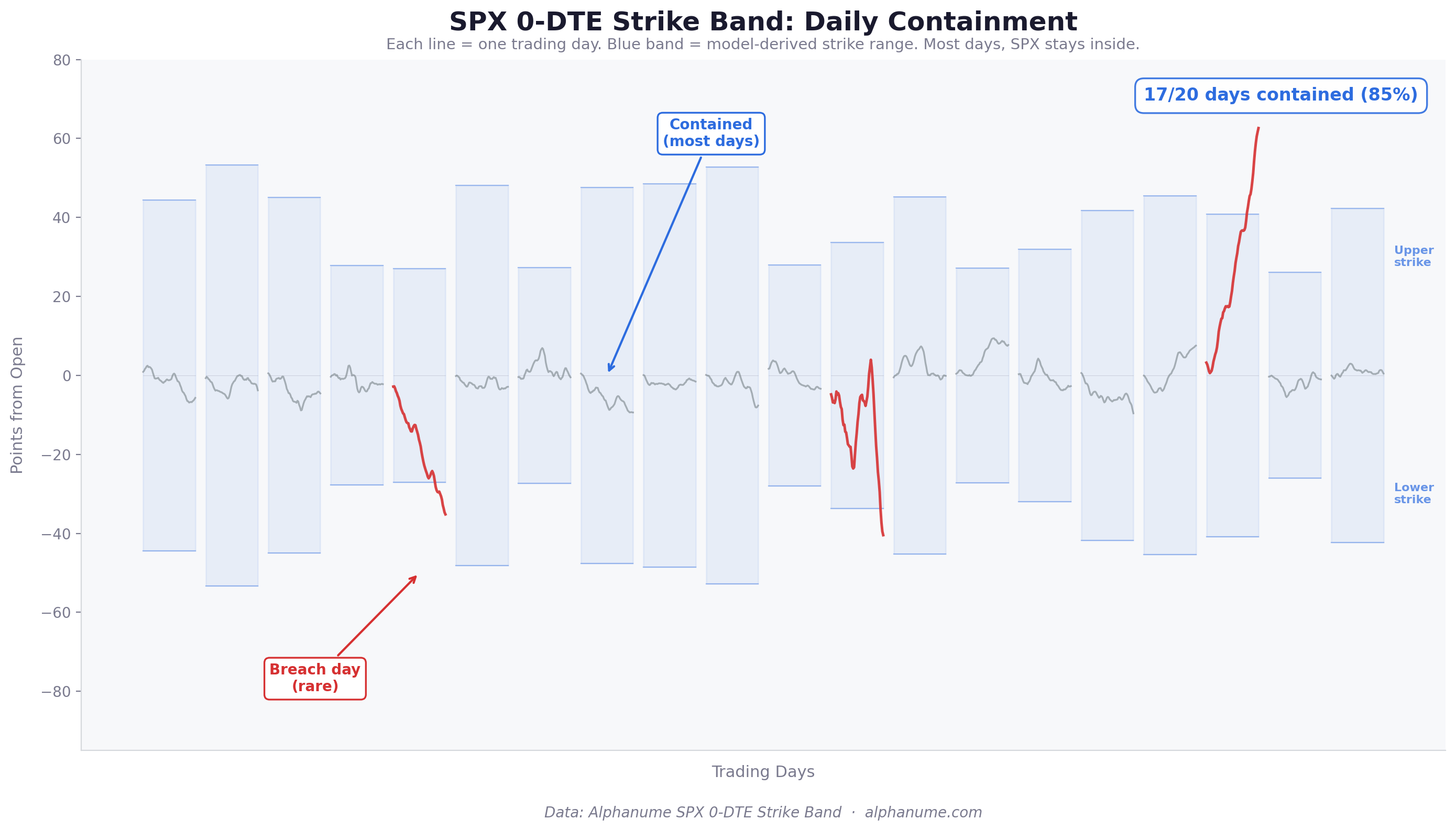
Every trading day at 10:30 AM ET, Alphanume’s SPX 0-DTE Strike Band publishes two numbers: a lower strike and an upper strike.
These aren’t arbitrary.
They’re derived from the actual implied probability distribution embedded in that day’s SPX options prices, combined with realized volatility and broader risk factors. The model distills the market’s own assessment of where the index is likely to stay through the close, then rounds to the nearest listed strike so you can use the levels directly.
When the market is pricing a fat left tail: Fed day, CPI print, geopolitical shock; the lower strike moves further out. When conditions are calm and dealer gamma is pinning the index, the band tightens. The levels adapt to the actual risk environment instead of relying on assumptions that ignore it.
This was today’s output:
{
      "date": "2026-04-06",
      "lower_strike": 6550,
      "upper_strike": 6670,
      "instrument": "SPX"
}
Not last week. Not a backtest. Today. April 6th, 2026; logged at 10:30 AM, before the session played out.
SPX closed at 6,611. The lower strike was 6,550. The upper strike was 6,670. Both held. Every spread sold at or beyond those levels expired worthless: that’s real premium collected by whoever was on the sell side.
Today was a good day. Not every day is. But the point isn’t that any single day works, it’s that you made the decision with the market’s own implied probability distribution instead of a rule of thumb. Over enough days, that difference compounds.
Here’s how to pull it yourself (copy and paste this):
import requests

# Pull today's SPX 0-DTE strike band
# Published daily at 10:30 AM ET — two strikes, one API call

url = "https://api.alphanume.com/v1/spx-0dte-strike-band"

params = {
    "api_key": "YOUR_API_KEY",
    "date": "2026-04-06"
}

response = requests.get(url, params=params)
data = response.json()

# Extract the model-derived strike levels
lower_strike = data["data"][0]["lower_strike"]
upper_strike = data["data"][0]["upper_strike"]

print(f"Today's 0-DTE Band → Lower: {lower_strike} | Upper: {upper_strike}")
Two numbers. One API call. That’s your strike selection for the day.
What You Actually Do With This
Sell spreads at the band. Place your short strikes at or beyond the band’s lower and upper levels. You’re positioning outside the range the implied distribution expects the index to stay within. This isn’t a guarantee, nothing is, but it’s a probability-informed starting point rather than a guess.
Size by band width. A wider band means the market is pricing more intraday movement. Use band width as a position-sizing input: smaller on wide days, larger on narrow days. Or skip wide-band days entirely if the expected range exceeds your risk tolerance. This alone filters out most of the days that blow up accounts.
Sanity-check your own process. Even if you have your own strike selection method, run it against the band. If your short put is well inside the lower strike, you’re taking on more risk than the implied distribution says you need to. That’s not necessarily wrong, but you should know you’re doing it.
Backtest with historical bands. The dataset is point-in-time, meaning every historical band reflects what was known at 10:30 AM on that date; not a retroactive calculation. Pull the full history going back years, compare each day’s band against actual SPX price action, and you can answer the question empirically: how often did the index stay inside the band? How far did it breach when it didn’t?
The 0-DTE Divide
There are two kinds of 0-DTE traders.
The first is buying lottery tickets at 3:45 PM, hoping for a 10-standard-deviation move in 15 minutes. Some days it works. Most days it doesn’t. Over time, they are the liquidity that funds the other side.
The second is selling premium at 10:30 AM with strike levels derived from what the options market itself is pricing. They collect theta decay all day. They size by volatility regime. They know exactly where the implied distribution says the risk is, and they position outside of it.
The instrument is the same. The approach is not. The first is gambling. The second is a strategy.
Pull tomorrow's band yourself. The SPX 0-DTE Strike Band is available on every plan: free for historical exploration, Pro for real-time. Start at alphanume.com.
This highlights the delta aspect partially, it does not address the volatility aspect. Instead of fixed 1030 am, sell 0dte when you have higher than usual IV/RV, intraday morning. Many trade 0DTE as futures unknowingly - irrespective of being options sellers or buyers.
https://substack.com/@theschrodingercat/note/c-235451268?r=2o4y8k
Hi there, I was trying to get historical data of the SPX band on the alphanume website but got a 403 error. I got into touch requesting a trial but so far didn't get an answer. Hope you can help, thanks!