

Sometime in the last week of May, Strategy, the company formerly known as MicroStrategy, sold 32 bitcoin.
That’s about $2.5 million at the $77,135 average the filing reported, out of a treasury that measures its position in the hundreds of thousands of coins, and it was the company’s first sale in over three years.
The disclosure was one line in an 8-K filed June 1, the kind of housekeeping detail an analyst skims on the way to the leverage tables.
It flipped a $60 million Polymarket contract from a near-certainty into an 81-cent panic, drew two formal resolution proposals that both got challenged, went to a token-holder vote, and as of July it’s the subject of a lawsuit in the New York Supreme Court.
I spent this week reading everything that line broke.
A market about a thing that never happens
The contract was “MicroStrategy sells any Bitcoin by May 31, 2026?”, and for most of its life it was one of the most boring things on the venue.
Saylor’s entire public identity is that he never sells, so YES traded down at a few cents the way deep out-of-the-money puts trade at a few cents:
someone is always willing to hold a lottery ticket, and someone else is always happy to collect pennies for insuring an event that never happens.
About $60 million of volume went through on those terms.
And if you were short YES down there, you were arguably making the cleanest bet on the platform:
The company files everything with the SEC
The treasury wallets are watchable on-chain
The one man who decides whether to sell gives interviews about never selling.
As forecasting problems go, there was almost nothing to get wrong.
June 1, 81 cents
On June 1st, the 8-K landed:
The sale executed between May 26 and May 31, which sits inside the market’s window.
The disclosure arrived June 1, which sits one day outside it, since the contract’s cutoff was 11:59 PM ET on May 31.
Within hours YES had spiked from low single digits to 81 cents as traders piled into what looked like a resolved question, because the filing said, in plain SEC prose, that the thing the market asked about had happened on time.
Polymarket’s team then pinned a clarification to the market page, which is what the next two months of fighting were about:
“Confirmation achieved outside of the market’s time frame does not qualify.”
Read one way, the market asked whether Strategy sells by May 31, Strategy sold by May 31, done.
Read the other way, a market has to be resolvable from information available inside its own window, and on May 31 no filing, no on-chain evidence, and no credible reporting confirmed any sale.
Both readings are coherent, which was pretty much the problem as the resolution text supported either or.
I pulled the contract’s price history and annotated the whole arc (chart below)
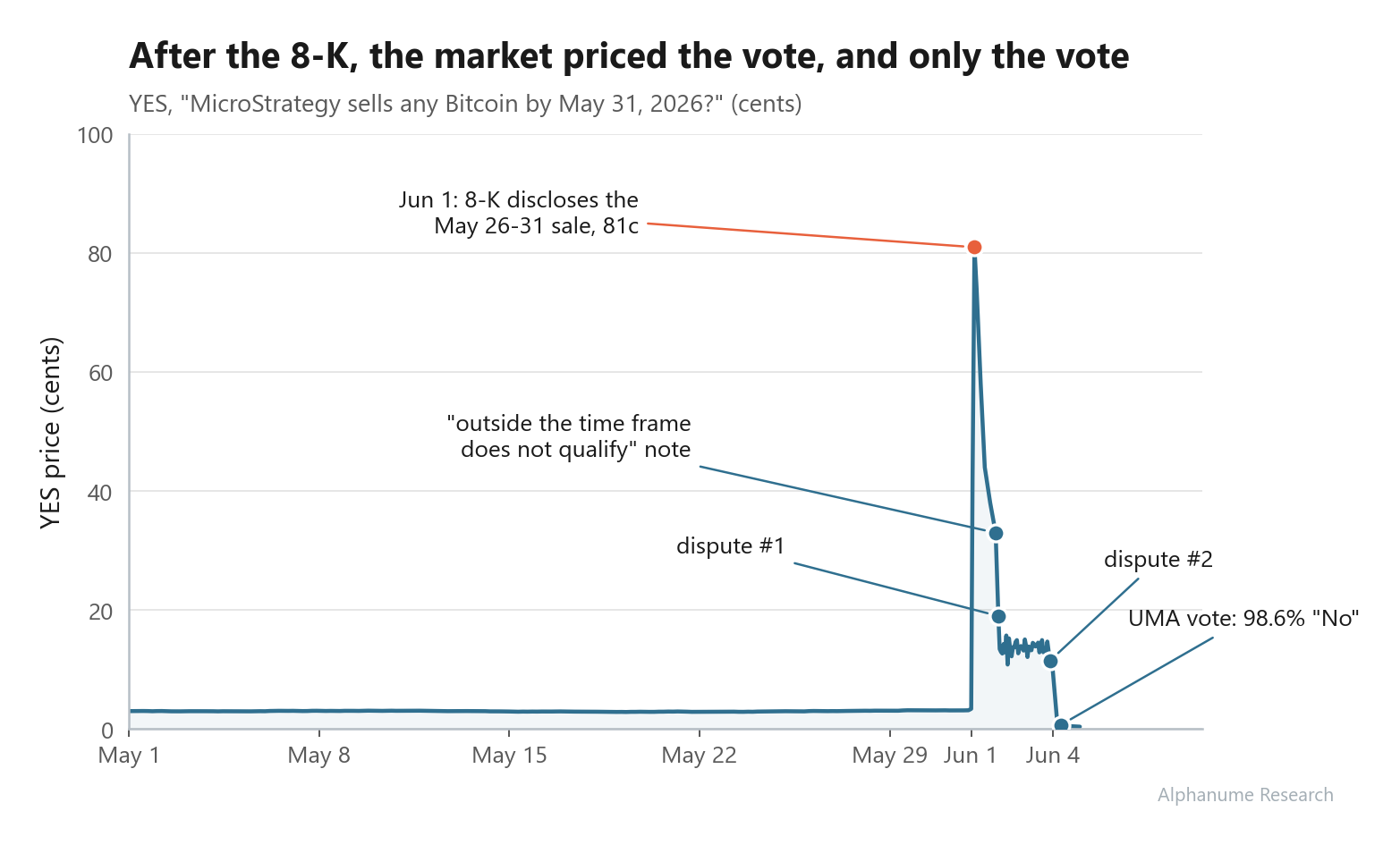
That middle nub, where YES hovered near 12 cents for days, is a beautiful representation of how markets become efficient. By then, the original outcome was pretty much established (he sold the Bitcoin), so the price at 12 cents acted as a proxy for how the hundred or so pseudonymous token holders would vote on the final outcome.
“Pseudonymous token holders” might sound like jargon-slop at first glance, but if you’re getting into prediction markets, you quite literally need to know how they work.
Two disputes and a token vote
Polymarket outsources settlement to UMA’s optimistic oracle:
Anyone can propose an outcome by posting a bond, and if nobody challenges it within a couple of hours, it stands.
Almost every market resolves this way, cheaply and instantly.
The keyword here is almost, as this one went a bit differently:
Someone proposed “No” and got challenged, a second “No” proposal followed and got challenged too, and after that the question escalated to UMA’s voting layer, where UMA token holders pick the outcome and voting power is proportional to how many tokens you hold.
The ballot had three options: settle it “No” on the announcement-timing reading, settle it “Yes” on the event-timing reading, or call it too early to resolve.
By the end, about 98.6% of voting power went “No”, the vote wrapped June 4, and YES went to effectively zero.
One account had bought roughly 50,000 YES shares for about 35,000 USDC after the 8-K dropped, which is to say they paid about 70 cents a share for a claim on an event that had already, verifiably occurred, and they collected nothing.
Another trader claims he lost $500,000 on the same trade.
On July 3, two of them sued Polymarket and its executives in the New York Supreme Court, alleging breach of contract and deceptive practices and asking for the full $1.00-per-share redemption value.
Who counts the votes
So the natural next question is who these voters are, which is what the Wall Street Journal spent the spring answering.
Their analysis of UMA’s voting records, published about two weeks before this dispute, found that:
At least 60% of active UMA voters are linkable to live Polymarket accounts
The ten largest wallets carry more than half the voting power in most disputed markets
In roughly one in five disputes, at least one voter held a financial stake in the very outcome they were ruling on (chart below).
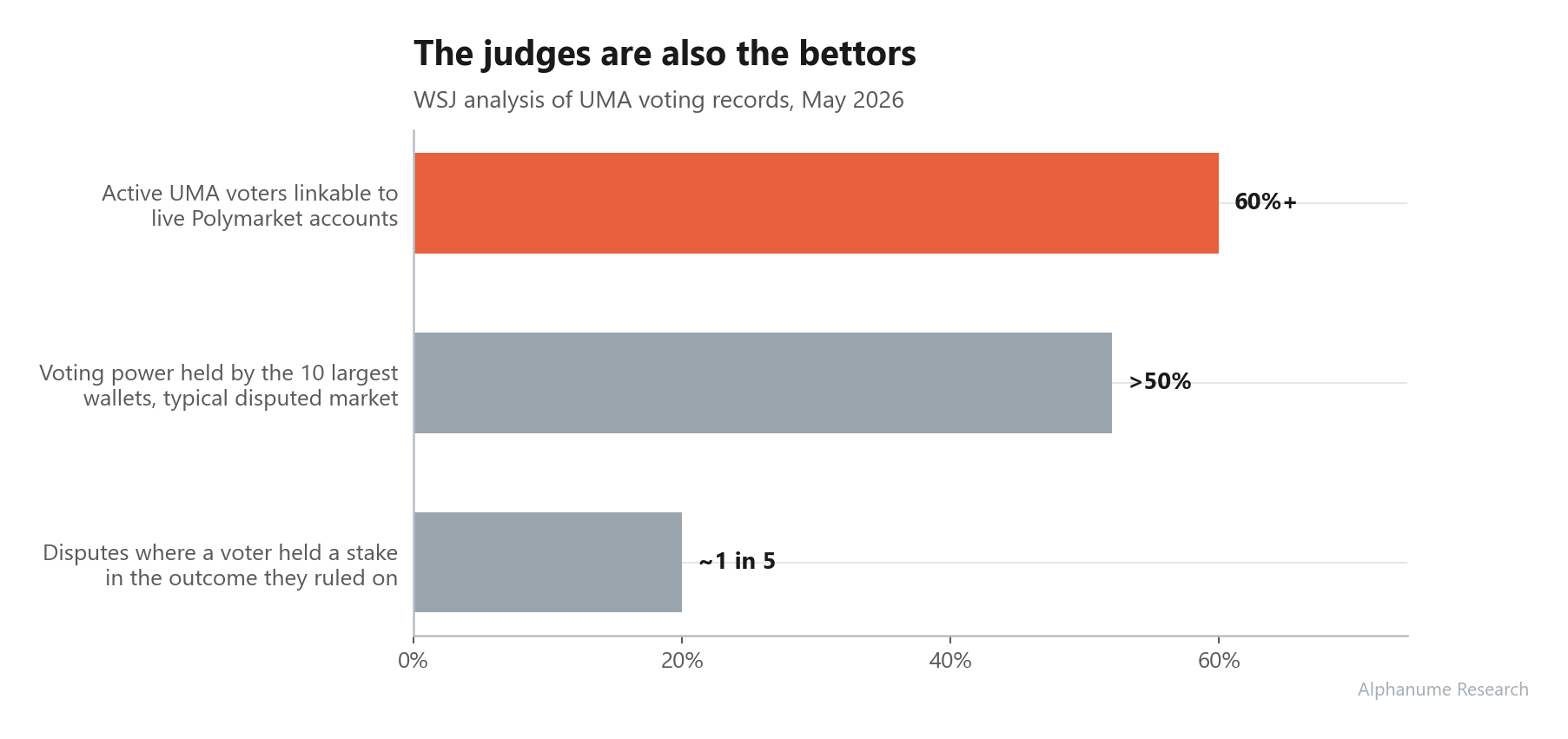
None of that proves this particular vote was corrupt, and to be fair, a 98.6% landslide doesn’t need any self-dealing to explain it. Still though, you have to admit it’s… interesting.
In any regulated corner of finance, an arbitrator with a position in the case is a Bloomberg-headline-turned-arrest, but in prediction markets, it’s pretty much the default.
What you’re actually long
If there was any general lesson to pull out of this, I’d say:
A prediction-market contract is a package of two bets: one on the event, and one on the resolution process agreeing with you about the event.
On the happy path, the second bet is invisible and free, so everyone prices these contracts as if the first bet is the whole product.
This episode highlights what it looks like when that “free” second bet gets nasty. It happens exactly when the outcome is ambiguous and the money at stake is large, since that’s when someone finds a dispute worth bonding. And you can’t hedge it, because your counterparty in the settlement fight may literally be the one voting.
For the sellers of long shots, the pennies-collecting crowd, this is something you need to be aware of. You’re likely already automated, so at the very minimum, pass in the contract’s resolution rules to an LLMs API to get a score on the ambiguity of the settlement; it might be the only thing that keeps you in business.
Final Thoughts
I love prediction markets, and none of this changes the fact that they price ordinary events well and settle nearly all of them without drama.
As we covered in our "Bonding Bots" in Prediction Markets post, you really can run a solid business of executing high-probability trades, but the settlement risk will always be there.
So, if you’re just getting started and want to trade these markets, then at the very minimum, just keep that in mind.
As always, thanks for reading, and we’ll see you in the next one.