

This is the second post of our new series, Sketchy Trades, which we introduced here, dedicated to showcasing the “darker side” of quantitative trading research.
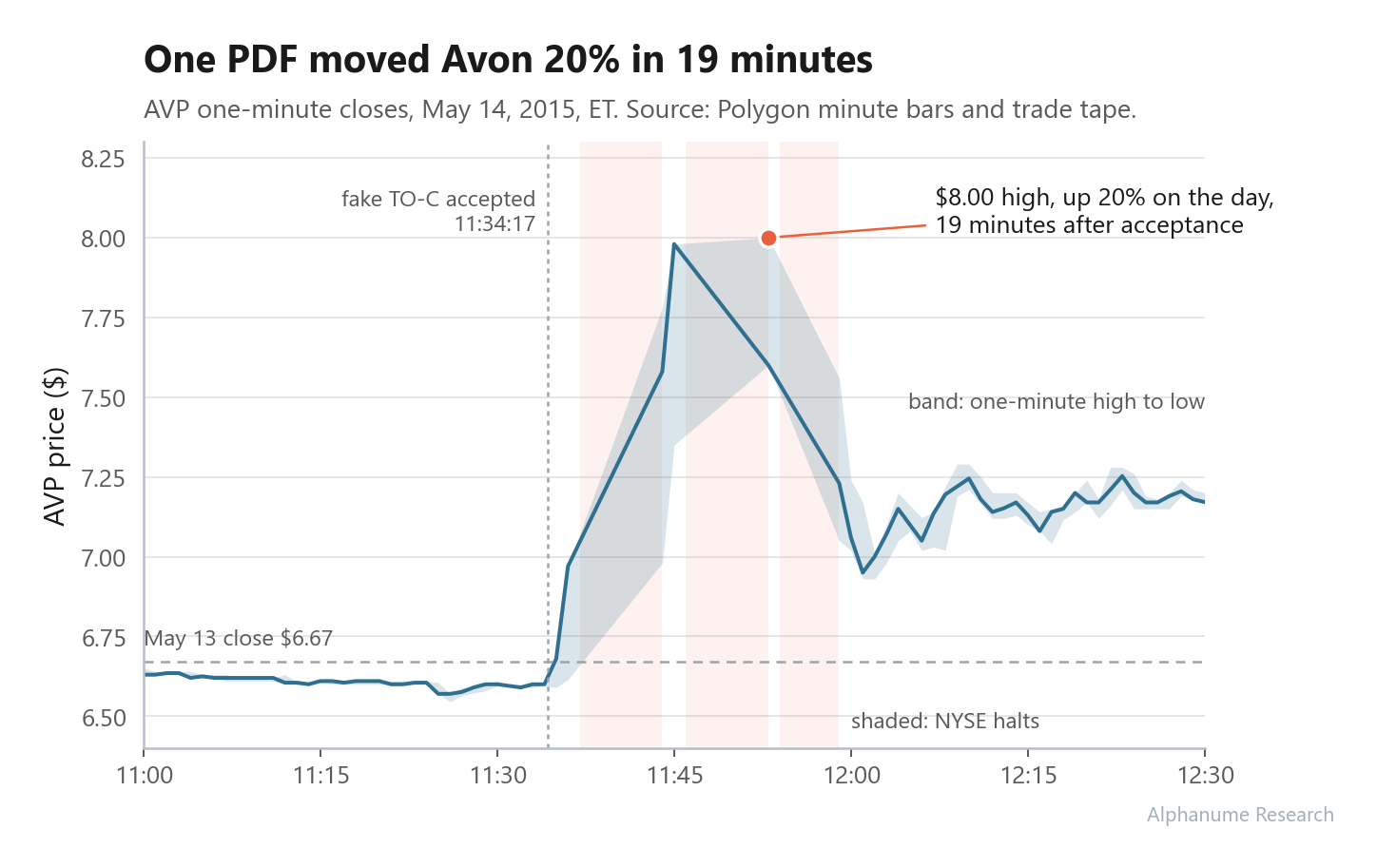
A few years back, EDGAR (the place where SEC filings get distributed) accepted and published a Schedule TO-C from a company called PTG Capital Partners, announcing an offer to buy all of Avon for $18.75 a share.
Avon had closed at $6.67 the night before, so it was a 181% premium.
Within 19 minutes of the filing, the stock went up 20%, the exchange halted trading three times, and about 31 million shares changed hands against a normal volume of ~13 million.
Unfortunately, the offer was fake. In fact, “PTG Capital” wasn’t even a real firm that existed.
When I first heard about this, I naturally thought, “Hmm, crazy. I bet there’s now lots of structure in place to prevent that from happening again”.
But the more I looked into this, the more I found out that there’s virtually nothing in place to prevent someone from doing this right now.
That’s a bold claim anyone can make though, so today, we’re going to show you the full mechanics of how this is done in the modern age, why it’s impossible to stop, and why you probably shouldn’t do it yourself.