

I pulled the full adjusted history for SQQQ, ProShares’ 3x inverse Nasdaq fund, back to January 2015. Over those eleven and a half years it lost 99.988% of its value, while its mirror image TQQQ compounded 37x.
Every time that pair of numbers makes the rounds, the same idea follows:
“both of these things are decay machines by construction, so short $100 of each, net out the market, and collect the drag from both sides at once.”
QuantSeeker took a run at it in July and landed about where the academic literature lands, the decay is real but frictions eat a meaningful chunk of it.
Now, if you’ve been reading our work for awhile, you know that we love nothing more than these kinds of potentially scalable, market-neutral edges.
So naturally, I wanted to look at the data myself: the borrow in actual dollars, the margin it locks up, what the rebalance schedule changes, and what the tail did across the full sample.
So, I rebuilt the whole thing from scratch and ran every version of the trade side by side.
Short $100 of TQQQ and $100 of SQQQ. Where does the money actually go?
Why there’s drag to harvest
Both funds promise 3x the daily move of the Nasdaq-100, and the daily part is where we need to look: they reset leverage every close, so over any horizon longer than a day the compounding takes over:
If the index goes up 1% and then down 1%, it sits 0.01% lower while the 3x fund sits 0.09% lower. What makes the trade tempting is that the minus-3x fund is also down 0.09%.
A flat, choppy market grinds both legs down simultaneously, and a short position in both collects the grind.
In theory, the harvest should scale with realized variance, and in the data it does: the yearly gross P&L of the pair short correlates with the Nasdaq’s realized variance at 0.60 across the sample (2015-2026).
So, right off the bat, chop pays.
The Reddit version
The Reddit version is as crude as it gets: short $100 of each in January 2015, walk away, let both legs rot.
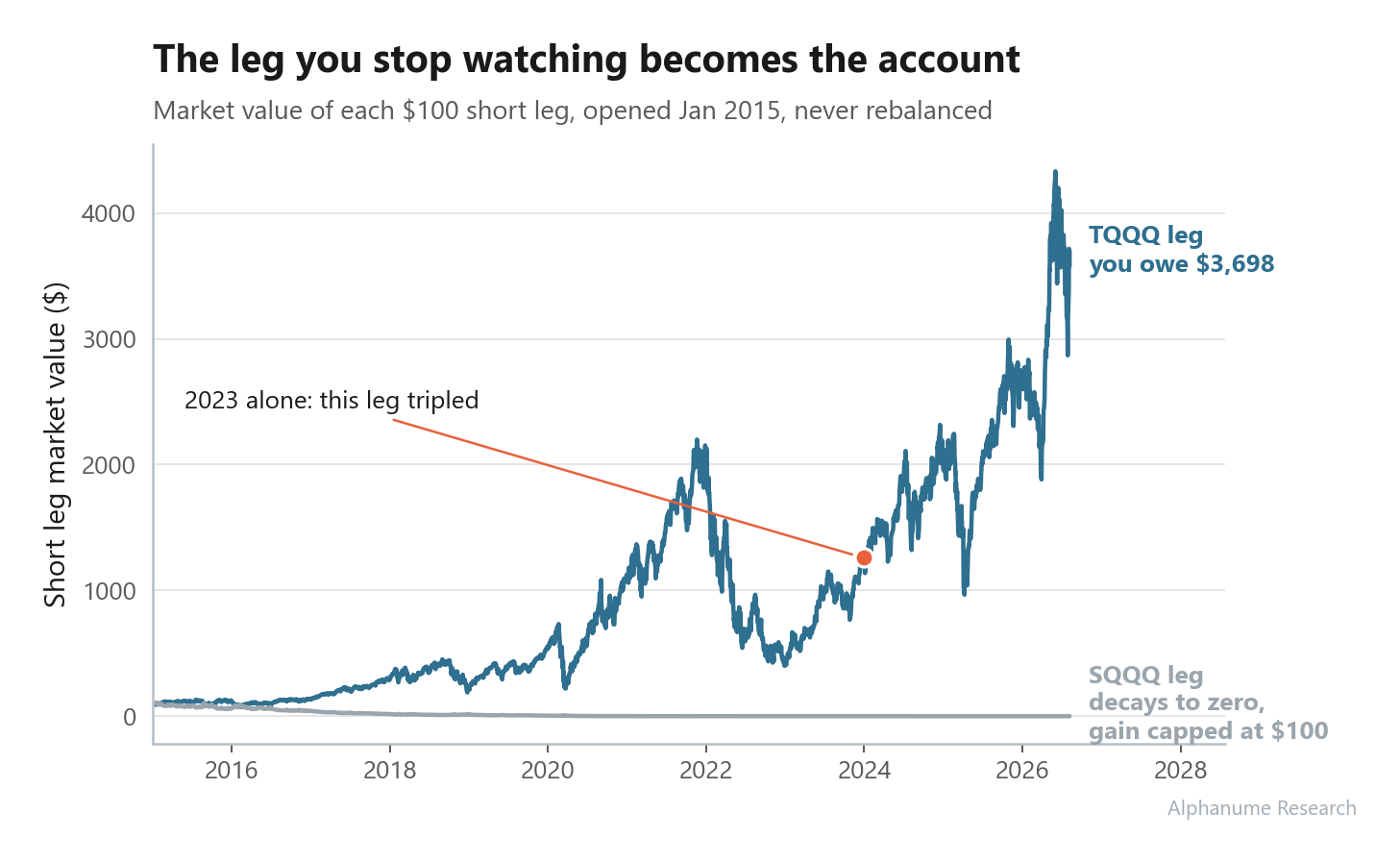
The SQQQ leg performs exactly as advertised and hands you the full $100, since a short’s gain caps out at the entire value of what you sold, but the TQQQ leg is where you’re effectively guarnteed to blow-up.
A short’s loss has no cap, TQQQ went up 37x, and what started as a $100 short liability compounds into a $3,698 position you owe.
The pair finishes down $3,498, and at the low in June 2026 it was down $4,132 (chart below).
Rebalancing fixes it
Now, obviously the naive version doesn’t work; so at this point, we can ask ourselves a simple question: instead of just holding forever, what if you just rebalanced the position frequently?
Fortunately, this is where things get good.