

When you think of risk-less arbitrage, you likely imagine a frontier HFT firm with ultra low-latency connections to NYSE, trying to peel off a fraction of a penny per second.
Traditionally, that’s true as such a profit mechanism naturally lends itself to a “if it was easy, everyone would be doing it” sort of defense.
However, it’s far from the only place where that kind of no-risk edge exists and more importantly, outside of HFT, this kind of edge is “easier”.
Being in the quantitative trading space, it’s largely your job to be at the very minimum, aware of these kinds of trades so that even if you don’t trade it directly, it can give you a baseline idea of where else you might apply it on your own.
So today, we’re going to be showing you first-hand what it takes to capture a specific type of arbitrage you might be loosely familiar with:
The Treasury Basis Trade
Now, we don’t expect everyone to be bond market experts, so to understand this idea, it'll help to walk through an example.
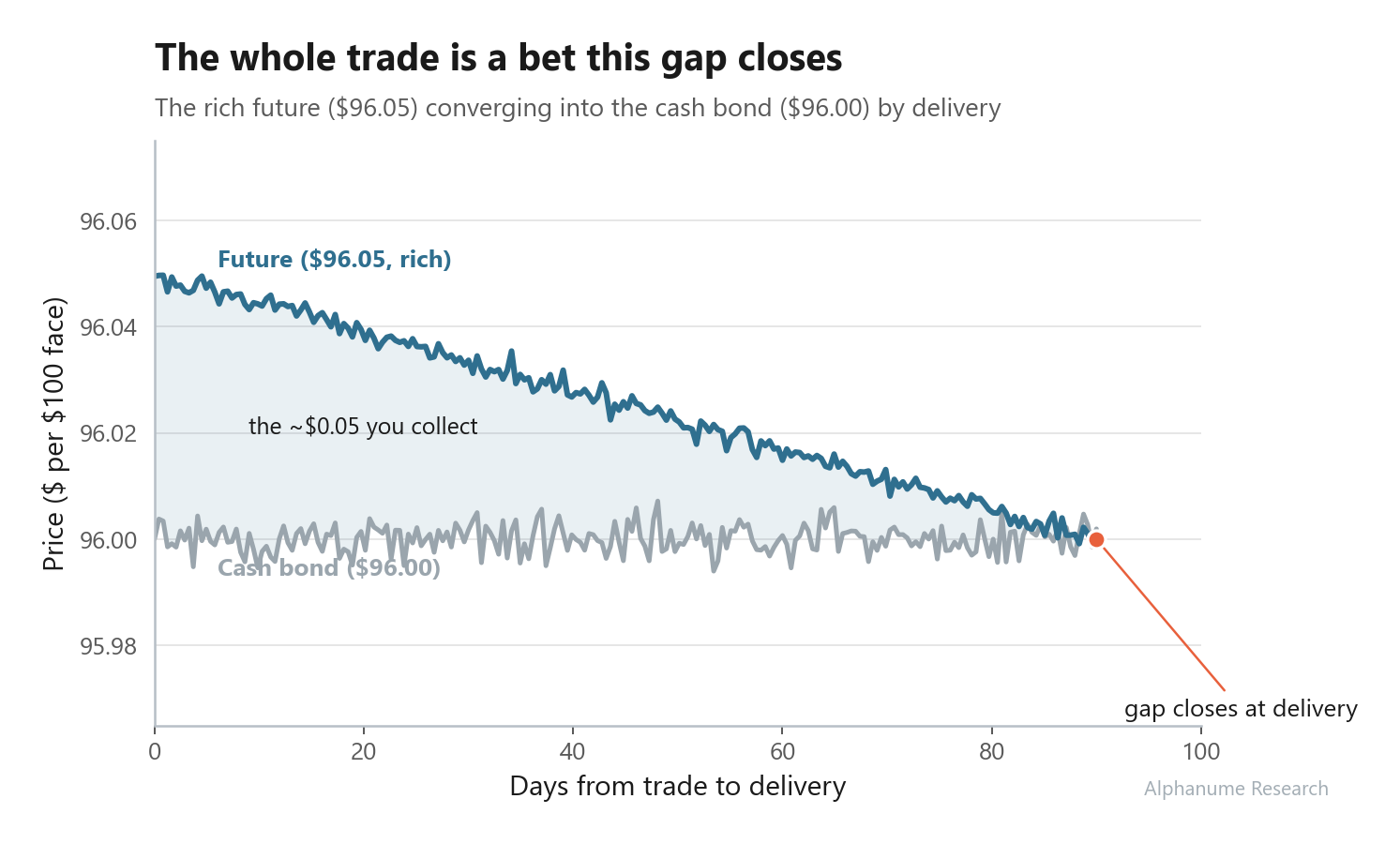
You see a 10-year treasury trading at a yield of 4% ($96)
At the same time, the CME 10-year treasury future is trading at a yield of ~3.99% ($96.05)
So, you short the future and simultaneously buy the bond, collecting a theoretical spread.
Naturally, even with perfect execution, this spread isn’t worth much, so you borrow.
Instead of running this trade with a million bucks, you hit the repo market with the bond you bought acting as collateral, then you lever it up 50-100x.
On the futures expiration date, you deliver the bond you bought and close out the trade.
Repeat.
With such an attractive risk-profile and relative simplicity, one naturally begs the question:
Could you actually run a version of this yourself?
Well, sort of.
To better answer that, we need to break the trade down into the pieces you’d actually have to assemble yourself.
Strip away the jargon and the professional version is really just three things stacked on top of each other:
You own a specific Treasury.
You short the matching future against it.
You finance the trade so the tiny spread is worth the effort.
The first two, you can do from your couch. The third is where the whole thing lives or dies, so we’ll save it for last.
One Account, Two Markets
The first hurdle is boring but real: you need a single account that can touch both the cash bond market and the futures market.
That rules out most of what a normal person already has. Your TreasuryDirect account can buy the note, but it can’t short a future. Your average stock app can’t do either leg properly.
What you want is a broker that clears futures and gives you access to secondary-market Treasuries, with Interactive Brokers being the obvious pick for a retail setup.
Leg One: Own The Bond
Now, you don’t just buy any 10-year and call it a day.
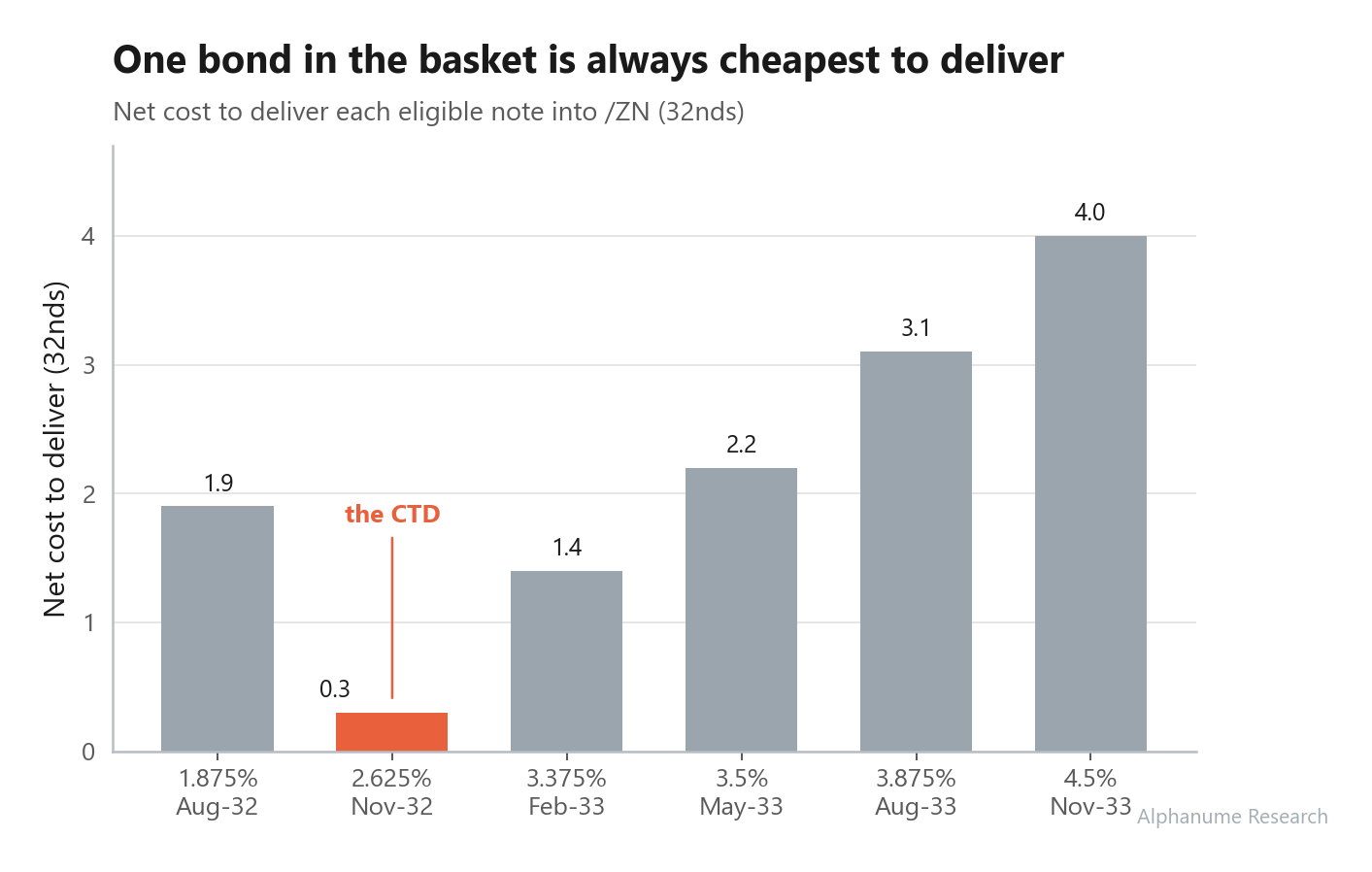
The CME future doesn’t track “the 10-year” in the abstract. Whoever is short the contract has to deliver a specific bond from an eligible basket at expiration, and they’ll always hand over whichever one is cheapest to deliver (the CTD).
The eligible basket holds a handful of different notes, each with its own price, coupon, and maturity. The contract puts them on a level playing field using a conversion factor for each one, and the short simply runs the math on all of them: buy the bond today, deliver it into the contract, and see which one leaves the most money in your pocket.
The winner of that little contest is the cheapest to deliver.
So if you want your long leg to actually mirror what the future is pricing, you buy the CTD issue itself, not a random note off the run.
Practically, that means pulling up the deliverable basket for the contract you care about (/ZN for the 10-year), identifying the current CTD, and buying that exact CUSIP in the secondary market.
You’re now long the same bond the entire futures market is implicitly quoting.
Leg Two: Short The Future
This part is genuinely a few clicks.
You short one 10-year Treasury future, each contract representing $100,000 in face value. The margin the exchange makes you post is tiny relative to that notional, usually a couple thousand dollars, which is your first taste of the leverage that makes this trade work.
The only real subtlety is how many contracts to short, because it isn’t one future per $100k of bonds.
The bond and the future don’t move dollar-for-dollar, so you size the short to match the dollar duration (DV01). You scale by the CTD’s conversion factor so that a one-basis-point move in yields moves both legs by roughly the same dollar amount:
contracts to short ≈ (face value of your bond / 100,000) × conversion factor
Get that ratio right and the two legs cancel on rate moves. Get it wrong and you’ve accidentally put on a directional bet on yields, which is exactly the thing to avoid.
At this point, congratulations!: you are long the cash bond, short the future, and pocketing that theoretical ~0.05% spread.
Can You Even Get the Data?
That word “theoretical” is doing a lot of work, and the first reason is almost embarrassingly basic: can you even see the number?
You need four things to compute the basis, and three of them are refreshingly public:
The deliverable basket and its conversion factors come straight from the CME.
The financing rate you’ll benchmark against is SOFR, sitting on FRED and updated daily.
The futures prices are on whatever quote feed you already have.
The fourth input is where it gets hard: live, accurate cash Treasury prices.
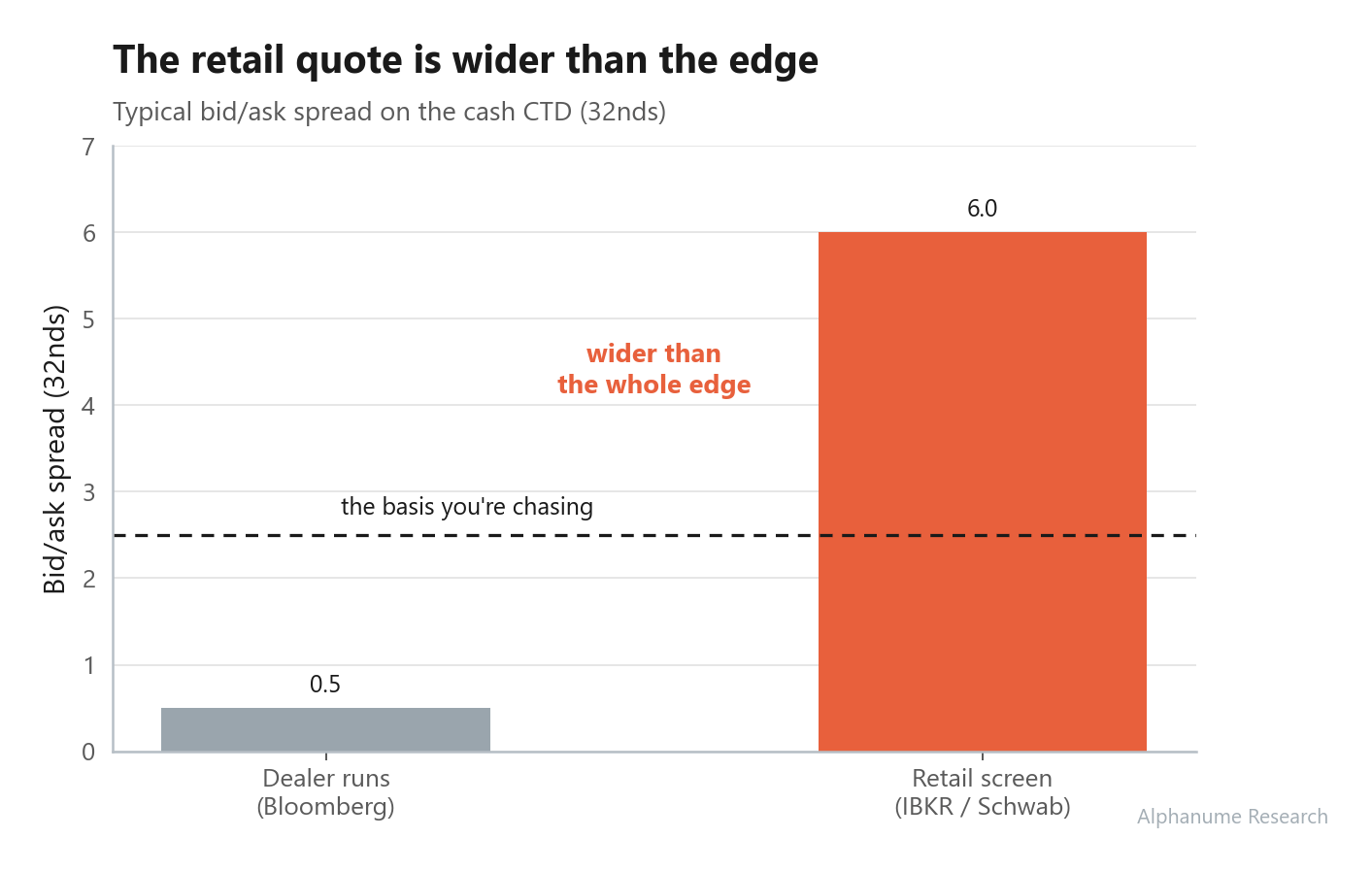
The cash Treasury market is over-the-counter (OTC), so there’s no consolidated tape like equities have.
The good pricing lives on Bloomberg terminals and dealer runs, while the retail-accessible quotes tend to be wide, stale, or both.
This matters because the entire edge lives in a spread of a few cents. If your cash bond price is off by more than the basis you’re trying to capture, that number you’re calling an edge is just your own data error.
Reading the Signal
So, how do you actually know when the basis is worth putting on?
A couple of terms you’ll bump into here, and they’re simpler than they sound.
The gross basis is the raw price gap between the cash bond and the future, adjusted by that conversion factor.
Net that against the carry you earn from holding and financing the bond, and you get the net basis.
Take the same idea and express it as a rate instead of a price, and you get the implied repo rate: the return you’d lock in by buying the cash bond, delivering it into the future, and collecting the convergence.
Now here’s the whole intuition, and it’s the one thing to walk away with.
Set that implied repo against your actual cost of financing the bond.
→ Implied repo above your financing cost = the trade pays you to carry it.
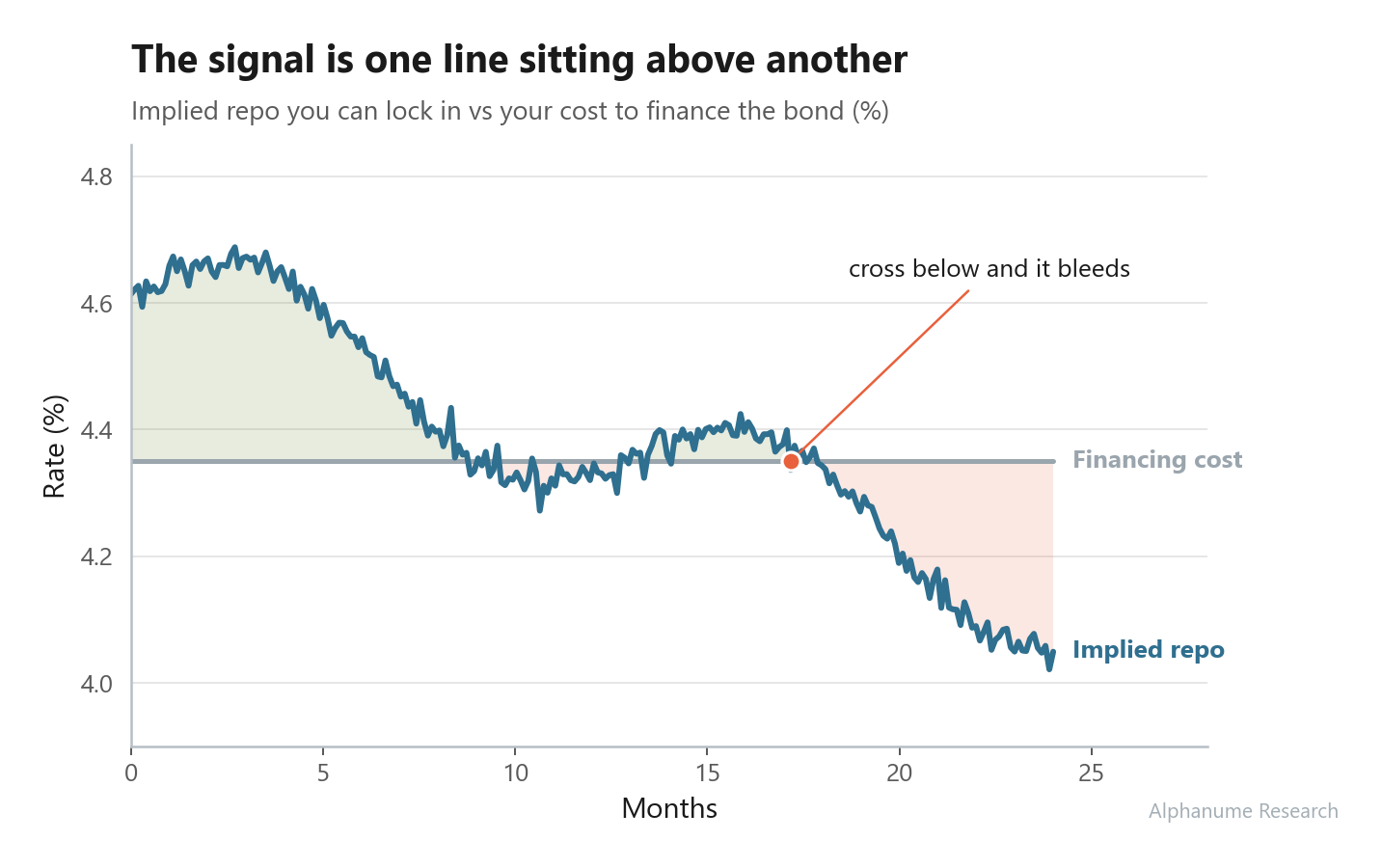
When the market hands you a higher implied return than it charges you to borrow, you capture the difference, geared up dozens of times. When those two rates cross, the printer quietly turns into a slow bleed.
That single comparison is the entire signal and it’s exactly why this isn’t free money for everyone. The implied repo you can actually capture depends on the repo you can source.
A prime-brokered relative-value fund and a retail account are looking at two different trades, because they finance at two very different rates.
Now, About That Leverage
Here’s where the couch version runs into the wall.
Remember, that spread is tiny. On an unlevered basis, capturing five hundredths of a percent is a rounding error that commissions will happily eat for lunch.
The pros solve this in the repo market. They take the bond they just bought, post it as collateral, borrow back almost all the cash they spent, buy more bonds, and repeat until they’re levered 50 to 100x.
You, sitting at home, might have a bit of trouble doing this.
Repo is an institutional counterparty market, so the minimum sizes are enormous, and nobody is opening a tri-party repo line for $100k. That single door being closed is the real reason this trade “belongs” to funds and doesn’t get spoken about much.
However, not all hope is lost.