

A while back, I wrote a bit about an MLB game where a team was trading at 99¢ to win on Polymarket, right up until a last-minute overrule that flipped the result.
The gist of the story was that so-called “bonders” made big bets on those near-certain wagers, but they lost substantial sums when it suddenly went to 0.
Now, that’s to be expected.
If you bet it all on a 99% likelihood outcome, eventually that 1% will kick in and you’ll lose everything.
However, when thinking about it again, I started to wonder about what would happen if someone took a more serious approach to this.
It might be a false equivalence, but in the US, mortgage delinquency rates currently run at ~4%, but financial products that combine thousands of those mortgages together are still selling like hotcakes and generating stable returns.
So, what if instead of betting big on a few “sure things”, we treated it like a real security and strategically bundled as many of them as we could?
In theory, this could function as a cash-machine that produces a continuous yield as different wagers mature, and the rare losses could be offset by the sheer diversity and the payments received.
Hopefully the idea of this excites you as much as it did us, so I won’t waste any more time before showing you what we found.
Let’s get right into it.
Let’s Start With The Basics
Every Polymarket contract pays $1 if its outcome happens and $0 if it doesn’t, so a side trading at 97¢ is basically the market saying “about 97% likely.”
If you buy that side and hold it until the market resolves, which is essentially when it settles on the real-world answer, you make 3¢ on 97¢, or about 3.1%. Let’s say this is the “coupon rate”.
The risk here is the default, where every so often the near-certain thing doesn’t happen and the bond goes to zero.
Making a Modern-Day CDO
If you’re reading this, odds are The Big Short is probably also your favorite movie (or at least it’s up there), so you already know what a CDO is.
If not though, these are basically thousands of loans grouped together and traded as one portfolio. As long as a significant percent doesn’t default, it’ll produce a pretty solid, safe yield. You can even sell that portfolio for cash up front, use it as collateral to buy another CDO, or maybe even trade derivatives around it.
So, to get started, we first need to figure out how we’ll find these wagers to bundle up in the first place.
To do that, we’ll build out a simple screener that filters by price and maturity. For this run, we’ll treat “maturity” as how many days until a market is scheduled to resolve, and we’ll target a 30 day maturity.
From there, it’s pretty simple:
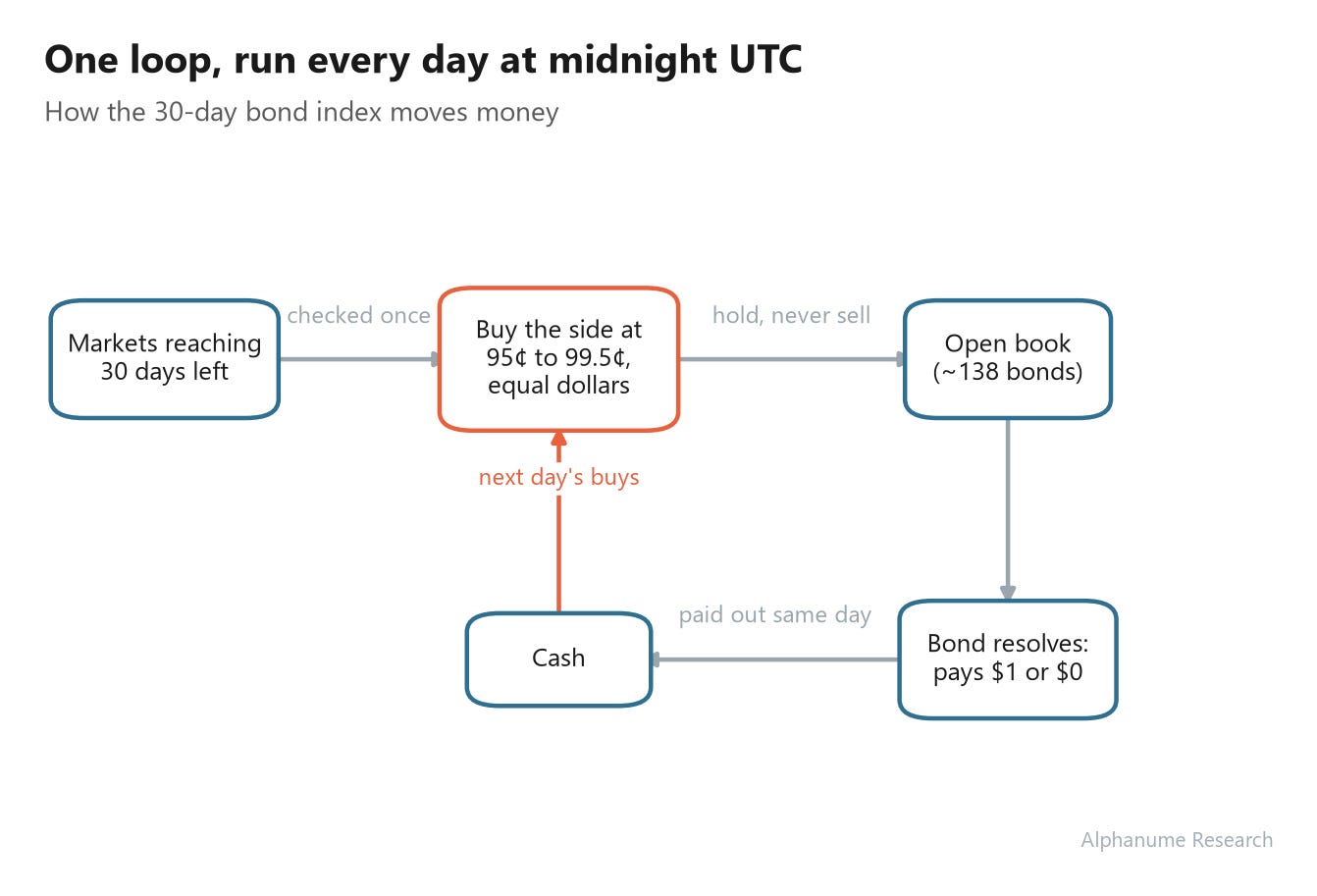
On date t, check each market once and pull all scheduled to resolve within 20-30 calendar days
Of those, buy the side trading between 95¢ and 99.5¢
Two-outcome markets only (clear yes/no)
The market also needs to have done at least $10k in volume
Mandate an equal-weight sizing, where each new bond gets the portfolio’s value divided by how many bonds qualified over the last 30 days
Hold to the end, with no early selling or stop-losses.
When a bond resolves, its payout lands in cash that day and goes back out into the next day’s new bonds
It can be beautifully visualized as one complete loop:
For costs, I measured what buyers actually paid above the mid price on a sample of 599 bonds and used that cost for every buy, scaled by the market’s lifetime volume:
0.40¢ on markets under $100k
0.25¢ on markets between $100k and $1M
0.10¢ on markets over $1M
Fees were zero on nearly every market in the sample, and since nothing ever gets sold, that entry order is the only trading cost.
So, Does It Actually Make Money?
Surprisingly, yes: