


In markets, one thing is simple. “Insider trading” results in a major accrual of no-no points which in the best case is undetected, and in the worst case means actually going to jail.
But what does insider trading even mean?
If you’re on the board and trade ahead of something you planned, then yeah, that’s insider trading, no argument.
But what if you simply did your homework for a minor informational edge and provided value to markets by trading at prices you deemed inaccurate?
If news hits the Bloomberg Terminal first, but 90% of participants don’t have that feed, is it still insider trading?
At the end of the day, none of this really matters unless you’ve got some market-moving information that would actually make you stop and think before acting.
But, what if you did?
Today, we’re going to show you first-hand what it looks like to aggressively hunt down informational edges and where that line of “insider trading” gets blurred. This won’t be pouring over some random SEC filing either, you’ll see what it looks like when a fund REALLY wants to get their hands on some edge.
So, without further ado, let’s get right into it.
The Low Hanging Fruit
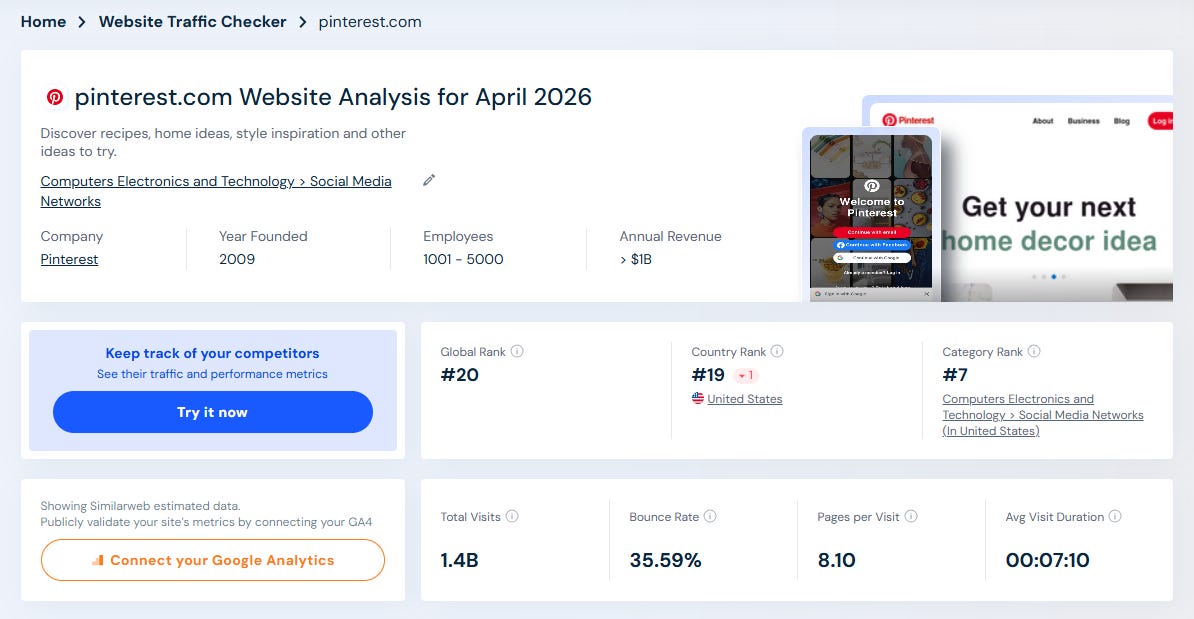
To start off with the obvious, if you knew that Pinterest received 3x the average website traffic over the last 3 weeks, it would at least to some degree reflect the idea that more people are using their services, and ultimately likely to result in a higher earnings figure for the quarter.
Now, if you own a website, you know that while you can see how many visits you got today, I can’t. This is also the case for most websites.
But what if you really wanted to know how many visits a website got?
To see how this gets done, let’s see how some of the largest aggregators in the space do it:
Acquire or build a portfolio of basic, but popular browser extensions.
Things like free VPNs, coupon finders, theme changers, ad-blockers. Whatever, as long as it’s installed by a large mass of active users.
Embed deep-tracking cookies in these extensions and bury them in the Terms of Service and Privacy Policies
When a user has the extension active, URL visits are logged, along with time on page, click paths, and referrer chains.
After all the user did “agree” to that use of data.
Send the data back to your database and aggregate the results.
Publish and sell the insights to hedge funds looking for edge.
Controversial, expensive, and morally grey, but technically legal and the potential edge is massive when done at scale. Consent laundering.
But before you get any ideas: this is also exactly what got Jumpshot, a subsidiary of the Avast antivirus software shut down after reporters leaked just how granular the resold clickstream actually was.
That aside, this is a pretty established practice with layers of sophistication, so at this point we consider this data source to be pretty much commoditized and unlikely to be abnormally predictive.
Further, web traffic data is only indicative of performance for a few hundred companies. Most of Dow Chemical’s customers aren’t filling industrial paint orders via the website.
Undeterred, the hunt continues. You know that the real kinds of information are still out there.
The Higher Hanging Fruit
With the view that commoditized web traffic data probably won’t get you there, you get another bright idea:
“What if you just asked people who would know?”
Now, naturally, this crosses the line into actual MNPI (material non-public information) that can land you in trouble. So, you reframe the question:
"What if you just asked research questions to people broadly related to some information?"
And from there, things get interesting.
Before we walk through what that actually looks like in practice, it's worth pausing on the legal frame that determines whether any of this is allowed in the first place:
Mosaic Theory
This is basically the idea that a research analyst can legally combine many individually non-material, public or non-confidential pieces of information to arrive at a conclusion that is itself material, and trade on that conclusion, without it constituting insider trading:
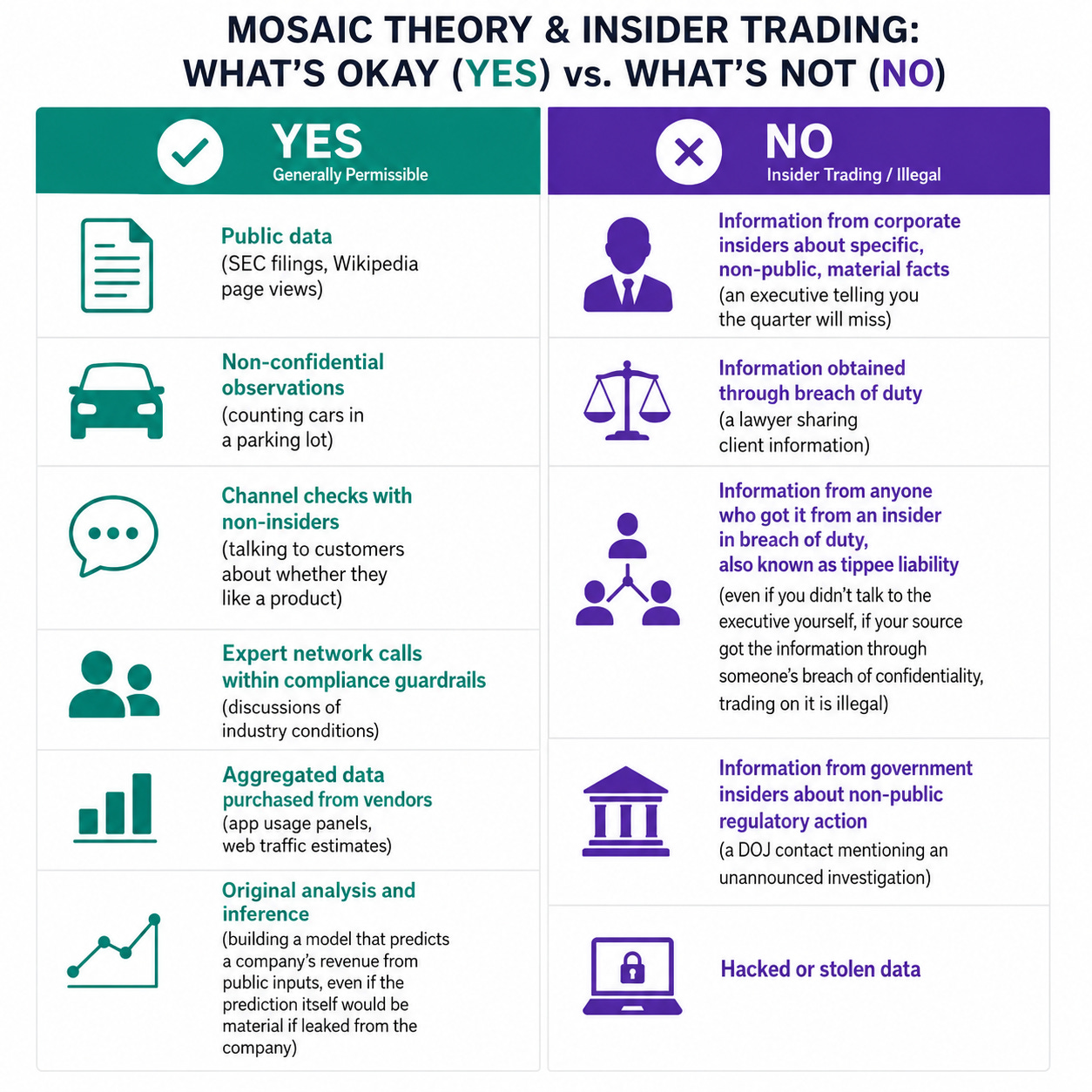
So, in sum:
Information you gathered, observed, or inferred is yours to use.
Information that someone breached a duty of confidence to put in your hands isn't, no matter how cleverly you stitch it together.
Now, you’ll see why we needed to make this disclaimer first.