“If the data is so good, why don’t you just trade it?”
Every trader has heard some version of this.
Someone finds out you use a dataset, a factor, a signal, anything that isn’t locked in a vault, and the response is immediate: “If it actually worked, why would anyone share it?”
It sounds like a gotcha. It’s delivered like one too, with the knowing smirk of someone who thinks they’ve just identified the oldest trick in finance.
The implication is that real edge is secret by definition. That anything you can buy, read about, or find in a paper must be already priced in. That the only way to make money in markets is to know something nobody else knows.
It’s a reasonable-sounding idea.
But it’s also wrong. And believing it will cost you more than any subscription ever could.
This post is about where that mental model came from, why it breaks down under scrutiny, and what a more accurate picture of edge actually looks like.
If you trade systematically, or want to, getting this right changes how you evaluate strategies, how you think about data, and how you allocate your time.
The Origin Story of “Alpha Decay”
Let’s start with where the paranoia comes from.
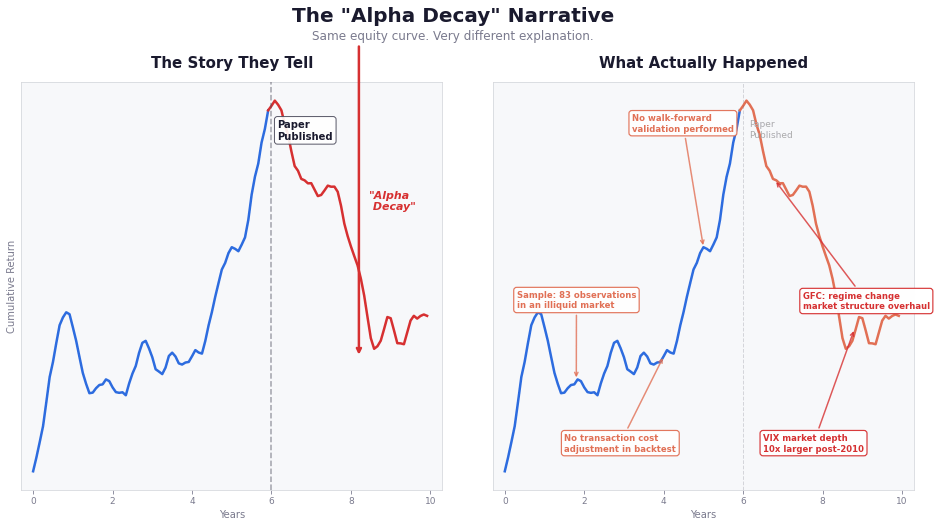
The idea that a trading strategy stops working once other people discover it has a specific origin. It came out of a cluster of academic papers from the mid-2000s documenting anomalies in then-niche markets — VIX futures term structure trades, certain merger arbitrage setups, microstructure effects in thinly traded ETFs.
Researchers found these patterns in historical data, published them, and within a few years the effects appeared to weaken or disappear.
The narrative that emerged was clean and satisfying: the strategy worked, it got published, too many people piled in, and the edge got “arbitraged away.” Alpha decay.
It became one of those concepts that sounds so intuitive that nobody questioned whether it was actually the right explanation.
But think about what was actually happening.
These were strategies backtested on small, illiquid markets with limited history. Many of them had fewer than a hundred observations. The researchers weren’t doing walk-forward validation or accounting for transaction costs in any realistic way.
The VIX futures market in 2005 looked nothing like it does today in terms of depth and participation.
The more likely explanation for most of these cases isn’t that the edge was real and then got competed away. It’s that the edge was never as robust as the backtest suggested. The strategy was fit to a specific market regime, and when that regime ended (as regimes always do) it stopped working. Publication timing was coincidental, not causal.
This matters because the “alpha decay” narrative got generalized far beyond its original context.
It became a universal law: all strategies decay when discovered.
But that law was derived from a very specific category of fragile, capacity-constrained, regime-dependent strategies. Applying it to everything is like watching ice cream melt and concluding that all matter is liquid at room temperature.
Markets Are Not Zero-Sum (And It’s Not Even Close)
The “why don’t you just trade it” question rests on an even deeper misconception: that markets are zero-sum, and that if someone else has your data, they’re necessarily taking money from you.
Let’s be precise about what zero-sum actually means.
In a zero-sum game, every dollar one participant gains is a dollar another participant loses. Poker is zero-sum (minus the rake). Betting on a coin flip is zero-sum.
For trading to be zero-sum, every profitable trade would need a corresponding unprofitable trade on the other side with the exact same magnitude.
Public equity markets don’t work this way.
Companies generate earnings. Those earnings flow to shareholders through dividends and buybacks. The aggregate market goes up over time because the underlying businesses create real economic value.
When you buy a stock at $50 and sell it at $70, the person who bought it from you at $70 might sell it at $90. You both made money. This isn’t a paradox, it’s the normal function of a market that prices in growing cash flows.
Even at the strategy level, the zero-sum framing breaks down.
If you’re running a momentum strategy and I’m also running a momentum strategy, we’re both buying the same winners. That buying pressure pushes prices further in the direction of the trend.
We’re not competing; we’re reinforcing each other.
The losers in this trade aren’t other momentum traders. They’re the investors on the other side of the behavioral biases that create momentum in the first place: the ones who anchor to old prices, sell winners too early, and hold losers too long.
This is true more broadly than people realize.
Passive indexing is the most well-known “strategy” on the planet. Trillions of dollars follow it. And it keeps working; not despite the fact that everyone knows about it, but partly because so many people do it.
The consistent buying pressure on index constituents creates structural flows that are predictable and exploitable. More participants doing the same rational thing can amplify an effect, not eliminate it.
The question isn’t “does someone else know about this?” The question is “does more participation change the mechanism that makes this work?” And for most strategies built on real economic rationale, the answer is no.
The Strategy Spectrum: Secrecy vs. Rationale
Not all strategies are the same.
The confusion comes from collapsing a wide spectrum into a single category and assuming the rules of one end apply everywhere.
Here’s a more useful framework. Think of strategies on a spectrum from secrecy-dependent to rationale-dependent.
Secrecy-dependent strategies live at one extreme.
These are strategies where being first, or being one of very few, is the entire edge.
High-frequency market making, latency arbitrage, certain types of statistical arbitrage on correlated instruments at the microsecond level. In these strategies, if someone else has your exact signal and faster infrastructure, you lose. The edge is access and speed, not insight. And yes, for these strategies, sharing your approach would be self-defeating.
But here’s the thing: this category is a tiny fraction of the trading landscape. It requires millions in infrastructure, co-location agreements, custom hardware. It’s not what 99% of systematic traders are doing or should be doing.
Rationale-dependent strategies sit at the other end.
These are strategies where the edge comes from a well-understood economic mechanism that doesn’t disappear just because other people are aware of it. The profitability is grounded in why something happens, not in being the only person who noticed.
Consider a few examples:
Momentum works because human beings are psychologically wired to underreact to new information and then overreact once a trend is established. Institutional investors have quarterly rebalancing cycles that create predictable flow patterns. These behavioral and structural forces don’t go away when a paper gets published about them. If anything, more momentum traders amplify the effect.
Post-dilution underperformance works because when a company issues new shares, it mechanically increases supply. If demand doesn’t increase proportionally (and it usually doesn’t as the dilution itself signals management’s view of valuation) the stock underperforms.
This is supply and demand.
Ten thousand people knowing about it doesn’t change the fact that a secondary offering adds shares to the float.
De-SPAC underperformance works because the SPAC structure creates a systematic misalignment between sponsor incentives (get any deal done before the deadline) and shareholder outcomes (acquire a good company at a fair price).
The result is a well-documented pattern of post-merger underperformance. More people shorting de-SPACs doesn’t fix the incentive structure that produces bad deals.
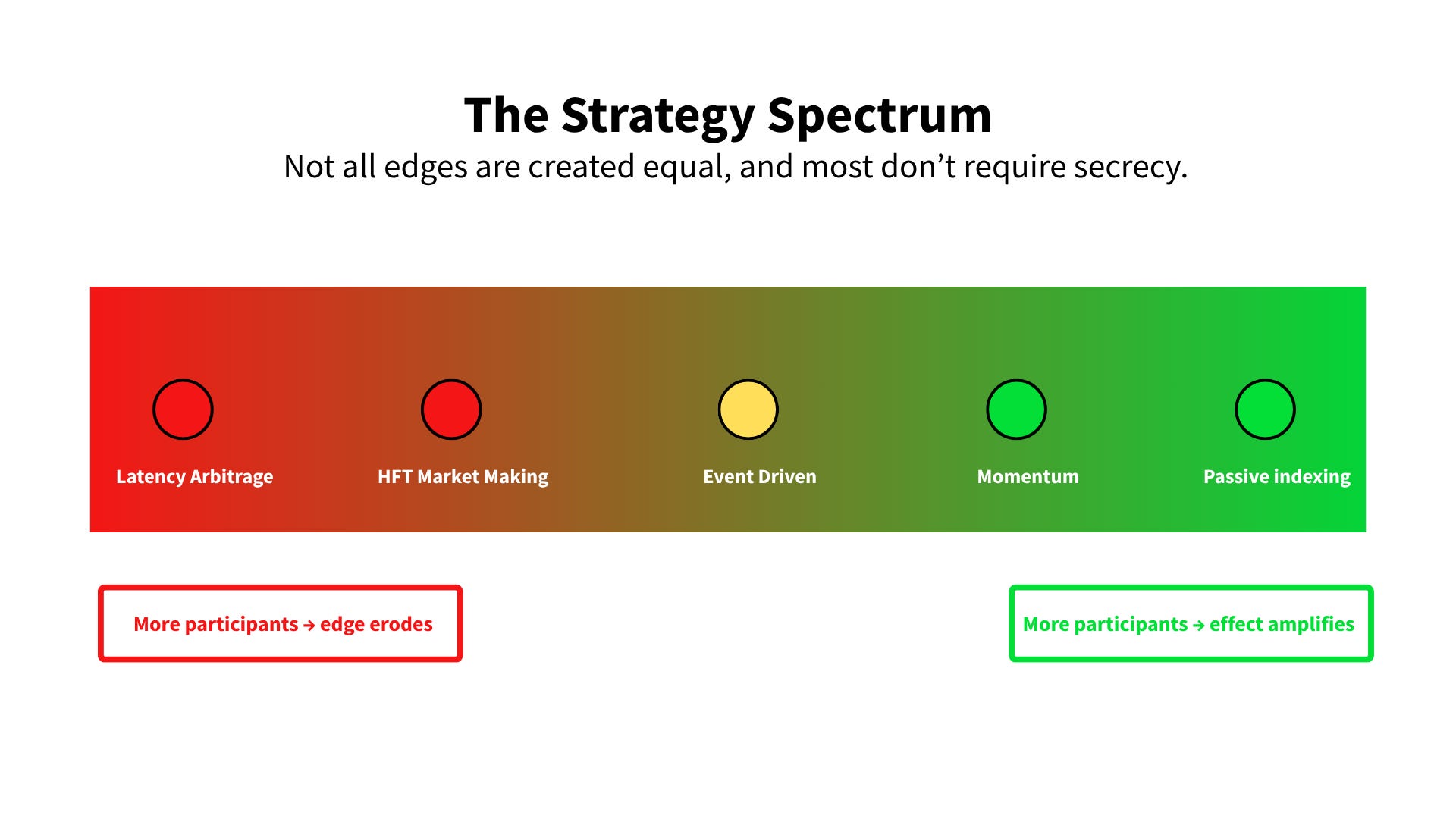
The critical insight is this: for rationale-dependent strategies, sharing the data doesn’t destroy the edge because the data isn’t the edge. The mechanism is the edge. The data just lets you systematize it.
Why “Well-Known” Strategies Keep Working
This is the part that seems to break people’s brains.
If momentum is so well-documented, if factor investing is the subject of a thousand papers, if everyone knows about the de-SPAC trade; why do these strategies keep generating returns?
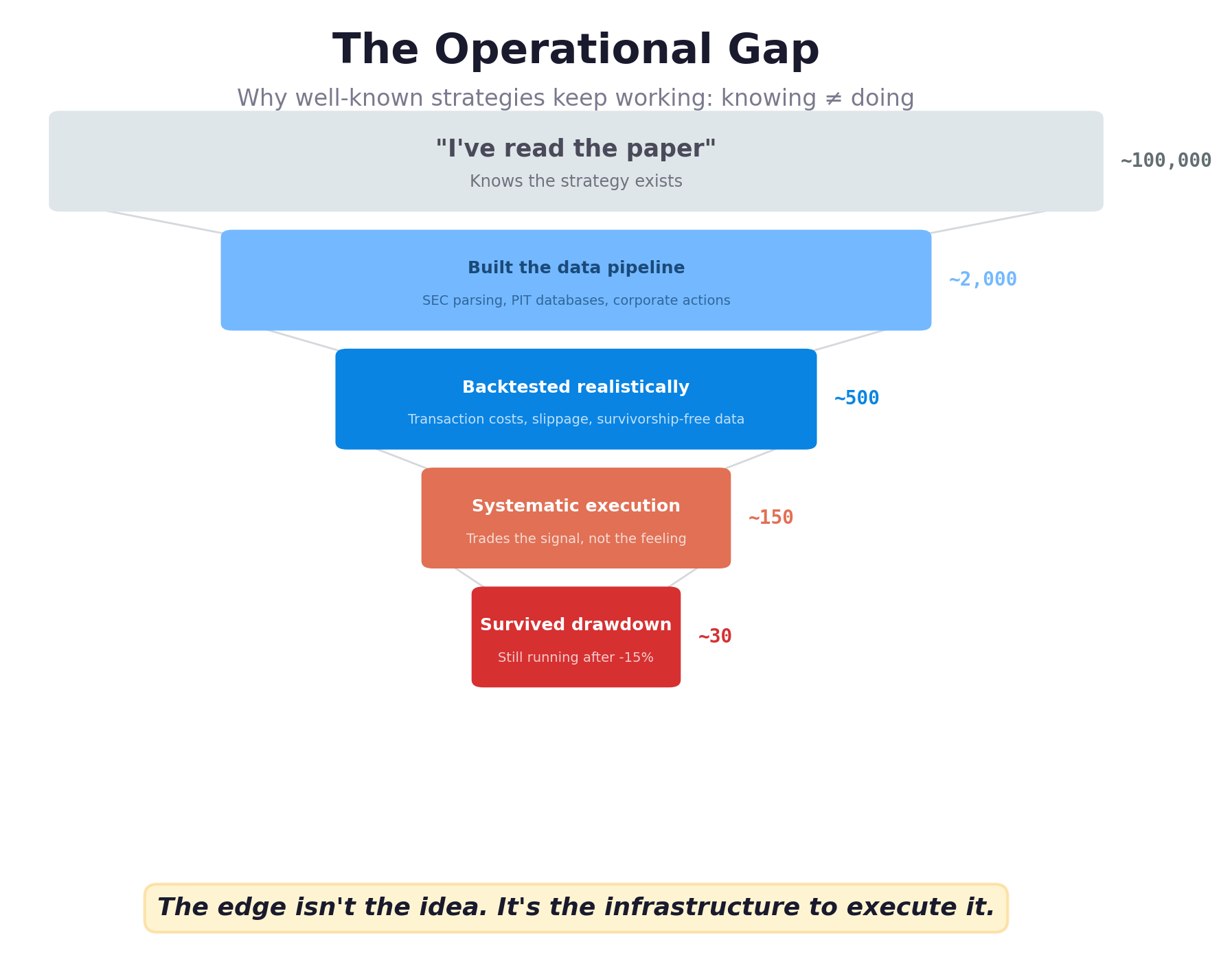
Because knowing about a trade and actually executing it systematically are two completely different things.
Think about it from the other direction.
Everyone knows that eating well and exercising produces better health outcomes. The information is free, universally available, and uncontested. And yet the fitness industry is enormous, and most people are not in great shape. Knowing the answer and consistently acting on it are separated by a vast operational gap.
In trading, this operational gap has specific components:
Data infrastructure. To run a dilution-based strategy, you need to systematically identify every dilutive filing across the entire universe of public companies, in real time, with clean and accurate data. That means parsing SEC filings, distinguishing between routine shelf registrations and actual offerings, normalizing across different filing formats, handling amendments and withdrawals, and maintaining a point-in-time database that doesn’t introduce look-ahead bias.
Most people who “know about” dilution trades have never built any of this.
Execution discipline. Systematic strategies require systematic execution. That means trading when the signal fires, not when it feels right. It means sizing positions according to your model, not your gut. It means taking the next trade after a drawdown instead of pausing to “see if the strategy still works.”
This is psychologically brutal for most people, and it’s why discretionary traders who intellectually understand factor premia still don’t capture them.
Maintenance and monitoring. Strategies need ongoing data pipelines, reconciliation, corporate action adjustments, and universe management. This is unglamorous, time-intensive work that has nothing to do with the original insight and everything to do with operational reliability.
It’s the data engineering equivalent of doing your taxes: necessary, tedious, and the thing most people procrastinate on until it causes a problem.
The “well-known” strategies keep working because the market doesn’t just need participants who know the right answer. It needs participants who can operationalize the right answer consistently, at scale, over time. And that pool is much smaller than the pool of people who’ve read the paper.
What This Means for You
If you’re reading this and you trade, here’s the practical takeaway.
Stop evaluating strategies based on how secret they are.
Start evaluating them based on how strong the economic rationale is.
Ask yourself: does the mechanism that generates returns change if more people participate?
If a stock drops after dilution because of supply mechanics, does that stop being true if more traders are watching for it? If De-SPACs underperform because of sponsor incentive misalignment, does that fix itself if more people know about it?
If the mechanism is durable, the strategy is durable.
The constraint isn’t knowledge, but execution. And the hardest part of execution, for most systematic traders, isn’t the strategy logic. It’s the data infrastructure that makes reliable, automated execution possible.
That’s the problem we solve.
Our datasets: dilution tracking, de-SPAC identification, corporate action event data; are built around strategies with strong, well-understood economic rationales.
We don’t sell secrets. We sell the infrastructure layer that lets you go from “I have a thesis about dilutive offerings” to “I have a live, systematic strategy that trades dilutive offerings” without spending six months building SEC filing parsers and point-in-time databases.
The data is good. That’s exactly why we don’t need to be the only ones trading it.
Alphanume provides institutional-grade, point-in-time datasets for systematic trading strategies built on durable economic rationale. Start with a free API key and see the data for yourself.