

If you’ve spent anytime on Fin-Twit in the last few weeks, you’ve likely heard about one of the major names in the volatility trading space who recently encountered some trouble:
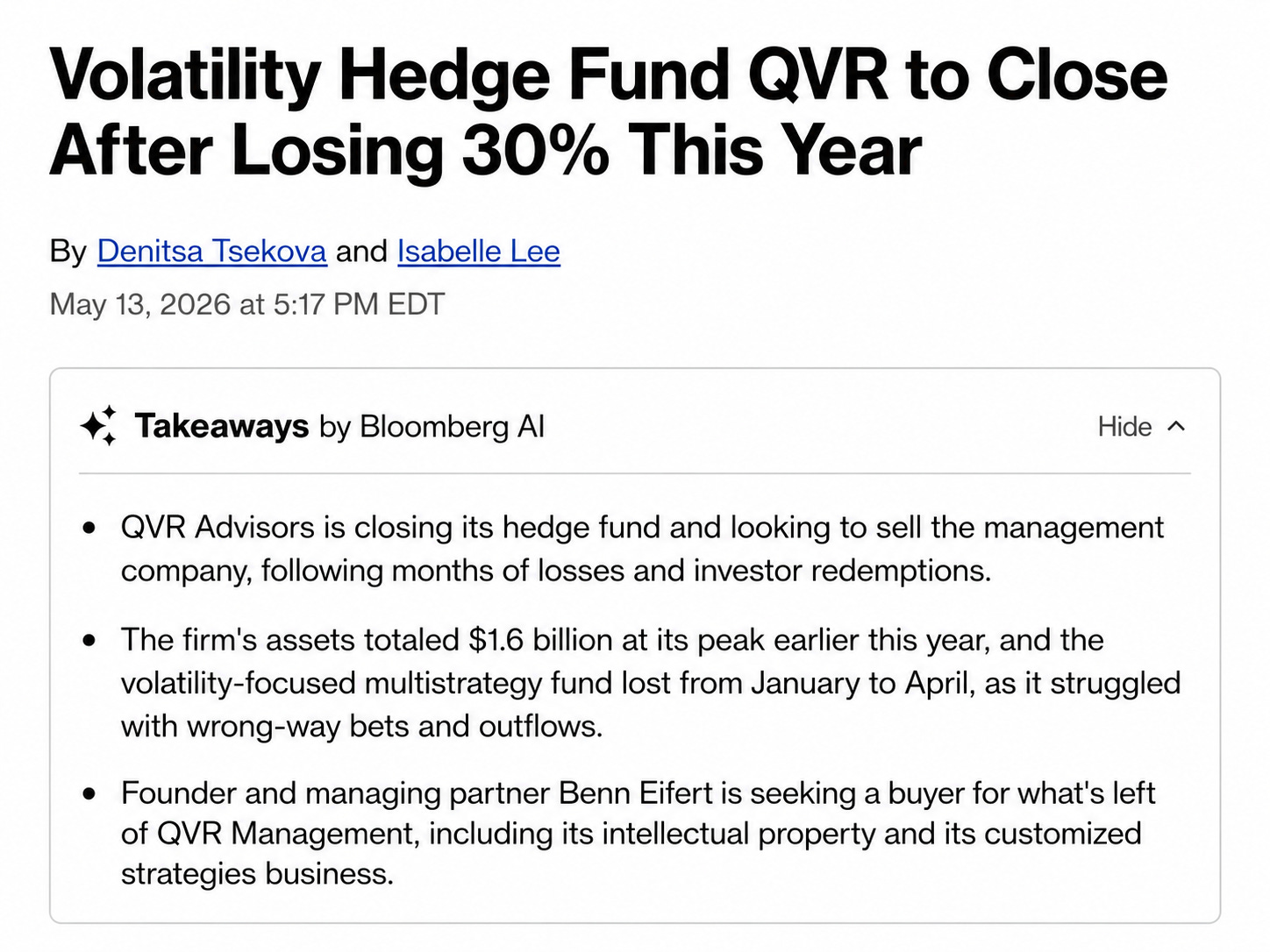
What makes this case notable beyond the existing popularity of the founder, is that multi-strategy funds aren’t supposed to do this.
The entire goal of a multi-strategy approach is to run multiple uncorrelated strategies to create a steady stream of returns in any given regime; long momentum here, short junk bonds there, long some vol over there, whatever.
When news of this first broke out, Eifert, the face of this, gave his full perspective on what happened:

It was shockingly honest and transparent, but for the large swaths of people not familiar with esoteric vol arb strategies, it did sound a bit jargon-y.
The entire story is actually pretty fascinating, so today, we want to peel back a few layers and walk you through what actually happened, in a way that you can intuitively grasp.
We’ll start with a high-level look at what volatility arbitrage even is, go into the strategies the desk ran, then show you exactly where things went wrong.
By the end of this you’ll not only learn more about a fascinating, but under-mentioned corner of quantitative trading, but you’ll also get a clear view on what exactly not to do, should you be in a similar position.
So, with that said, let’s get right into it.
WTH Is “vol arb” Anyway?
The birds-eye view of vol arb is essentially selling expensive derivatives and simultaneously buying cheap derivatives.
We know that sounds vague, so let’s walk through an example.
You spot two related instruments priced differently
Two stocks around $100, same industry, similar products, historically similar movement.
A one-month at-the-money option on Stock A implies 40% volatility; the same option on Stock B implies 28%. The market is forecasting far more turbulence for A than for B.
You check whether the gap is justified
A difference like that usually exists for a reason: earnings, a lawsuit, a pending FDA decision, a takeover rumor. If a real catalyst explains it, there is no trade. If you check and find nothing, then the gap might be a genuine dislocation.
You sell the expensive option and buy the cheap one
Short the Stock A option, collecting the rich 40% premium. Long the Stock B option, paying the cheaper 28%. You are now short expensive volatility and long cheap volatility, betting only that the 12-point gap converges.
You hedge out the directional exposure
Selling options leaves you with unwanted exposure to which way the stock goes. You buy or short shares of each name until the position has no directional tilt (delta-neutrality) and re-hedge as prices move. What remains is a clean bet on volatility itself.
You collect the spread as the gap closes
With no catalyst to justify the spread, Stock A drifts like a normal stock and its realized volatility comes in well below the 40% you sold. Stock B does roughly what its 28% implied, so the option you bought costs you little.
The expensive side was overpriced and you were short it; the cheap side was fair and you were long it. The spread converges, and the convergence is the profit.
Of course, this was a simplified example, but it’s the core basis of what’s generally referred to as volatility arbitrage.
Eifert’s account is unusually detailed as it names the exact trades they took.
So with that covered, the exact strategies they were running will be a lot easier to understand.
What On Earth Were They Actually Doing?
Term Structure Trades
“long cheap gamma at the front of the curve, short expensive volatility in the belly of the curve, and long again at the back.”
Protection has a term structure, like bonds. Plot implied vol against time-to-expiry and you get a curve: cheap and jumpy at the front, richer and more stable at the back.
QVR was short “the belly”: the two-to-four-month region where structured-product hedging oversupplies volatility, and long the cheaper wings further back.
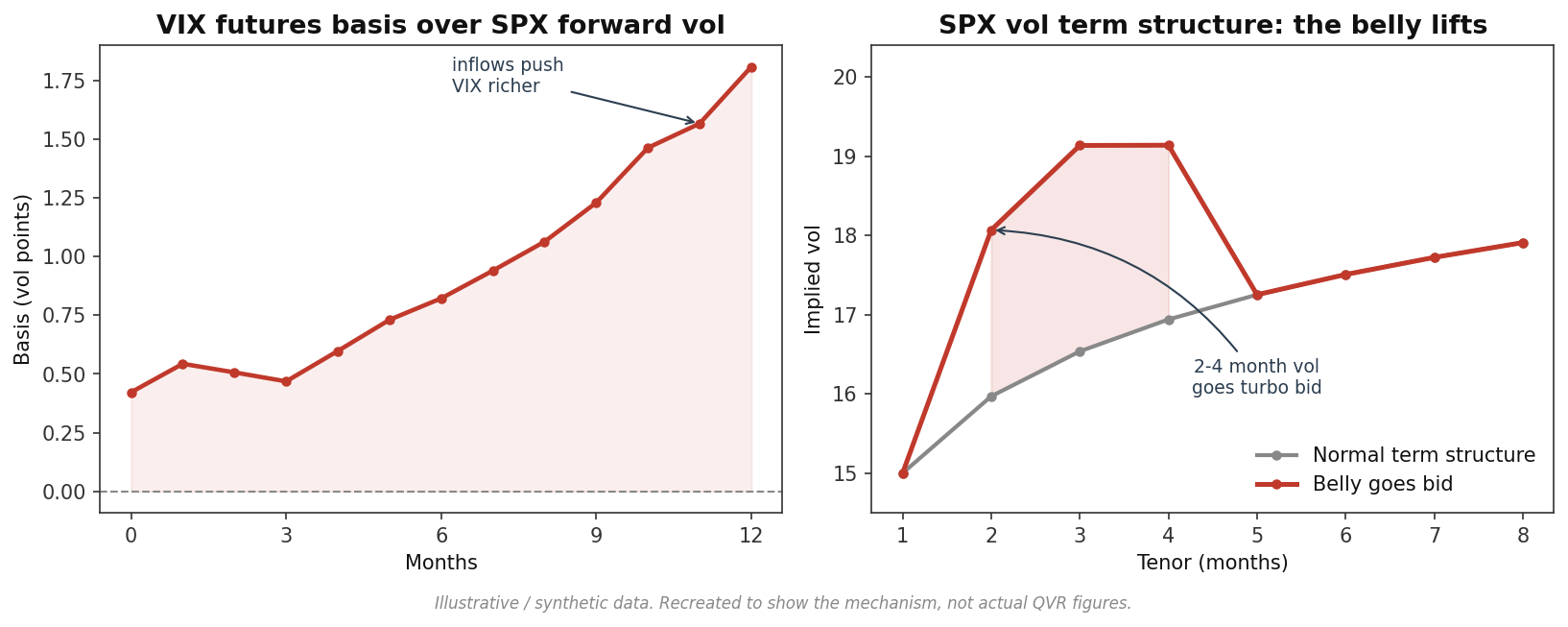
Being short the belly pays two ways: the rich vol you sold decays, or the market moves and your long front-month gamma fires.
So you’re covered in a quiet market or a volatile market, in theory.
What became a problem was that the belly they were short went, in Eifert’s words, “turbo-bid”, and spiked away from the rest of the curve, driven by inflows into VIX-linked products.
The front-month gamma leg (the hedge) only pays off on movement, so with realized volatility on the floor it sat there doing nothing. The core leg lost, the other was inert, and the hedged trade was just a loss.
Skew
“long the massively over-supplied long-term downside on the back of autocall issuance... short medium-term downside against it, and long short-dated crash puts.”
Skew is the price difference across strikes: downside puts trade richer than upside calls because everyone wants crash protection.
QVR’s skew book had three legs across maturity: long long-dated downside, short medium-term downside, long short-dated crash puts. Long the wings, short the middle. The same shape as the term structure trade, just in a different product.
The leg that needs explaining is the long-dated one, because of why that downside was cheap: autocalls.
An autocall is a structured product banks sell to yield-hungry investors; you get a fat coupon, say 10%, as long as an index holds a level: above SPX 7000 by Dec 2027 and the deal pays out.
Below it, the deal rolls another year and tries again. Fall through a deeper barrier, though, say -30%, and you eat the full loss like you owned the index outright. The investor is selling crash protection for yield, which leaves the bank holding a mountain of long-dated downside it has to hedge.
That hedging floods cheap long-dated downside into the options market, which is exactly the leg QVR was buying.
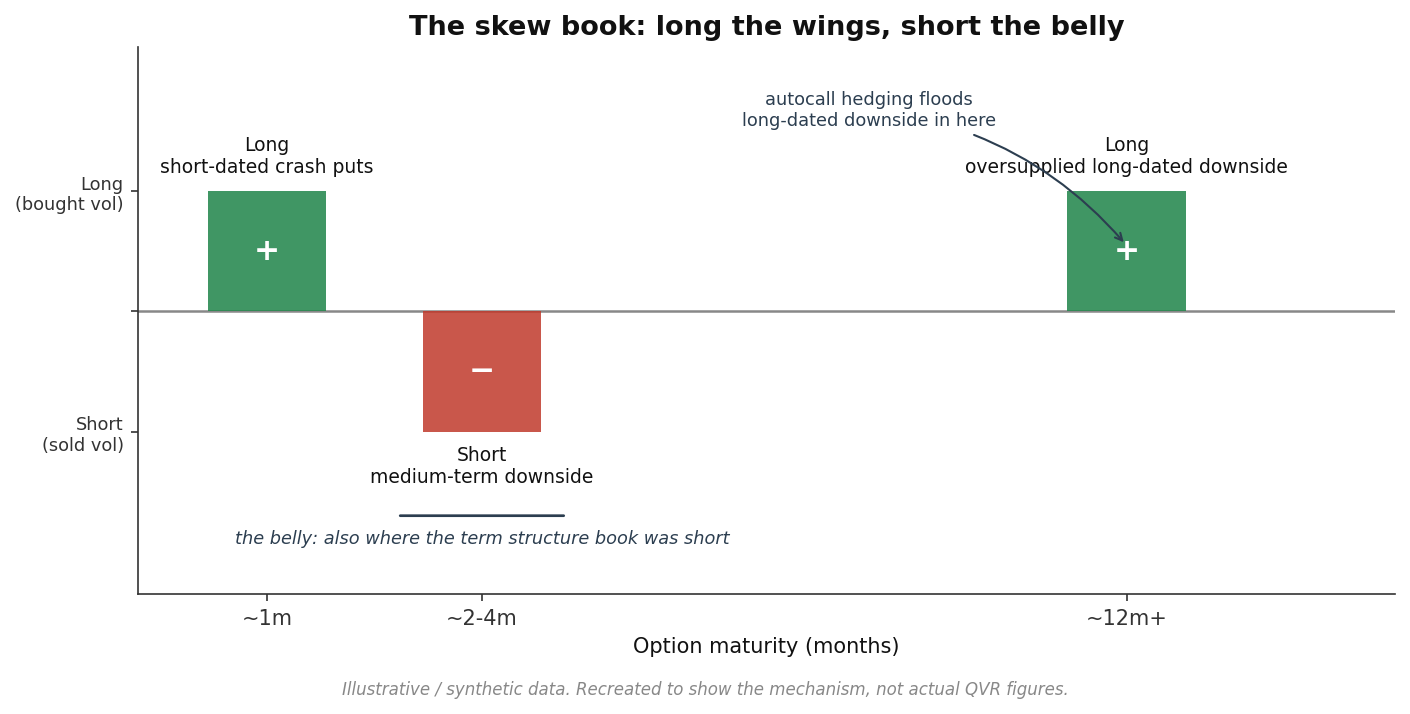
These were different parts of the surface, in different products entirely, but both were short medium-term volatility, and both leaned on autocall-hedging flow staying calm.
When medium-term vol went bid, it hurt both the term structure book and the skew book.
Short Vol, Short Delta
“short volatility (via put spreads on VIX) versus short delta (via ES futures).”
Short vega is short volatility; short delta is short the market. The pairing is historically beautiful: when the market sells off, vol spikes, so one leg pays while the other takes the hit. The hedge depends entirely on vol and direction staying linked.
Then, the Iran-Israel conflict escalated:
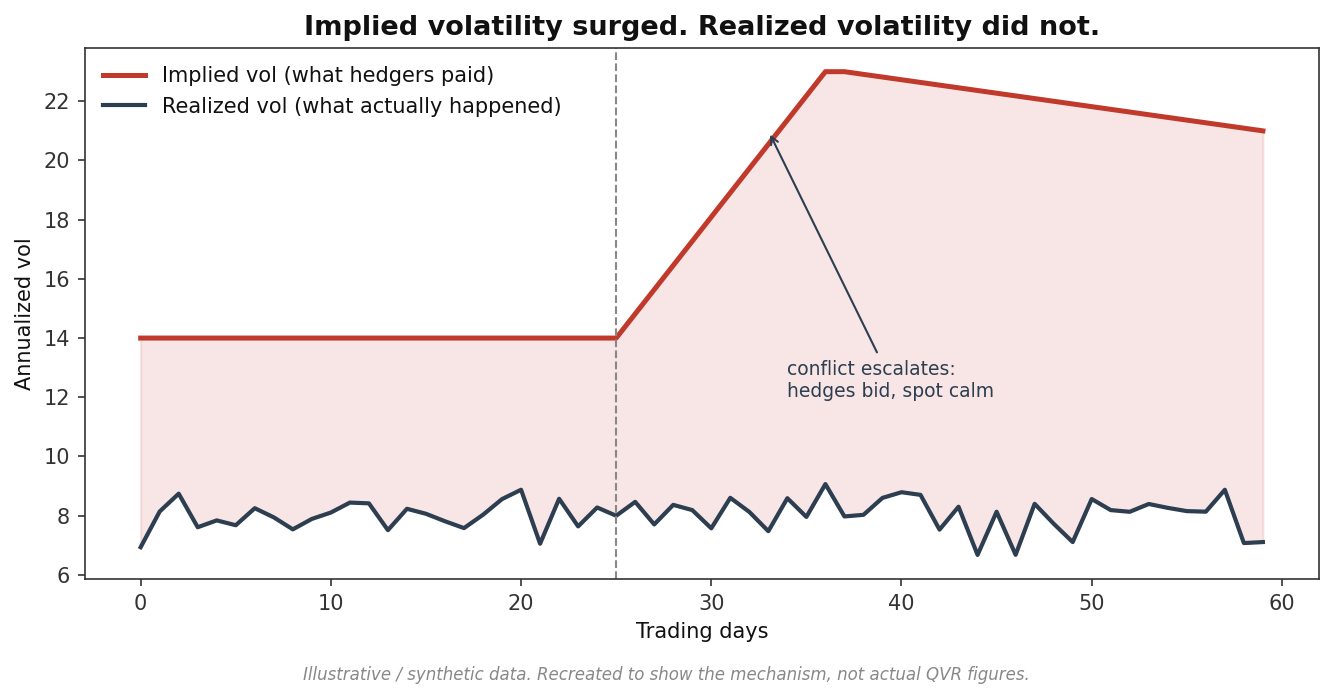
Implied vol surged as hedges got bid. But the market didn’t sell off, not really.
Investors panic-bought protection while holding their equities, so volatility rose without the market falling.
Short vega lost on the rising implied vol and short delta lost on a market that drifted up.
Reverse Dispersion
“We started building a reverse dispersion position at all time high spread levels around 17.5 (3-month tenor). That spread went as high as 22.”
Dispersion is a trade around correlation. Index volatility depends on how much single stocks move and how much they move together.
The vol spread, single-name vol over index vol, is wide when correlation is low. QVR shorted that spread at a record-high 17.5, betting correlation would rise and the spread would compress.
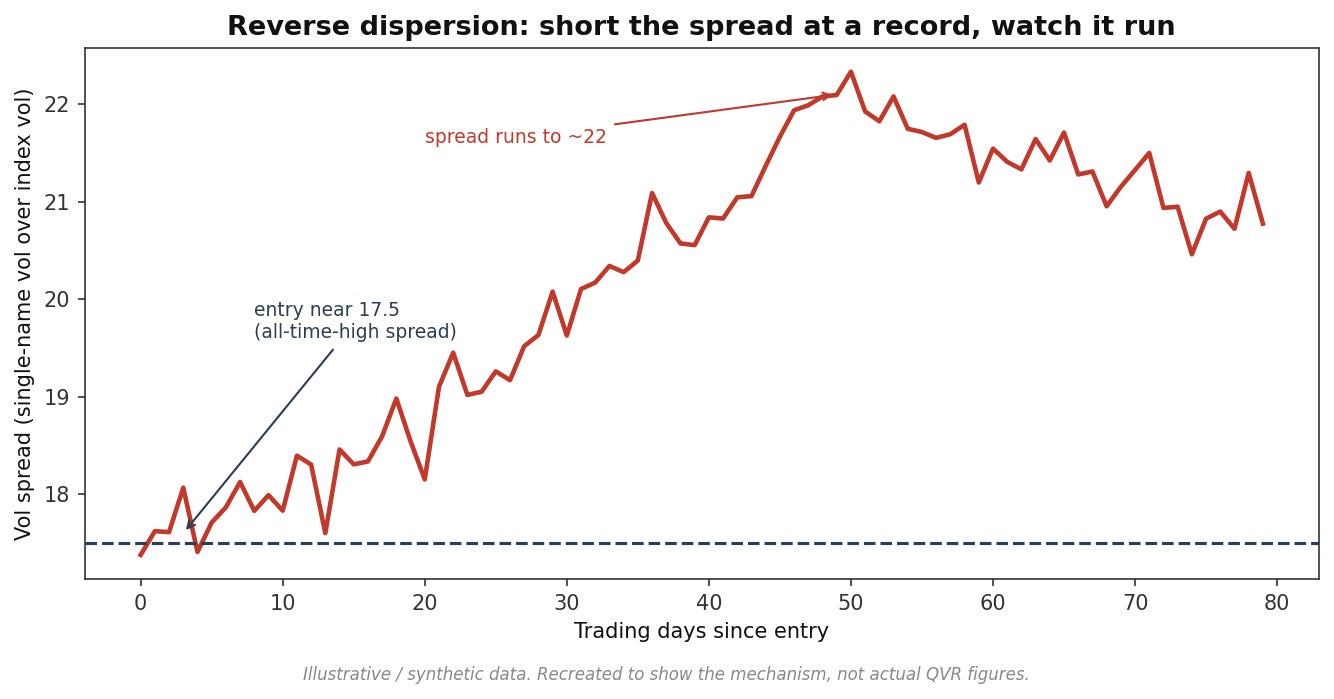
It ran to 22 and a new record became a deeper record.
The painful part is what the loss meant:
A short-spread position is a long-correlation bet, and rising correlation normally travels with cheap index volatility, which would have made the term structure and skew books print.
Reverse dispersion was supposed to be the diversifier that paid when the others struggled, but instead it lost alongside them.
So, What Actually Went Wrong?
Now, these strategies are clearly very sophisticated, and most of the time, they work well enough to keep these shops in business. Each has a hedge on top of another hedge, where that hedge acts as a hedge against something else.
So, with all this hedging, one can naturally ask how a -28% loss just happens.
Well, it wasn’t a single bad trade gone wrong, but rather the same trade going wrong, sizing up, having it go wrong again, sizing up even more, having it go wrong again, and eventually having investors run out of patience.
Every position QVR held was a convergence bet: some spread had stretched away from its normal level, and QVR was positioned for it to snap back.
That phrase, snap back, is where the trouble started: the assumption that dislocations have to snap back eventually.
When a convergence trade loses money, it often looks like an opportunity for a better entry. A spread at 17.5 was attractive; the same spread at 22 is, on the same logic, even more attractive. So when there’s a losing month, you don’t cut, you just add more.
The bet got bigger as it lost, then it lost again, so the bet got bigger again.
No single month was a disaster, the fund just went down 7-9%, four times in a row.
Just a string of increasingly large bets that spreads would tighten, made into a market where spreads kept widening instead.
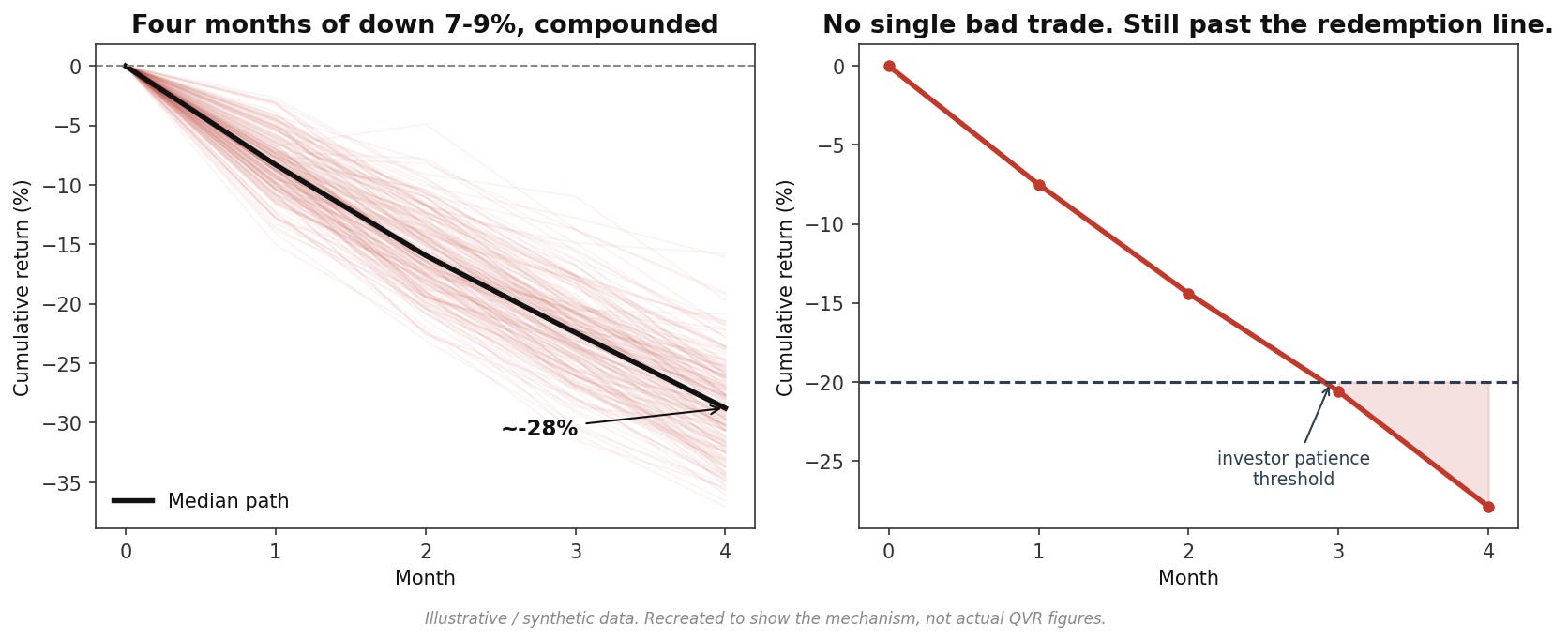
It’s entirely possible, even likely, that QVR’s positions will eventually be vindicated, but similar to a martingale strategy, no one has the privilege of infinite time or infinite capital.
So, What’s The Big Picture?
It’s tempting to file this under a risk management failure and move on; Eifert uses the phrase himself. But he is also careful to say it was “a much more nuanced one than just having a stupidly risky trade on and blowing up”.
He saw the correlation across his strategies shifting, attributed it to the right causes, and chose to “hold and increase positions,” waiting for “the reversion that would take us from down 15-20% on the year to up 20%.” He just needed the fund to survive long enough to flip it, and “four months of down 7-9% in a row” is, in his own words, “too much for investors to reasonably handle.”
The trades may yet be right and the spreads may still converge; it just won’t be QVR’s flagship collecting the payoff, as the redemptions came first and “the economics of a small/medium sized hedge fund business” stopped working.
So, if there was only one thing to take away from this, we can sum it up to:
Being right about the destination does not help if you get liquidated before it arrives.
or, put colloquially,
“The market can stay irrational longer than you can stay solvent.”
Interestingly, QVR is not the only desk exposed to this same risk. The same structured-product machine that distorted QVR’s belly is feeding the same suppressed-volatility, short-premium picture into a great many portfolios at once: autocall and QIS issuance, bank dispersion swaps sold to institutions with, as Eifert puts it, “very limited knowledge of the strategy themselves”, covered call ETFs, and so on.
A large share of the volatility world is holding some costume of the same trade, just on different desks, in different tenors, and through different marketing language.
So, if you came here to see how these more opaque corners of the market actually work, hopefully the term structure, the skew book, dispersion, and the rest feel a little less like black boxes now.
As always, thank you for reading, and we’ll see you in the next one.
this makes no sense "QVR was short “the belly”: the two-to-four-month region where structured-product hedging oversupplies volatility, and long the cheaper wings further back."