

In April, a company that burns billions of dollars in cash borrowed $3.5 billion for six years at 1.75%.
CoreWeave, the AI infrastructure name whose entire business model is buying GPUs faster than the revenue comes in, went out for $3.0 billion of convertible notes. Demand was strong enough that the deal got upsized to $3.5 billion and settled within days.
That’s a coupon the US Treasury itself couldn’t beat.
So, something about this picture is clearly off:
“Who hands a cash-burning AI credit billions of dollars at 1.75%, and why were they fighting each other for allocation?”
The short answer is that nobody in that order book was lending.
The buyers were, overwhelmingly, hedge funds running one of the oldest trades in the business: convertible bond arbitrage. And within hours of the deal pricing, most of them had shorted CoreWeave stock against their allocation.
This might seem a bit strange at first, so today, we’re going to walk through the whole machine using the real CoreWeave deal: what the instrument actually is, how the trade gets put on in dollars, what three months of CRWV chaos did for the people running it, and why the issuer is thrilled to play along.
Nobody Here Is Lending
At root, a convertible bond is two instruments stapled together:
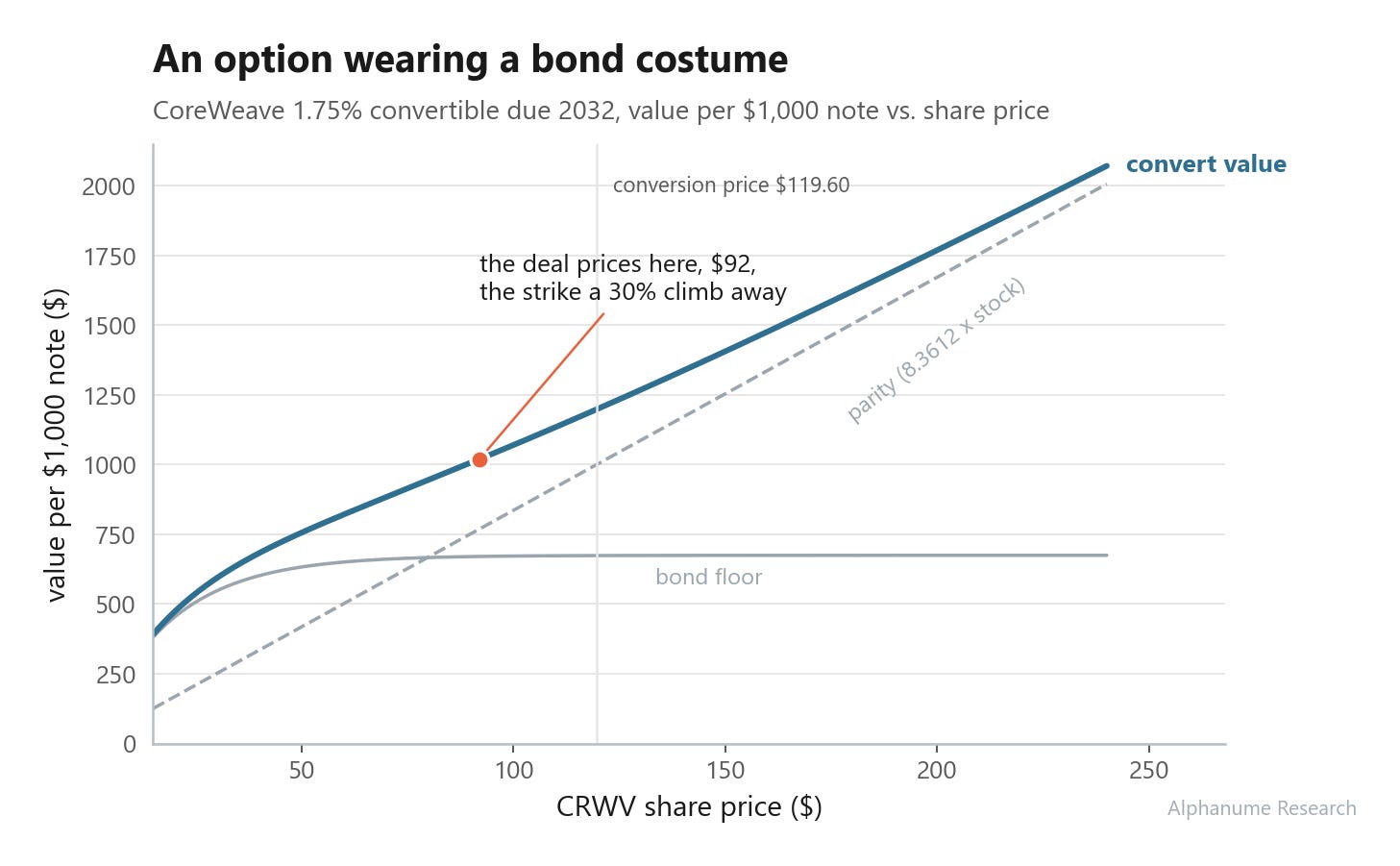
convert ≈ straight bond + embedded call option
For the CoreWeave deal, each $1,000 note converts into 8.3612 shares, which pencils out to a conversion price of about $119.60, a 30% premium over the $92.00 close on the day the deal priced.
Now, priced as straight debt, a 1.75% coupon on this credit is nonsense. A plain six-year bond from a cash-burning AI name would need a coupon several times higher to clear the market.
The spread between that hypothetical coupon and 1.75% is the price of the call option. The buyer accepts a below-market coupon and gets paid in optionality instead (chart below).
There’s a sweetener, too: new converts typically come a few points cheap to theoretical value, because the only way to move billions of dollars of paper in a single evening is to price it at a discount. The arb funds are buying vol below fair.
This explains the last piece of the pattern, the one that confuses equity holders every single time: the stock usually drops the morning a convert is announced.
Every fund that expects an allocation is shorting its delta at the same moment. That drop is the hedge going on, live and in public.
The Trade, In Dollars
Say you took down $1 million face of the CoreWeave 1.75s of 2032 at issue. The position looks like this:
Buy $1 million face of the notes at par.
Count your shares. At 8.3612 per $1,000, the position controls 8,361 shares of CRWV if converted.
Short the delta. The model calls the embedded option something like a 55 delta at pricing, so you short roughly 4,600 shares at $92, about $425K of stock against your $1 million of bonds.
Collect the carry. The 1.75% coupon, plus a positive rebate on the short-stock proceeds. During the zero-rate decade this second leg paid nothing; now the short leg itself is a source of yield.
Rebalance as the stock moves and the delta moves with it.
At this point you own the convert, you’re flat the stock, and you’re clipping carry from two directions.
And step 5, the boring-sounding one, is where the actual money is.
The Swings Are the Salary
A delta-hedged convert is a long gamma position, and long gamma has a very specific personality: