


Imagine you’re holding a $50M nano-cap that just ripped 80% on a press release about some new “AI pivot.”
The volume is insane. Fin-Twit is calling for a 5-bagger. You’re up big and feeling like a genius.
Two trading days later, a filing for new shares hits the wire.
The company is selling 7 million new shares into exactly the strength you just bought. By the close, you’ve given back the entire move and then some.
You got diluted.
If you’ve spent any time trading small-caps, you’ve likely lived some version of this. When it happens, most attribute it to bad luck, a rug pull, or a thing that just happens.
What they don’t see is that the whole sequence is one of the most repeatable, predictable, and mechanically extractable edges in the entire market.
So today, we’re going to take it apart from first principles: how dilution actually works, why price always moves the same way after it, and then we’ll walk through a real-world trade example from catalyst to close using the same dilution data we run at Alphanume.
With that covered, let’s get right into it.
They Sold A Little Stock, What’s The Big Deal?
The first stock market officially opened in 1602 and since then companies have devised countless ways of raising more capital to fund and grow their operations. Whether it’s tapping the bond market, issuing commercial paper, taking on a line of credit, whatever.
However, when all of those more respectable avenues of capital are closed, there exists a worst-case, emergency option: Dilution.
In sum, share dilution is basically just creating new shares that didn’t exist before, then selling them on the open market.
This is the absolute last-ditch option for a few reasons:
It tells the market you’re out of options.
Bonds, credit lines, commercial paper, those all require someone on the other side to look at your books and decide you’re good for it. When a company skips all of that and just prints shares to sell, it sends the message that nobody else would give them the money on reasonable terms.
It punishes the people who already believed in you.
Every new share that didn’t exist before makes every existing share worth a little less. Same company, same business, but more slices of the pie. Shareholders who bought in early get quietly watered down to fund a raise they had no say in.
It signals management thinks the stock is expensive, not cheap.
A company buys back its own shares when it thinks they’re undervalued. Selling new shares is the exact opposite trade. When insiders choose to issue stock instead of repurchase it, they’re effectively telling you the current price is a good price to sell at, and they should know better than anyone.
There’s no obligation to do anything good with the cash.
Debt comes with covenants, schedules, and people watching how the money gets spent. Dilution proceeds come with none of that. The company can burn it keeping the lights on for another two quarters and owes no explanation, which is usually exactly what’s happening.
As we’ve covered in our A Junior Quant’s Guide to Event-Driven Trading, this structure is the lifeblood and oxygen for a systematic event-driven trading approach:
known event on a specific date → clear implication on forward performance → execute trade
That arrow diagram is abstract, so here’s what it looks like on a real name. We’ll go deeper into the data later, but to start:
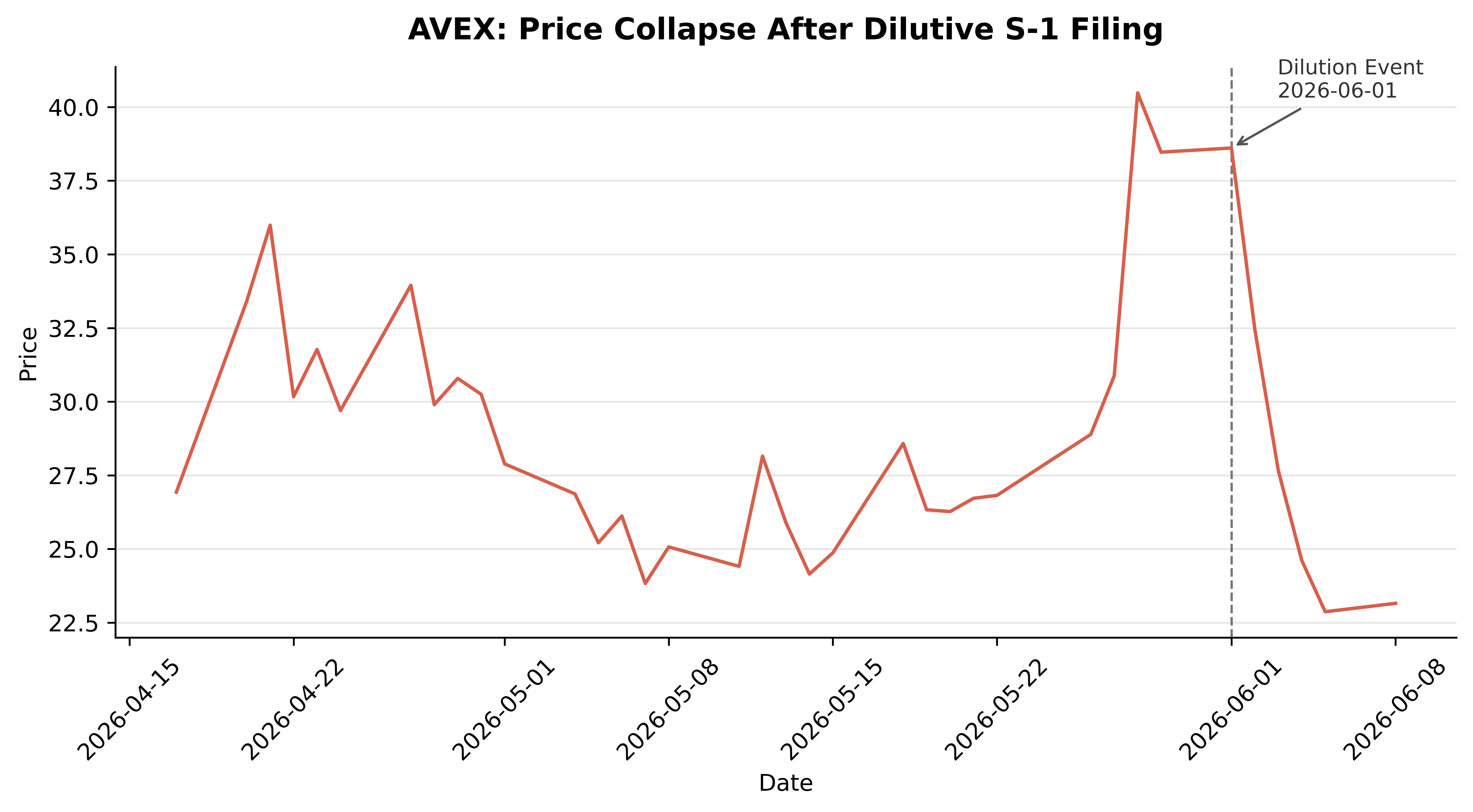
On June 1st, 2026, AEVEX Corp. (AVEX), an $8b drone maker submitted an S-1 filing indicating that they’d be issuing 5 million new shares after a 50% rally in the prior week.
Not even one week later, 40% of the company’s value was erased:
Now, one textbook example doesn’t make a strategy. So before we go shorting every S-1 that crosses the wire, there’s a wrinkle in how these filings actually work.
The Nuance
To trade this properly, you first have to understand how those new shares actually travel from a niche filing to the tradeable open market.
First, it starts with the registration.
When a company wants to sell new shares to the public, it can’t simply dump them on the tape. It first has to register them with the SEC, and that registration is the document you’re watching for:
Bigger names with a long reporting history use an S-3, a reusable shelf they sell from over time; the small and micro-cap names often don't qualify, so they file an S-1 instead. Either way, the filing is the company raising its hand and saying, on the record, that more supply is coming.
The moment a dilution filing hits the wire, sophisticated participants know the float is about to expand, and they start selling ahead of it. You’ll often see the initial leg down within minutes of the document posting, well before a single new share has actually changed hands.
However, and it’s the part you have to know:
Not every S-1 is dilutive.
At root, an S-1 is just a registration form.
Plenty of them are completely benign: registering shares for an employee plan, allowing an early investor to resell an existing stake, or covering a routine shelf that may never get used. None of that creates new supply hitting the open market.
If you short every S-1 that crosses the wire on reflex, you’ll get run over by the ones that were never going to dilute anyone. So the filing has to actually be read.
You’re looking for the specifics:
Are these newly issued shares or existing ones being resold?
Is the company itself the seller?
How many shares relative to the existing float?
A company with a billion shares outstanding registering 50,000 of them is inconsequential, but a nano-cap registering 3 million new shares against a tiny existing float is a trade.
Next, once you’ve confirmed it’s genuinely dilutive, there’s a second clock running: the effective date.
A registration alone doesn’t let the company sell anything the instant it’s filed. The SEC has to declare it effective first, and only then can the shares legally be sold into the market.
You can think of the two filings as:
“We’re going to do something hugely -EV soon, maybe, probably.” (S-1)
“You know that bad thing we mentioned? It’s official now.” (EFFECT notice)
So with dilution, you’re effectively trading a sequence with two distinct punishment points.
The Part Where We Make Money
Alright, now that you have the base foundations, we can finally get into actually putting on a trade.