


Every day, dozens of public companies issue dividend payments. Some large, most small, but every day, a check goes out to someone.
Upon knowing this, every market participant gets a bright idea:
“What if I just collected dividend payments and sold the stock right after?”
Not long after, they find out that the price tends to drop by the dividend amount on the ex-dividend date, making the returns net 0. At that point, the search gets shelved, a lesson gets learned, and the trader moves on.
Nevertheless, it does pose an interesting question.
Yes, a dividend is basically just a withdrawal of cash from the company, creating no new economic value. But it is still a tangible market event where you can know the cashflow being distributed to millions of shareholders with pin-point precision.
So, if you have all of this information of who’s getting what and exactly when, you might ask:
“Is there really no way to derive a profitable extraction of this?”
As it turns out, there actually is.
We’re the first to publicly document this approach, so if you’re interested in running these kinds of niche, but profitable strategies, you’re going to want to see this.
Just Forget About The Ex-Date
Okay, so let’s start with what we know.
When a company is paying a dividend, it has an ex-dividend date which is the cutoff point for when you have to own the shares by. For instance, if the ex-dividend date is April 17th, you have to be an owner of the stock on April 16th or sooner.
On the ex-date, the dividend is immediately priced in:
The exchange marks down existing limit orders
The options market prices puts higher and calls lower
It does this as soon as the dividend is known, as the dividend yield is a direct plug-in to the Black-Scholes model.
Additionally, if you have an open short position before the ex-dividend date, you are entitled to make that payment from your own position.
So, right off the bat, trying to game the actual payment mechanism is a dead-end.

However, after that initial mechanism, the resulting movements in the stock go back to normal; driven by information, new catalysts, and most importantly, investor behavior.
Every single dividend payment and schedule is public, so if we know all of them, we can create a new hypothesis:
“Do certain types of dividends lead to predictable behavior of market participants?”
Tax structure effects
Do investors react differently to MLP distributions (taxed as tax-deferred cost of capital) versus REIT dividends (taxed as ordinary income)?
Special, one-off dividends
If a company has never paid a dividend but issues a large one-off after a settlement, do investors behave differently than they would with a monthly-paying dividend ETF?
DRIP re-investment timing
There’s a large community of investors in products like SCHD whose strategy is to automatically re-invest dividends as they come in. How long does that re-investment actually take to hit the tape?
Each of these is a fully-formed research question on its own, and we’ll likely come back to the others in future posts. But for today, we’re going to narrow down to the one we think has the cleanest behavioral thesis to test: how investors react to the payment itself, and whether the one-off nature of a dividend changes that reaction.
Despite getting a check, many investors can perceive dividend payments as a net negative event. It can be read as the company having cash and no ideas on how to boost growth, so they just pass it through to shareholders.
This might be especially true for one-off dividends; if the stock hasn’t done anything for years, but investors finally receive some outcome, they may conclude that the position is “complete” and sell it to allocate elsewhere.
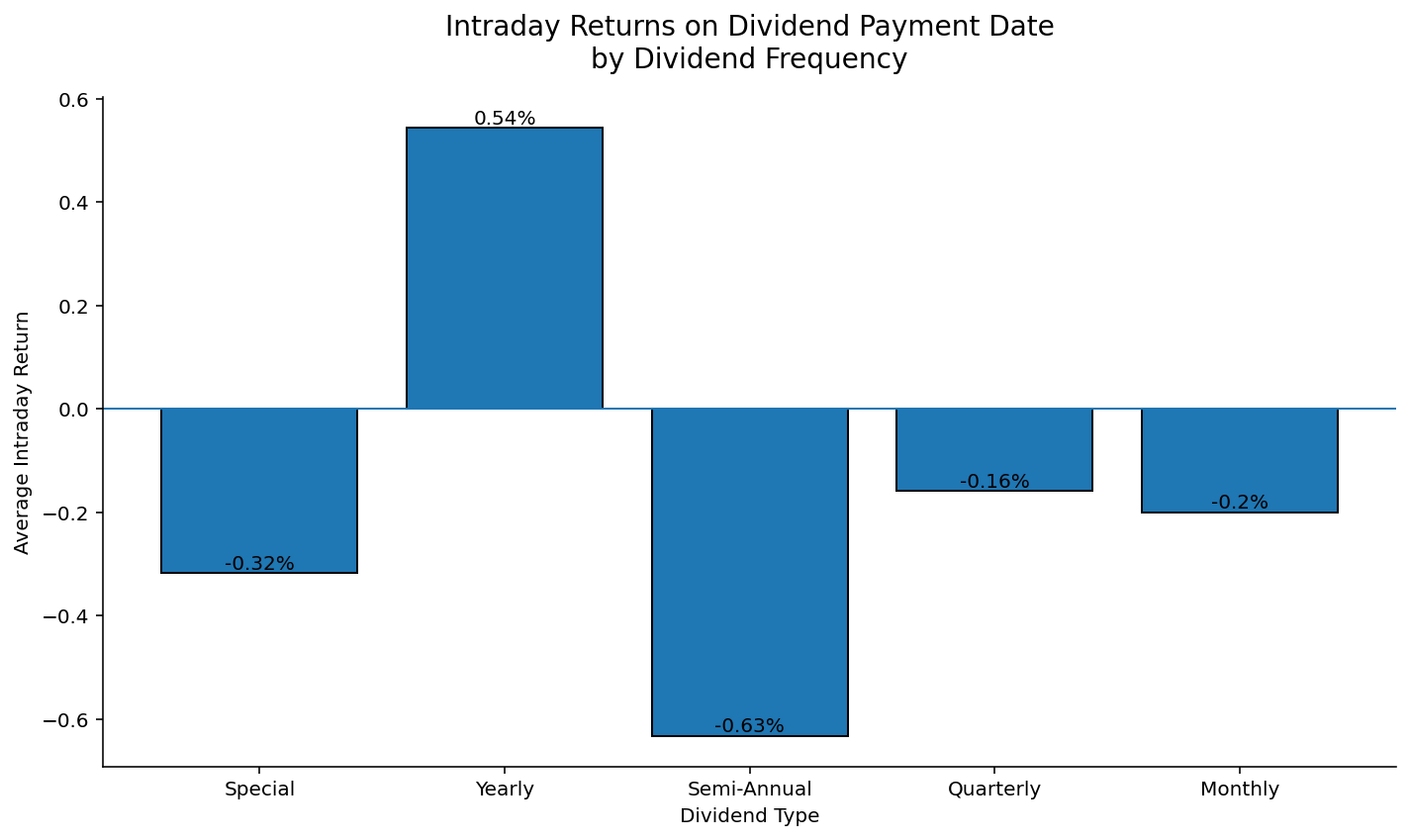
So, to test this out, let’s first take a look at what usually happens to price on the payment date:
Before getting into the numbers, a quick note on methodology: we chose the payment date itself rather than the ex-dividend or record date, because that’s when most investors will actually be notified that a dividend even happened.
Outside of hedge funds and sophisticated traders, most long-term holders aren’t tracking the nuances of ex-dividend dates or record dates, but they are aware of the morning notification hitting their account saying a fresh payment has arrived.
That notification is the trigger for the behavioral response we’re trying to isolate.
With that framing in mind, here’s what we found:
From a sample of ~3,000 dividend payments between 2023 and 2026, the price of the stock tends to go down intraday on the payment date, on average.
It isn’t a linear relationship (with yearly payments being an outlier), but given the large sample size in uncorrelated names, it’s worth looking deeper.
So, going back to our original theory, if we think that, in aggregate, a good chunk of holders will get rid of the companies after they actually pay out, we can form a simple strategy:
On the scheduled payment date, we submit a short market-on-open order
This allows us to execute as close as possible to the open price that we can reliably backtest on.
Near the close of the trading day, we submit a buy market-on-close order.
This lets us execute as close as possible to the official “close” price that you often see.
Repeat.
With that defined, let’s see how well this approach held up: