

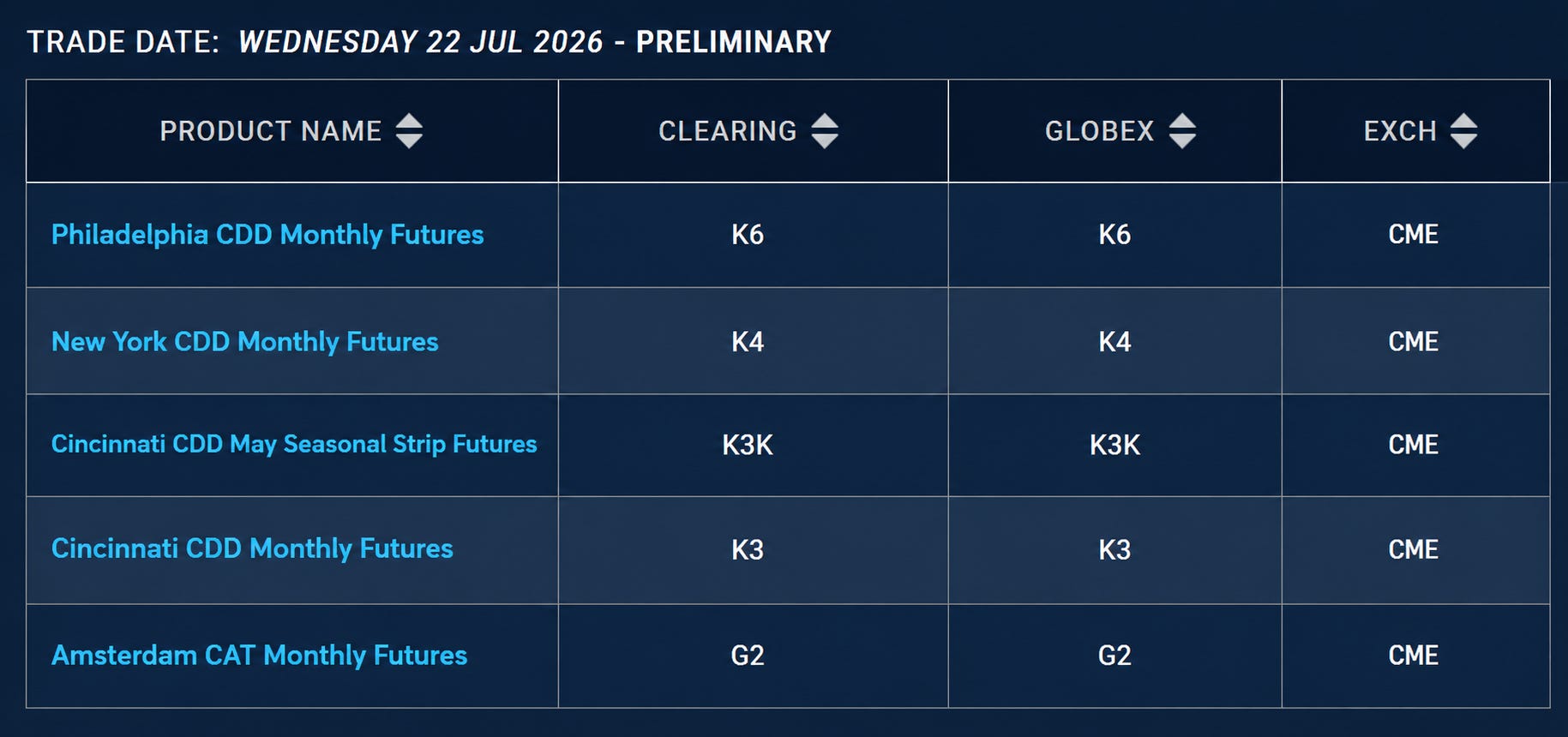
Believe it or not, the CME lists a futures contract that essentially settles on a thermometer reading:
To see why anybody would want that, put yourself behind a gas utility desk:
Ten weeks into winter somewhere in the Midwest, and nothing has broken. No pipe burst, no substation dropped, no crew got called out at three in the morning.
The winter is just… mild. A few degrees above normal, day after day.
Every therm (unit of gas) you didn’t deliver is a therm nobody pays you for.
Now, remember, you still own every mile of pipe, you still staff every crew, and you still service the same debt.
Mild winter → fewer therms out the door → lower revenue
By March you’ve missed guidance, and everyone on the call knows why.
So, you call your broker to ask what it costs to insure against this next year, but find that nothing really exists.
Insurance pays on a loss event, something discrete that an adjuster can drive out to, photograph, and attach a number to. When all you’ve got is a furnace in a house in Wisconsin that cycled on four fewer times a day for two months, you don’t really have a claim.
At this point, you ask a question:
“How do you still make a profit, even when the weather acts against you?”
Fortunately for you, this is the whole idea behind weather derivatives.
It’s a niche market, tiny compared to equities or rates, and almost nobody outside a handful of trading desks and utility hedging teams actually trades it.
Even so, the mechanics are elegant once you see them, and the fact that this market exists at all tells you something about how far derivatives can be stretched once you’re willing to turn anything measurable into an index.
So today, we’re going to take a quick journey into the strange land of trading weather futures.
How Does This Stuff Even Work?
The whole market rests on the degree day.
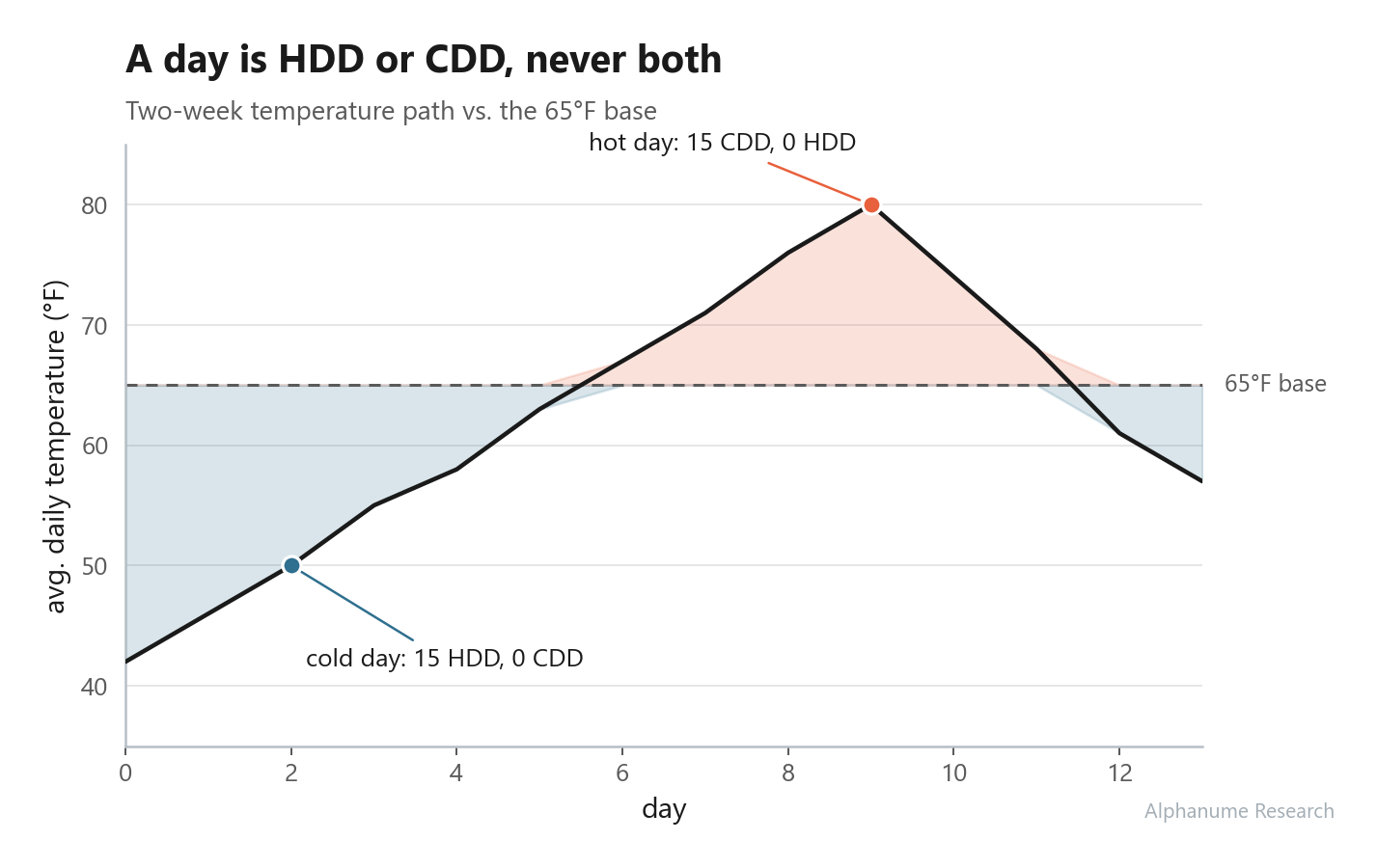
Heating and cooling demand tracks how far temperature strays from 65°F, the rough point where a building doesn’t need the furnace or the AC. That’s the industry convention, and it’s the base of almost every US contract written.
From there, each day converts into one of two numbers:
HDD = max(0, 65 - average daily temperature)CDD = max(0, average daily temperature - 65)
Average daily temperature is the day’s high plus the day’s low, divided by two.
A 50°F day gives you 15 HDD and 0 CDD. An 80°F day gives you 0 HDD and 15 CDD (chart below).
Cold day → HDD. Hot day → CDD. 65°F → nothing happened.
Sum the daily values across a month or a season at one weather station and you have a cumulative HDD or CDD index.
Just Add It Up
At this point, seeing how this maps to a tradeable product likely seems vague, but it’s actually pretty simple:
Pick a city and a period, either a calendar month or a multi-month seasonal strip. CME designates one weather station per city.
Convert each day, taking the station’s reported temperature and adding the resulting HDD or CDD to a running cumulative total.
Settle on the total. At expiration, that cumulative number is the settlement index.
Multiply. For US cities the contract unit is $20 times the cumulative index. A 31-day month averaging 55°F throughout is 310 cumulative HDD, worth $6,200 per contract.
Pay in cash. Whoever was positioned for a colder or hotter month than showed up pays the difference.
Run it through our utility desk from the top of the post and it looks like this:
The exposure: a low-HDD month is what hurts you, since fewer degree days means fewer therms sold
The position: short 20 contracts at the market’s 310 HDD level
Riding on it: 310 × $20 × 20 = $124,000
The month comes in warm. Your station stops at 260 cumulative HDD.
Settlement index: 260
Move against the level: 310 - 260 = 50 HDD
Hedge P&L: 50 × $20 × 20 = $20,000
The 50 degree days you didn’t get are the same 50 degree days the contract just paid you for.
Where Trading Gets Interesting
As usual, every market built for hedging ends up attracting people with nothing to hedge. Weather is no exception as whoever took the other side of that utility’s short doesn’t own a mile of pipe and has never sold a therm in their life.
To see how, let’s work through a real-world edge-case: