

To quickly bring you up to speed, AI models need a lot of GPUs to run, but naturally, no one would bother creating or running models if they had to buy hundreds of $40,000 NVIDIA GPUs upfront.
As such, most decide to rent this processing power by the hour.
Now, if you’ve been remotely following markets in the past few months, you know that a major fear is that too many companies are overspending on this compute and may not be able to justify the returns soon enough.
So to partially address this risk, a new futures market was created, where you can now essentially bet/hedge that the price of compute will either go up or down.
This interested me as, on the surface, it doesn’t really make that much sense:
What is the actual deliverable?
What does it actually hedge against?
If you short it, are you hedging against the Mag 7 missing earnings? If so, what’s the optimal hedge ratio?
If you long it and lock-in the price, see question 1.
There are currently ~20 live markets on Polymarket quoting the future rental price of Nvidia GPUs, covering everything from the H100 down to the RTX 5090 in your gaming rig.
So curious, I pulled every quote through their public API to try making sense of the numbers.
What’s actually trading
Each market is a bracket ladder (e.g., $2-2.25) on where a GPU’s rental price will close the month.
The resolution source is the Ornn compute index, a daily benchmark of what an hour on that GPU actually rents for, taken from real transactions.
Here’s the live ladder for the H100 at the end of August, three days from resolution:
$2.75 to $3.00: 46%
$3.00 to $3.25: 20%
$2.50 to $2.75: 17%
$3.25 or higher: 9%
everything below $2.50: ~8% combined
For reference, Ornn printed $2.76 on August 27, so the market is effectively saying “it’ll close right about here, maybe a touch higher by Monday,” which makes sense given the short time-to-expiration.
Being so new and niche, the liquidity for these are pretty low, with just ~$34k in liquidity for that contract.
Going back to what we know about standard futures and options, we know that the premium for out-of-the-money strikes drastically decreases with time as there’s a smaller probability that a major event will occur by expiration.
So if the same dynamics apply to these, we also know that most of the money is made from future expectations:
If we take the expected price 3 months out, can we convert that into an “implied volatility” figure?
If so, can we reconstruct a short-volatility position via the positions ladder?
E.g., Taking “no” wagers of >$3+ and <$1.50 (pays off if price is below $3 and above $1.50)
A question with high rewards, but to even see if it’s possible, we need to pull some more data.
What the curve believes
To try creating a “term structure” for these markets, I computed the implied averages (Σ (midpoint × normalized probability) ) for each H100 market that expires in later months:
end of August: $2.88
end of September: $2.74
end of October: $2.65
end of 2026: $2.72
Against spot at $2.76, the market’s forecast for the next four months is basically “nothing happens”, the lumpiness is a bit unusual, but we’ll attribute it to the wide bid-ask spreads which can distort the mid.
Interestingly enough though, there does seem to be a pretty strong informational view in the tails further down the curve. By the December expiry, traders put roughly 21% on the H100 closing the year below $2.00 and 34% on it closing above $3.00 (chart below).
In other words, a fifth of the probability mass is a rental-price crash, and a third is a further squeeze.
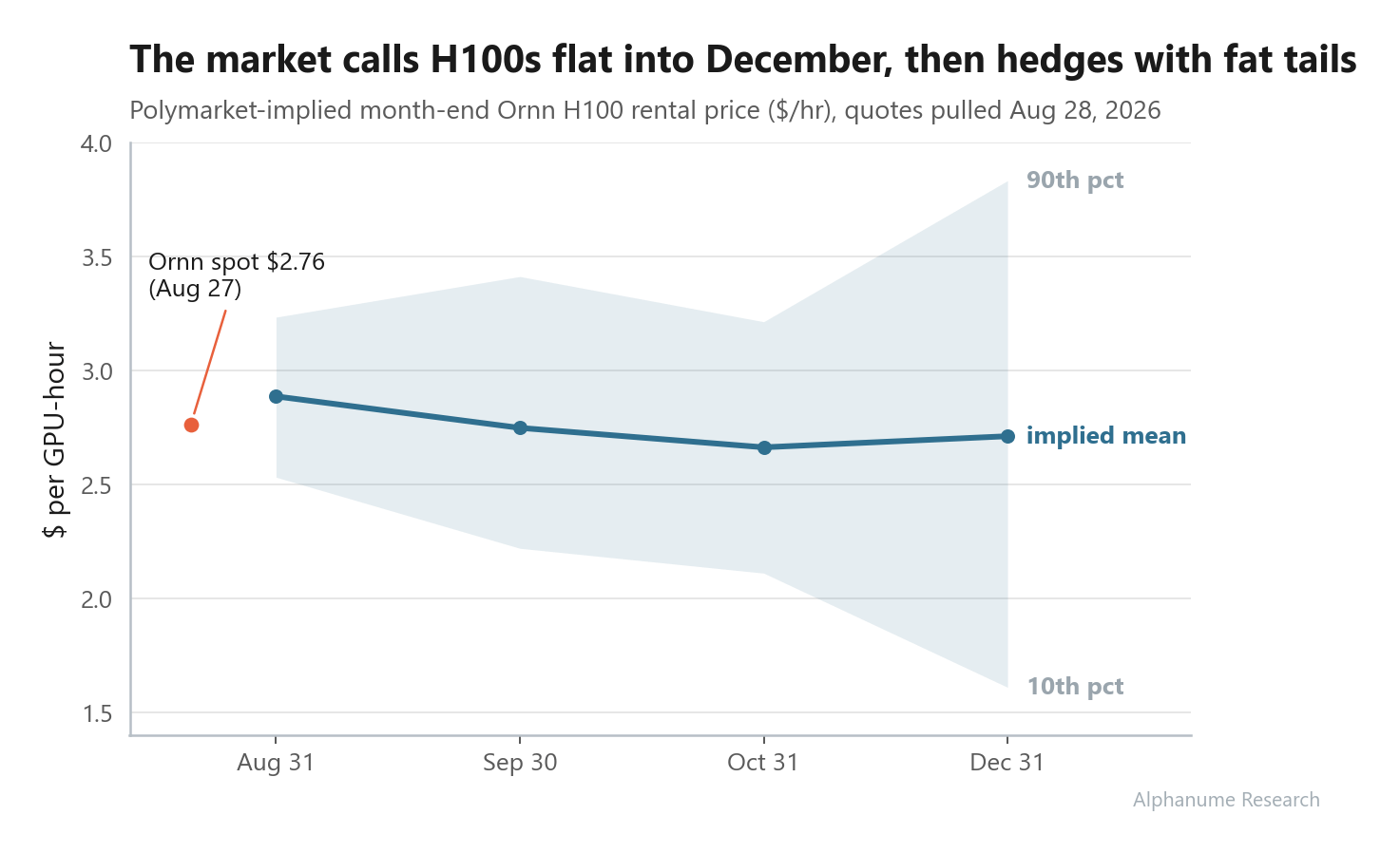
This likely represents the high-conviction “AI bubble” vs “AGI tomorrow” crowd placing high-payoff wagers in either direction, but regardless of the reason, it shows that there’s a volatility risk premium in this market as well.
So, to answer our earlier question, you absolutely can trade this from the lens of a volatility trader: