

On March 28, 2025, Milestone Pharmaceuticals told the market the FDA had turned down its heart-rhythm nasal spray, and the stock went from $2.25 to $0.88 in a single session.
Strangely, though, it rallied 115% by just 60 days later.
The first part of this basically fits the style of event-driven trade I’ve come to love:
genuine catalyst event with known positive/negative implications → market reaction → subsequent price follow through
I didn’t know whether this was a one-off thing or not, so I wanted to pull as much data as I could on how stocks move after FDA decisions, to see if this could be added to the systematic farm we already run.
Now, biotech is a very niche corner of the market, where if you aren’t familiar with esoteric drug names and phase trial pipelines, you’ll probably never touch it.
Nevertheless, it’s a volatile and potentially lucrative corner that’s actually pretty simple once you know the mechanics.
So today, we’ll be going deep to understand what actually moves these shares, how predictable things are, and we’ll run a few strategies to see if it’s as lucrative as we think it is.
How Hard Can It Be?
When the FDA finishes reviewing a drug application, it either approves it or sends a Complete Response Letter (CRL), which is basically the formal “not yet” with a list of what needs fixing.
From a biotech trader’s perspective, there’s essentially three degrees of “how bad is this”:
Manufacturing only: a plant, an impurity, a supplier, all fixable without new patients
Addressable deficiencies: more analysis, a labeling dispute, or missing data the company may already have
New trial required: the bad one, which usually costs years and a lot of cash
Once the company resubmits, the FDA has a review goal of 2 months for minor fixes and 6 months for everything else, so a manufacturing CRL should only mean a short delay, while a new trial requirement might decimate the stock.
A clinical hold is a different animal entirely though, since that’s the FDA basically telling a company to stop dosing patients in a trial completely. The company then has to answer every concern before the FDA even starts its 30-day clock to decide whether the trial can restart.
Both CRLs and clinical holds show up through a company’s 8-K filing, so that gives us an easy path to start collecting data on them.
So, What’s The Trade Here?
Our earlier MIST 0.00%↑ example was a good anecdote, but to see if there’s a repeatable trade here, we need to go back a few years.
To get the rest of the letters, I used our FDA Response Events dataset, which tracks every CRL, clinical hold and refuse-to-file letter that a US-listed company discloses in an 8-K and/or an openFDA report.
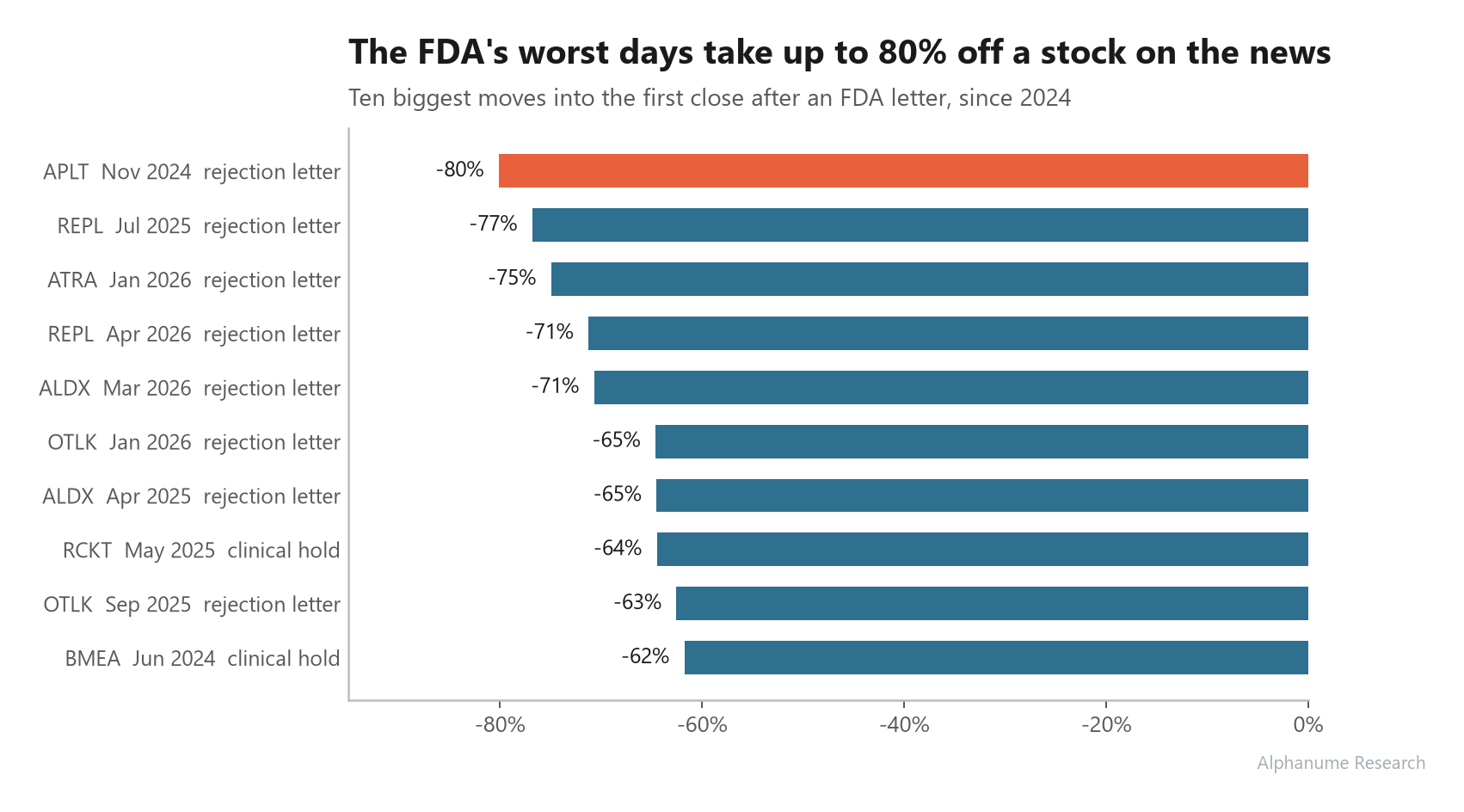
For this first test, we’ll focus on just the rejection letters, since there’s a clear rationale for why these should go down on release day. Now, these don’t happen every day, with each year generally only having about a dozen events, so we have to be careful with our assumptions from the start.
The specific FDA decision isn’t known in advance, so we have to assume that any trade we take must be placed after the news became public.
With that in mind, we can design our first strategy:
Get the timestamps of when each FDA rejection letter became public.
Calculate the returns from the report date until close. If the report came after market-close, we’ll use the next session’s close for the returns.
If the stock fell 30% or more, buy at the next available session.
Sell 60 trading days later.
Right off the bat, the results were extremely interesting: