

Once a year, in late June, the single largest trade in American markets happens in a few seconds, at exactly 4:00 PM Eastern.
This past June 26th, the Nasdaq Closing Cross printed roughly $334 billion of stock in one shot. Nothing else all year came close.
The Closing Cross is Nasdaq’s closing auction where instead of stocks trading continuously the way they do all day, every buy and sell order queued up for the close gets matched at one single price per stock, all at once.
What’s strange is that the date of that $334 billion trade had been public for years.
It happens because FTSE Russell rebuilds its stock indexes every June on a published calendar, an event called the reconstitution, and roughly $11 trillion is managed against Russell indexes. When the lists change, the money has to move. All of it, at the same moment.
Everywhere else in markets, participants go to absurd lengths to hide their orders: slicing them into crumbs, routing them through dark pools, randomizing their timing. But here, the biggest order of the year is announced in advance, sized in advance, and executed at a pre-scheduled second.
So naturally, it raises the question that every trading desk eventually asks:
“If the biggest order of the year is announced in advance, who gets paid for standing in front of it?”
For about thirty years, the answer was basically anyone who bothered.
Today, standing in front of that order is one of the largest-scale, most sophisticated trades in markets: probability-weighted baskets spanning hundreds of events a year, hedged to the dollar, levered 5 to 10x inside the biggest funds on earth.
So we’re going to walk through exactly how it’s run, from scratch and down to the final details, assuming you’ve never touched market structure before. And by the end, you’ll be able to run a baby version of it yourself.
The Most Obedient Buyers on Earth
An index fund is exactly what it sounds like: a fund that copies a list.
The S&P 500 is a list of 500 big American companies, each assigned a weight based on its size. An S&P 500 index fund takes your money and buys all 500 in exactly those proportions.
The manager has zero discretion. If the list changes, the fund changes.
And the manager is graded on a single number: tracking error, which is how far the fund’s return drifts from the index’s return. A fund that returns 9.98% in a year the index returns 10.00% is doing its job.
A fund that beats the index by 2% is just as broken as one that trails it by 2%, because the product being sold is the index itself.
Now, the wrinkle that creates this entire trade: when a new stock joins the index, the index itself incorporates it at the stock’s closing price on the effective date (the date the change officially takes effect).
So a fund that buys at exactly that closing price, whatever that price turns out to be, shows zero tracking error. Buying earlier and cheaper is riskier for the manager: if the stock dips before the close, the fund lags the index and someone has to explain why.
The career-safe move is to buy at the close, at the closing price, every single time.
Conveniently, there’s a venue built for exactly that. At 4:00 PM the exchange takes every order flagged market-on-close (an MOC order says “fill me at whatever the official closing price ends up being”) and matches all of them in one giant batch.
That batch has been swallowing more of the market every year. In Q2 2024, about 9.4% of all the dollar volume traded in American stocks went through closing auctions, a record, and on big rebalance days it runs closer to 20%.
So when an index changes, we know who has to trade (every fund copying the list), which direction, and precisely when: the closing auction on the effective date.
The Free Lunch Years
In the 1990s, the trade this created was almost insultingly simple.
S&P announces that a stock is joining the S&P 500. You buy it that evening. You wait the handful of days until the change takes effect (the median gap between announcement and effective date has been about 4.8 trading days), then you sell to the index funds who are forced to buy from you.
That earned roughly +7% in about a week, on average, for a decade.
None of this was a secret, either. Shleifer and Harris & Gurel documented ~3% announcement-day pops back in 1986, and academics gave it a name: the index effect.
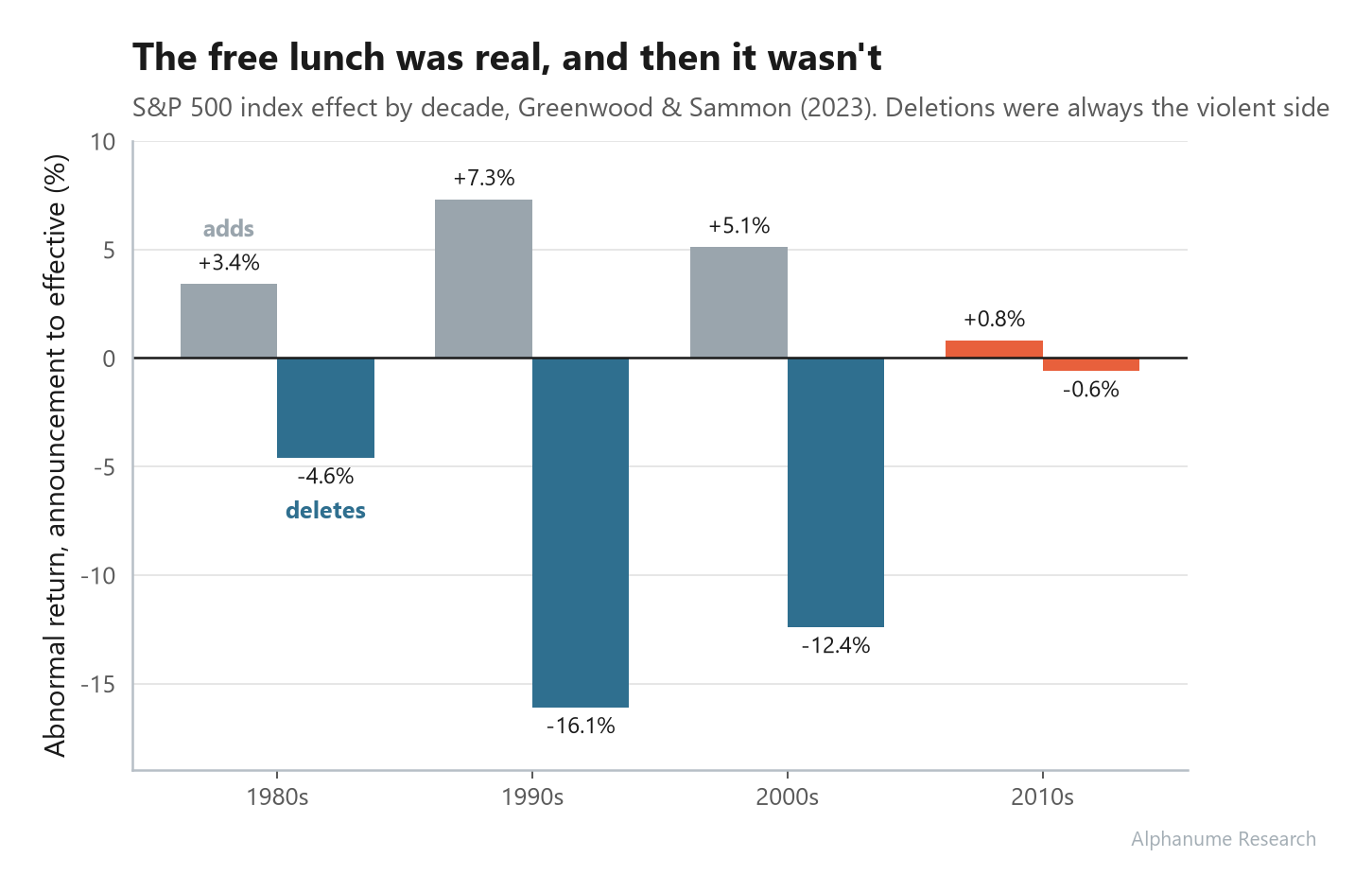
The cleanest accounting of what happened next comes from Greenwood and Sammon’s paper, The Disappearing Index Effect. Additions to the S&P 500 returned, from announcement to effective date and adjusted for the market: +3.4% in the 1980s, +7.3% in the 1990s, +5.1% in the 2000s, and +0.8% in the 2010s, which is statistically indistinguishable from zero.
Deletions were even harsher on the way down: -4.6%, then -16.1%, then -12.4%, then -0.6%.
The free lunch was real for decades, and then it wasn’t (chart below).
So the naive version is dead. Which leaves a puzzle:
“The forced buying didn’t shrink. Indexed money is bigger than it has ever been. So where did the return go?”
Hold that thought.
To answer it, you first need to understand the flow.
The Whole Trade Is Arithmetic
Roughly $16 trillion is benchmarked to the S&P 500, and about $10 trillion of that is passively indexed, per S&P’s own survey of assets. That $10 trillion is the obedient money from earlier: it must buy whatever joins the list.
And the size of that forced buying is computable, in advance, by anyone:
indexed dollars x index weight = dollars to buy
Divide the dollars by the share price and you get shares to buy. Divide the shares by the stock’s ADV (average daily volume, how many shares change hands on a normal day) and you get the number that actually matters: days of ADV.
Days-of-ADV is the unit of violence. A stock where the forced buying equals 8 days of normal trading is a fundamentally different event from one where it equals 0.5 days. The first one has to move the price; the second gets absorbed without a ripple.
There is no forecast anywhere in that arithmetic.
Deletions run the same math in reverse. The catch on deletes is that profiting from one means shorting the stock, which means borrowing shares first (your broker locates shares from a lender, you sell them, and you buy them back later to return them). The borrow is a constraint as names everyone wants to short get expensive to locate, or impossible.
The data you need for all of this is free or nearly free: