

Last week I bought 100 shares of Ford in my personal account, mostly so I’d have a concrete order to trace.
The fill came back in about a quarter of a second, a fifth of a cent per share better than the offer on my screen, and the confirmation email landed shortly after.
Pretty simple: you clicked, a computer matched you with a seller, done.
Naturally though, what wasn’t in the email was that my order almost certainly never touched an exchange.
In reality, my broker sold the order, a market maker filled it out of its own inventory from a data center in New Jersey, and the “better than the quote” fill was my cut of a pie that got divided three ways before I ever saw it.
Every junior quant eventually has to learn these mechanics, usually in fragments, so I traced my Ford order through every tollbooth to see who got paid along the way.
When you hit buy in a brokerage app, where does the order actually go, and whose P&L does it land in?
Hop one: your broker sells the order
To anyone who was around during the PFOF debacle with GME back in 2021, this part will be common knowledge, but it won’t hurt to start here.
At the end of the day, your commission-free broker’s routing decision is a revenue line. Wholesale market makers pay brokers for the right to execute their customers’ orders, which is the famous payment for order flow.
Interestingly enough, every broker publishes a quarterly Rule 606 report listing exactly which venues got its orders and what it was paid per hundred shares, and Robinhood’s disclosures even spell out the pricing model: the market maker pays a fixed percentage of the bid-ask spread on each execution.
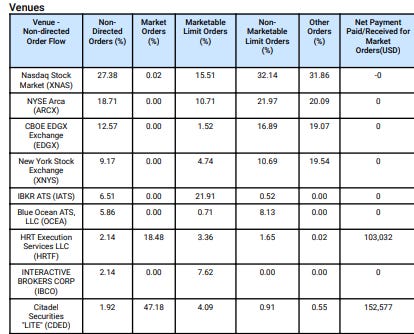
Wide-spread names generate bigger checks than tight ones, so naturally, most of the profit comes from more illiquid stocks.
Per share it looks tiny, a fraction of a cent, but multiplied across a few billion retail shares a month it’s the reason “free” trading exists.
Hop two: the wholesaler keeps the spread
Now, remember how we were so confident that our order never touched the exchange?
Well, marketable retail orders overwhelmingly skip the exchange entirely: more than 90% of them are routed to off-exchange wholesalers and filled from the wholesaler’s own book.
The wholesaler business, like any high-barrier industry, is about as concentrated it gets, with Citadel Securities handling roughly 41% of retail market orders, Virtu 26%, and G1 another 16%, so three firms see more than 80% of everything retail does.
What makes the business so attractive to market makers is that, in theory, retail flow is the safest counterparty in the market.
An order for 100 shares of Ford from a phone carries essentially zero short-term information; nobody’s personal account is front-running an index rebalance.
When the counterparty is uninformed, the market maker gets to earn the bid-ask spread without the adverse-selection tax that comes from trading against people who know something, and the SEC’s own economists have a working paper walking through exactly this logic.
The wholesaler’s fill is where my “price improvement” came from. The quote on my screen was, say, $14.38 bid, $14.40 offered. The wholesaler filled my buy at $14.398, two tenths of a cent inside the offer, and booked the difference between that and wherever it lays the risk off as its own edge.
By some measure, it’s a win-win and everyone walks away feeling good: I beat the quote, the broker got its check, the wholesaler kept the fat middle of the spread.
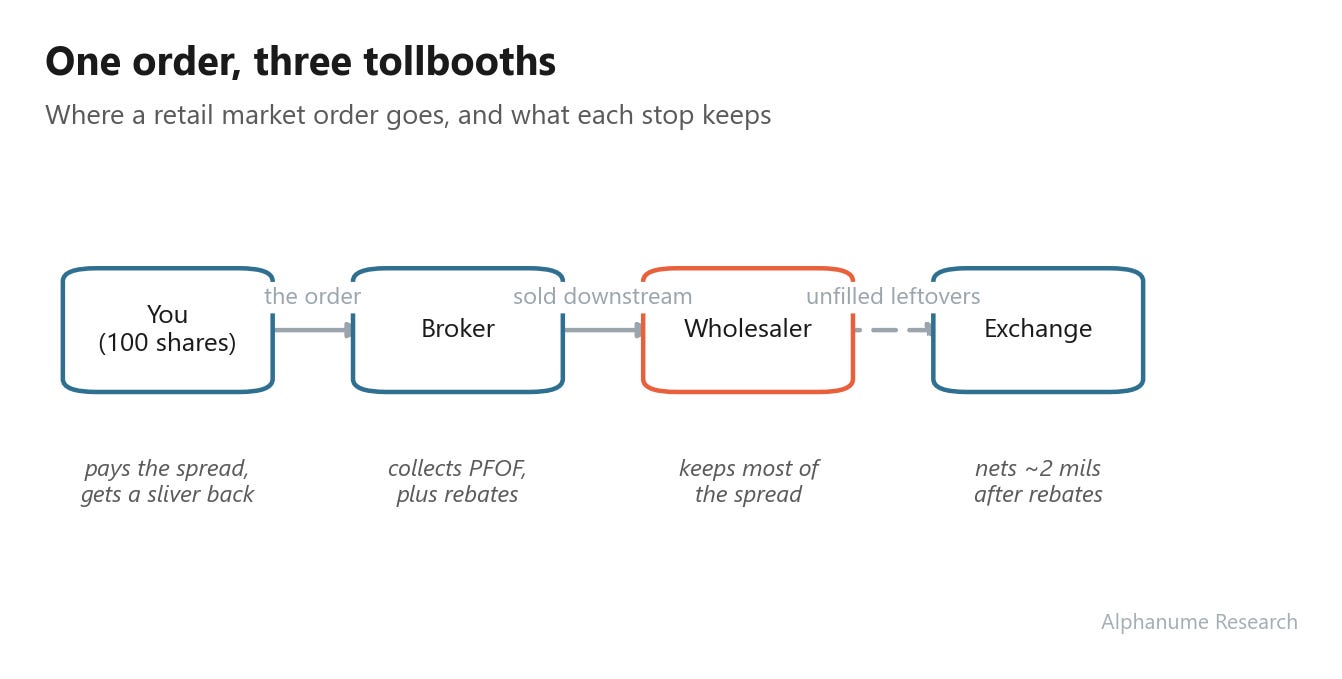
The key thing to grasp is that price improvement is measured against the public quote, and the public quote is set on exchanges the retail flow never visits.
The wholesaler “improves” on a benchmark it is partly responsible for leaving wide.
That’s the sentence that made the whole industry make sense to me, and I’d hold onto it before forming an opinion on whether the arrangement is good or bad for the little guy.
Whether the benchmark itself would be tighter in a world where retail flow hit the lit market is an open-ended question.