

Outside of the rugpulls, theft, and other ills you may associate with crypto, there’s a actually pretty serious side of it all, where professionals run real systematic strats with legit PnL.
Most of this happens in the perpetual futures market, which are essentially just futures on crypto tokens that never expire.
Now, the key feature that allows this to work are funding rates:
These are basically just incentives to keep prices in-line:
Token A’s “true” spot price: $5.00
Token A’s futures price on Exchange A: $5.81
The exchange makes long holders pay a 2% funding rate to short sellers every 8 hours, in order to incentivize people to short the future and bring the price back down closer to spot
After the exchange price normalizes closer to the fair spot price, the funding rate shrinks
It’s a simplified example, but that’s pretty much all you need to know to for how these work.
What’s interesting though is that funding rates, like implied volatility, can act as a pretty accurate source of future information.
When implied vol rises, the options price in the idea that in the future, the stock’s path will be much more volatile, and it’s generally correct.
In this case, funding rates increase on a directional basis (e.g., “you’ll get a large payment if you short the future”), as opposed to just forecasting raw volatility.
So naturally, one can ask the question:
“If we know what direction people are incentivized to trade in, couldn’t we make a profit by just trading in that direction ahead of time?”
As you’ll see shortly, the answer is an overwhelming yes, but the way you actually trade this isn’t what you’d first think.
So today, we’ll be showing you the real data of what it takes to actually pull this off, how much it makes, and how you can give this a go yourself.
With that said, let’s get right into it.
It can’t be that easy, right?
To quickly refresh, when the perp trades above the spot price, short sellers receive funding payments (paid by long holders) and vice verca (Hyperliquid’s docs lay out the formula if you want it).
Our starting thesis is that funding shows where the crowd is leaning: if traders are paying a lot to stay long a coin, the coin may keep going up, and vice versa.
With that in mind, we can outline our first strategy:
Universe: Bitunix (the only exchange that hasn’t KYC’d and banned us from the USA) perps with at least $1M of median daily volume
Signal: each coin’s last day of Bitunix funding
Book: long the 10 highest, short the 10 lowest, equal weight, rebuilt every day
When funding is positive (highest) long positions pay the funding rates
When funding is negative (lowest) short positions pay the funding rates
Window: March 2024 through September 2026
Right off the bat, the numbers were too good to be true, with a Sharpe of 1.70 and roughly +190% a year. To sanity check this, we ran the same test on Hyperliquid and the results were about the same.
However, since it was the first crude test, we only used prices and deliberately left out the funding payments that we’d have to pay along the way.
After including those, the picture looked much different:
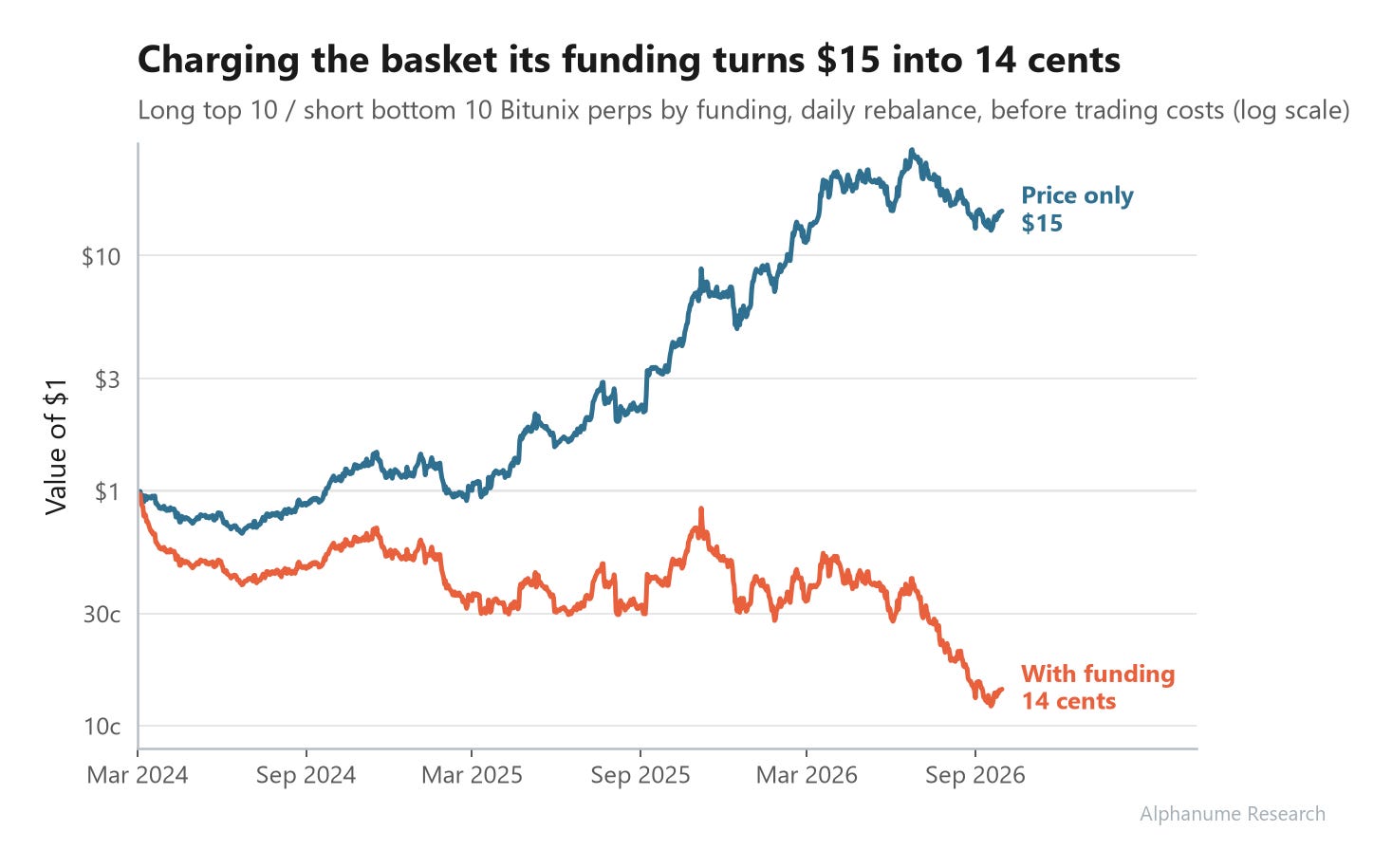
Once we ran the simulation with the funding we pay, the Sharpe went from 1.70 to −0.51, and that’s still before general trading costs.
Now, to be fair, this outcome should have been expected.
Similar to implied vol, we have to assume that there is a “pricing in” effect where everyone already knows what’s implied to come, so any extra profit has to come when the realized result exceeds what everyone else expected.
For instance, if longs are paying 2% to stay in a coin that’s drifting up 2%, the price gain and the funding bill cancel out, leaving no “edge”.
Fortunately, this is Crypto 101 knowledge and there is a solution to our problem; just with a bit more work.