

To really get this story, we have to start off with a scenario.
You’ve been trading your own account for a few years and the track record is real: a decent Sharpe, a small following, and a few calls that aged unusually well.
Suddenly, an email lands from a quant fund you’ve never heard of.
There’s no job in it, but for some reason, the fund wants to buy your trade ideas: ticker, long or short, a time horizon, how confident you are, all submitted through a portal.
If the ideas work, you get paid. Nobody interviews you, nobody audits your model, nobody even asks for a resume.
A multi-billion dollar quantitative fund, the kind of shop that measures execution slippage in fractions of a basis point, wants to wire money to strangers on the internet in exchange for stock picks.
The whole thing reads like a phishing attempt. However, it’s real.
In fact, that model has been running for over two decades, and the industry calls it alpha capture.
So today, we’re going to walk through where it came from, what actually happens when you hit submit, and what happened when two siblings in a London flat figured out how to game it.
It Started With an Argument
In 2001, the two founders of Marshall Wace had a disagreement.
Ian Wace, formerly Deutsche Bank’s global head of equity trading, and Paul Marshall, ex-Mercury Asset Management, couldn’t agree on whether the stock recommendations brokers constantly phoned in were actually worth anything.
To settle it, they handed the problem to a fresh graduate named Anthony Clake:
“build a system that tracks every broker idea and measures whether following them makes money.”
The first version was an Excel spreadsheet that eventually became TOPS, the “Trade Optimised Portfolio System,” and in July 2002 it started trading real money through the Eureka Fund.
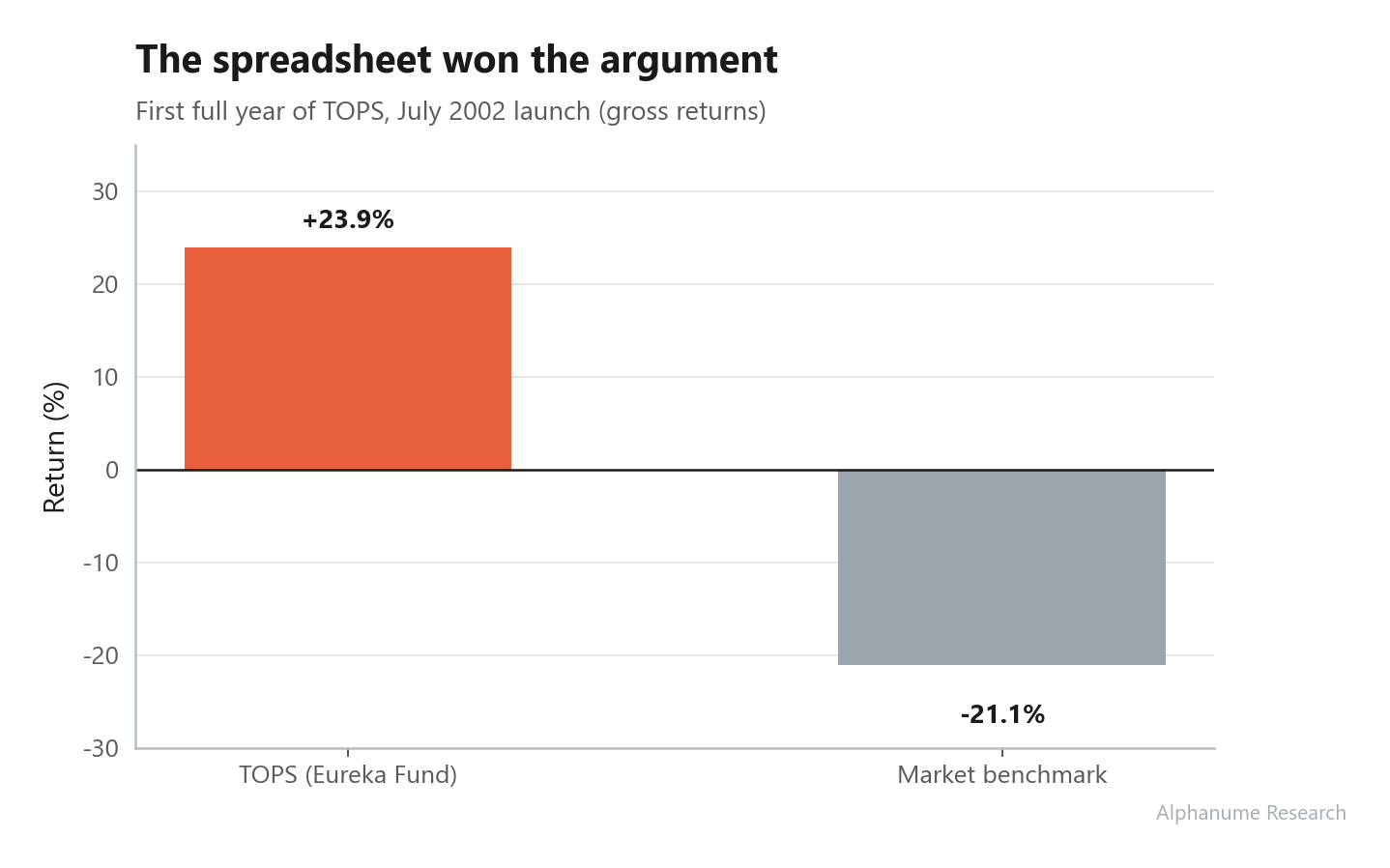
In its first full year it returned +23.9% gross while the market benchmark fell -21.1% (chart below).
The scaling from there was aggressive. By 2005 the London operation was ingesting 800 to 900 ideas per day, and the firm had collected roughly half a million trading ideas from 2,200 individuals across 246 securities firms.
Marshall Wace was paying brokerage firms over $250 million a year by 2004-05, and Wace described it himself:
“All TOPS is a Hoover... It sucks in great quantities of ideas and tries to sieve out what is interesting.”
Clake made partner in 2004, is now the firm’s third-largest owner, and reportedly took home around $330 million in a recent year. TOPS vehicles run roughly $30 billion today.
Too Good to Be True
If you wave dollar bills in the air and tell people you’ll pay them for trade ideas, eventually, you’ll get people who do whatever it takes to get paid.
Squarepoint Capital runs offices in London, New York, Singapore, Dubai and Paris.
Oerta Korfuzi, an Albanian day trader, submitted trade ideas to Squarepoint’s alpha capture program through an entity called Pelkor Capital. She shared a London flat with her brother, Redinel, a research analyst at Janus Henderson.
Her ideas were good. Specifically, they were short ideas on names about to announce dilutive equity raises, and they were remarkably well-timed.
Part of her brother’s job involved “wall-crossing” emails: confidential notices from companies gauging investor interest ahead of equity raises and block sales. If you know a company is about to announce a dilutive raise, you know its stock is about to drop.
Within minutes of those emails hitting Redinel’s inbox, trades went off in accounts operated by his sister.
The instrument of choice was CFDs, leveraged shorts on the exact names about to announce. Between 17 December 2019 and 25 March 2021, the pair traded ahead of announcements in 13 stocks, clearing over £960,000 in profit.
Now, what separates this from garden-variety insider trading is that the same information was being monetized twice.
Once through their own leveraged trading. And once more, sold to a quant fund as a “signal” through Pelkor Capital.
Think about what Squarepoint’s platform saw:
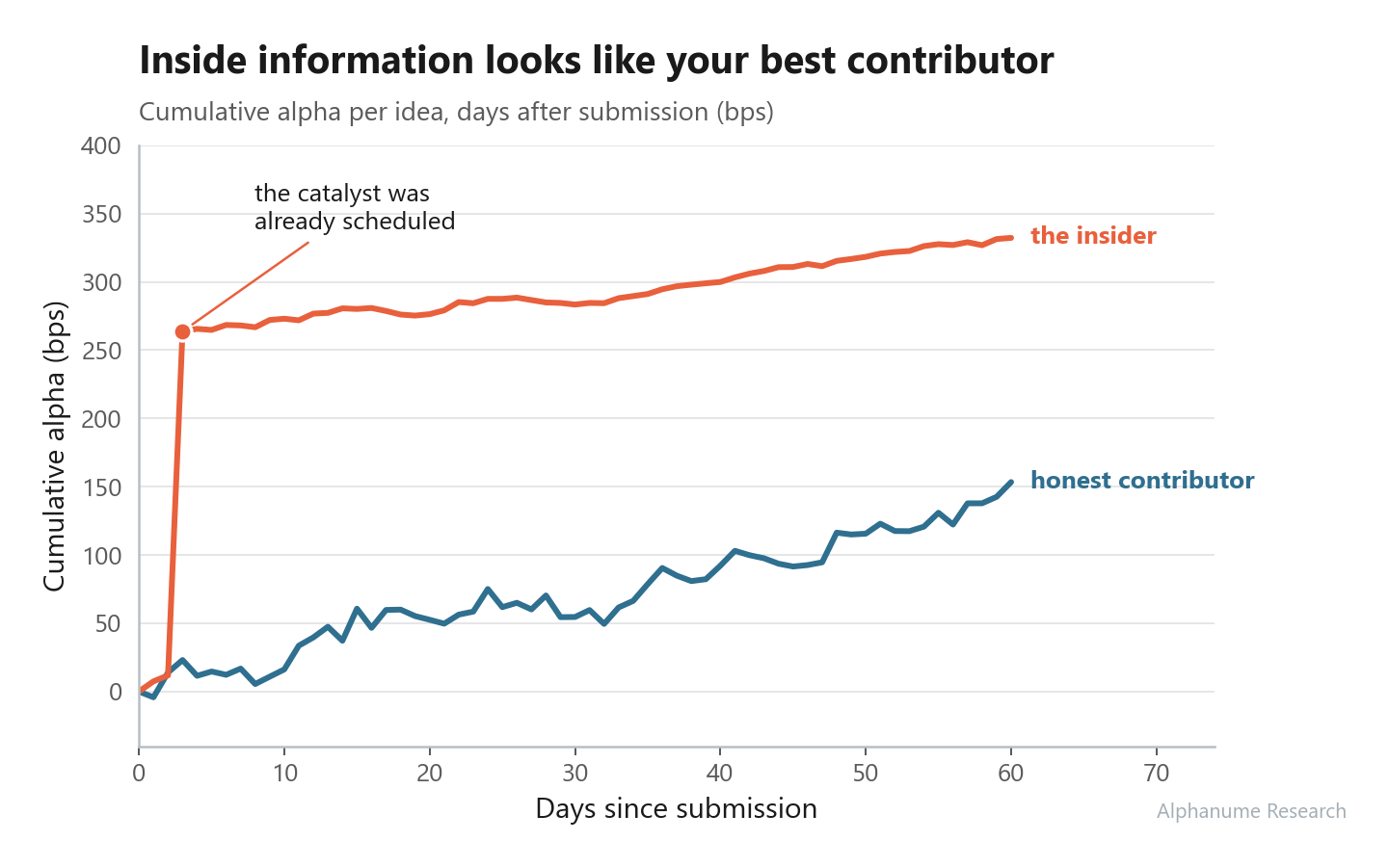
a contributor whose short ideas kept hitting within days
a hit rate a legitimate analyst would kill for
alpha with almost no decay, because the catalyst was already scheduled
Prescience and inside information look identical in a track record.
Worse than identical: the insider scores better. Higher hit rate, faster payoff, cleaner alpha versus benchmark (chart below).
A system that pays strangers for prescient ideas has no easy way to ask why the ideas are prescient.
The FCA (UK version of the SEC) caught it the way modern regulators catch most things: market surveillance and trading-pattern analysis across large datasets. The trades clustered too tightly around announcements Redinel had been wall-crossed on.
Investigators also found 173 deposits funneled to Albania and about £25,000 in cash sitting in a Knightsbridge safe deposit box.
Both siblings were convicted in 2025; Redinel got 6 years, Oerta got 5.
How It Actually Works
While the high-level version of this is interesting on its own, things get really quirky when you look at the finer parts.